
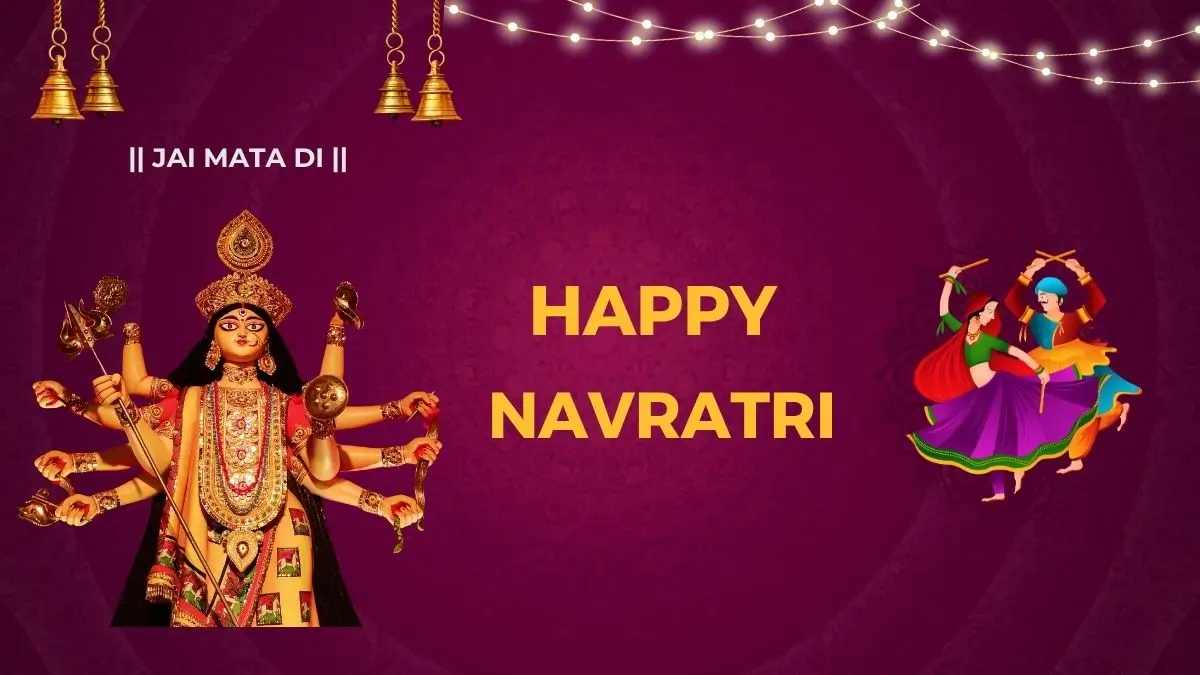
Sharad Navratri is one of the important Hindu festivals that takes place over nine days and ends with Vijayadashami/Dussehra. The Sharad Navratri will begin from 11 October in 2026, whereas Vijayadashami will take place on 20 October, as per the above-provided calendar. Sharad Navratri is celebrated in honour of the goddess Durga and her nine avatars, and it symbolizes victory of good over evil.
What is Navratri? Definition and Hindu Calender
The term Navratri is derived from two Sanskrit words, nava which means nine, and ratri which means night. It is celebrated in honor of Goddess Durga, who is worshiped as the incarnation of Shakti which stands for divine feminine energy representing creation, protection and destruction of evil.
The festival of Sharad Navratri is held in the Hindu lunar month of Ashvin which normally falls in the months of September and October according to the Gregorian calender. The date varies every year due to the reason that Hindu festivals are based on the lunar calendar and corresponding tithis or lunar days.
Four Navratris are celebrated every year, they are: Chaitra, Ashadha, Ashwin and Magha Navratri. The Chaitra Navratri is held in spring while Sharad Navratri in autumn.
Navratri 2026: Important Dates
| Occasion | Date in 2026 |
| Mahalaya | 10 October |
| Sharad Navratri begins; Ghatasthapana | 11 October |
| Maha Ashtami | 18 October |
| Maha Navami | 19 October |
| Vijayadashami or Dussehra | 20 October |
Note: Festival observances can vary by the different region and local Panchang calculations. The supplied sources differ on some Durga Puja dates, so the dates above follow the Navratri calendar provided in the source.
What Is Ghatasthapana?
The festival of Ghatasthapana heralds the start of Sharad Navratri. As its name suggests, the worship involves setting up of a ghata or kalash (sacred pot), which is considered auspicious and invokes divine powers. The ritual is conducted at designated timings as per the Hindu calendar.
Significance of Mahalaya in Bengal
The festival of Mahalaya is significant in Bengal as it indicates the end of Pitru Paksha (festival related to ancestors) and ushering of Devi Paksha (festival of Goddess).
It is also an occasion for invoking Goddess Durga before Durga Puja.
Nine Forms of Goddess Durga: Navadurga
The nine days of Navratri correspond to the nine manifestations of Goddess Durga which are collectively termed as the Navadurga. Each manifestation has different characteristics.
| Navratri Day | Date | Tithi | Goddess | Colour of the day |
| 1 | 11th October, 2026 | Pratipada | Shailputri | Orange |
| 2 | 12th October, 2026 | Dwitiya | Brahmacharini | White |
| 3 | 13th October, 2026 | Tritiya | Chandraghanta | Red |
| 4 | 14th October, 2026 | Chaturthi | Kushmanda Royal | Blue |
| 5 | 15th October, 2026 | Panchami | Skandamata | Yellow |
| 6 | 16th October, 2026 | Shashthi | Katyayani | Green |
| 7 | 17th October, 2026 | Saptami | Kalaratri | Grey |
| 8 | 18th October, 2026 | Ashtami | Mahagauri | Purple |
| 9 | 19th October, 2026 | Navmi | Siddhidatri | Peacock Green |
| 10 | 20th October, 2026 | Dsshmi | Vijayadashmi | — |
Why Colors are Associated With Navratri?
It is a practice that has now gained popularity in Navratri celebrations whereby people wear certain colors on different days of the festival. Colours have been linked with auspiciousness, devotion and attributes associated with the Goddess.
It is not a uniform custom among all the Hindus in relation to the order of colors. Certain days are also linked with the specific colors depending on cultural practices within the community observing Navratri.
What Is Navratri Festival About?
The main concept associated with Navratri is triumph of good over evil, which can be described in terms of diverse religious myths.
Goddess Durga and Mahishasura
- The legend goes that the buffalo-demon Mahishasura was granted an invincible boon. He was then killed by the Goddess Durga, bringing back the balance of the universe. This myth illustrates the victory of divinity over the negative energy.
- The myth is especially relevant to the occasion of Durga Puja in eastern parts of India, where images of the Goddess killing Mahishasura are the focus of celebrations.
Lord Rama and Ravana
- Another popular myth associated with the festival is related to the Ramayana, where Lord Rama worshipped the Goddess before the battle with Ravana, whose victory was celebrated on Vijayadashami.
- That is the reason why one and the same festival season witnesses different local celebrations: worshipping of Durga in eastern regions and celebrating the victory of Lord Rama in many northern and western places.
Navratri as Celebrated in Different Regions of India
The celebration of Navratri shows that even if a common theme exists in a religion, the cultural traditions can be very different.
- In Gujarat, garba and dandiya raas are integral components of the festival. The former traditionally involves dancing in a circle around the lighted lamp or representation of the Goddess in the form of an idol. Dandiya raas is danced with the help of decorated sticks.
- In West Bengal, the festival is celebrated by conducting elaborate pandals with artistic representations of the idols and performing various rituals. Bijoya Dashami marks the end of the main festival.
- In northern India, Ramlila is conducted during the festival which retells various tales from the Ramayana. In addition to that, in some places Dussehra festival is celebrated where the burning of effigies of Ravana, Meghnad and Kumbhakarna takes place.
- In southern India, various states and communities have their own traditions. For instance, in some parts of Tamil Nadu and Karnataka, the festival is celebrated with the representation of dolls called Golu and Bombe Habba.
Thus, Navratri is a perfect example of the unity in cultural diversity of India.
Dussehra or Vijayadashami: Importance of the Tenth Day
Vijayadashami or Dussehra symbolizes the end of Sharad Navratri in several rituals. Vijayadashami can be taken to mean the tenth day of victory.
The importance of Vijayadashami varies according to the region. According to the tradition related to Ramayana, it symbolizes the triumph of Rama over Ravana. According to the tradition related to Goddess Durga, it symbolizes the triumph of Durga over Mahishasura.
In some regions, the festival is also connected with Ayudha Puja – worshipping of tools, musical instruments, cars and other equipment used during one’s work.







 World Mental Health Day 2026: Theme, Tel...
 World Post Day 2026: Why October 9 Is Ob...
 Indian Air Force Day 2026: 94th Annivers...










