
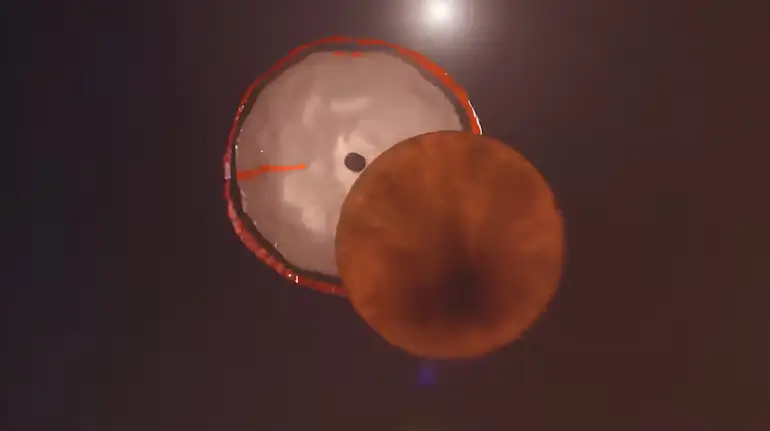
NASA’s planned 2028 Mars mission could take planetary exploration to a new level by combining nuclear-electric propulsion with three small helicopters known as SkyFall. The mission aims to demonstrate advanced space-power technology while exploring Mars from the air and investigating what lies beneath its surface.
Synopsis
The planned SR-1 Freedom mission is expected to carry three SkyFall helicopters to Mars while demonstrating a nuclear fission-powered electric propulsion system. The helicopters would use cameras, sensors and ground-penetrating radar to study Martian geology, weather and possible deposits of buried water ice.
What is SkyFall?
SkyFall is a proposed Mars exploration payload consisting of three small helicopters designed to fly independently over the Martian surface.
The helicopters build upon the concept demonstrated by NASA’s Ingenuity Mars Helicopter, which proved that controlled powered flight is possible in the extremely thin atmosphere of Mars.
SkyFall would take the concept further by using multiple aircraft equipped with scientific instruments. Instead of simply demonstrating flight, the helicopters would perform scientific observations and investigate areas that are difficult for conventional Mars rovers to reach.
What is the SR-1 Freedom Mission?
Space Reactor-1 Freedom, or SR-1 Freedom, is a proposed spacecraft mission expected to launch in late 2028.
One of the mission’s major objectives is to demonstrate the use of a nuclear fission reactor for producing electricity in deep space. The electricity generated by the reactor would power an electric propulsion system.
The spacecraft is designed to generate around 20 kilowatts of electrical power.
If demonstrated successfully, such technology could potentially support longer and more ambitious missions to Mars and other destinations where relying entirely on sunlight becomes increasingly difficult.
Why Use a Nuclear Reactor in Space?
Most spacecraft operating relatively close to the Sun can generate electricity using solar panels. However, sunlight becomes weaker as spacecraft travel farther into the Solar System.
Nuclear power offers an important alternative because it can generate electricity without depending on continuous sunlight.
In the proposed SR-1 Freedom system, a fission reactor would produce electricity, which would then power an electric thruster.
The mission could therefore serve as an important demonstration of nuclear-electric propulsion beyond Earth orbit and provide insights for future deep-space missions.
SkyFall Will Carry Three Mars Helicopters
One of the most interesting elements of the mission is the SkyFall payload consisting of three helicopters.
These aircraft would draw on lessons from Ingenuity but are intended to perform more extensive scientific work.
The helicopters are expected to carry instruments such as:
- Cameras for imaging the Martian surface
- Temperature sensors for studying environmental conditions
- Ground-penetrating radar for investigating beneath the surface
Using three helicopters could allow scientists to examine different locations and cover terrain that would be challenging or time-consuming for a rover.
What Will SkyFall Search for on Mars?
One of SkyFall’s most important scientific objectives would be to investigate what lies underneath the Martian surface.
Its ground-penetrating radar is intended to examine approximately the upper 3 metres of the Martian crust, with the possibility of reaching greater depths under favourable conditions.
Scientists would particularly look for:
- Buried water ice
- Underground cavities or voids
- Different layers of rock and soil
- Geological structures
- Features relevant to future human exploration
Discovering accessible deposits of water ice would be particularly valuable because water is considered an important resource for future crewed Mars missions.
Why is Water Ice Important on Mars?
Water is one of the most important resources for any future long-term human presence on Mars.
Martian water ice could potentially provide drinking water for astronauts. In the longer term, water could also be separated into hydrogen and oxygen, potentially providing oxygen and contributing to fuel production.
Knowing the location, depth and distribution of underground ice could therefore influence where future Mars missions establish exploration sites or bases.
SkyFall’s radar observations could help scientists build a better understanding of these underground resources.
Why is Flying on Mars Difficult?
Flying a helicopter on Mars presents a major engineering challenge because the Martian atmosphere is extremely thin compared with Earth’s.
Helicopter blades therefore have far fewer air molecules to push against to generate lift.
NASA’s Ingenuity demonstrated that powered flight is nevertheless possible on Mars. Future helicopter designs can use the lessons learned from Ingenuity to improve rotor performance, navigation and scientific capabilities.
SkyFall’s helicopters would be designed specifically to operate under these challenging Martian atmospheric conditions.
How is SkyFall Different from Ingenuity?
Ingenuity was originally sent to Mars primarily as a technology demonstration to determine whether powered, controlled flight was possible in the Martian atmosphere.
Its success opened the door for helicopters to become scientific exploration platforms.
SkyFall would represent a potential next stage of that development.
Instead of one experimental helicopter, SkyFall would deploy three aircraft carrying instruments intended for scientific investigation. They could potentially explore locations beyond the reach of traditional wheeled rovers and survey larger areas more rapidly.
Why Could the Mission Be Important for Future Mars Exploration?
The proposed mission combines two technologies that could play important roles in future planetary exploration: nuclear power and aerial exploration.
Nuclear-electric systems could provide reliable electricity for spacecraft travelling far from the Sun, while helicopters could provide scientists with a new way of examining planetary surfaces.
Mars exploration has traditionally relied heavily on orbiters, stationary landers and wheeled rovers. A fleet of helicopters could add another layer to this exploration strategy by providing greater mobility and access to difficult terrain.








 ISRO to Launch NVS-03 Navigation Satelli...
 DCGI Approves Zytorvi (Toripalimab) for ...
 NASA’s PUFFINS Mission: Indian-Origin ...










