
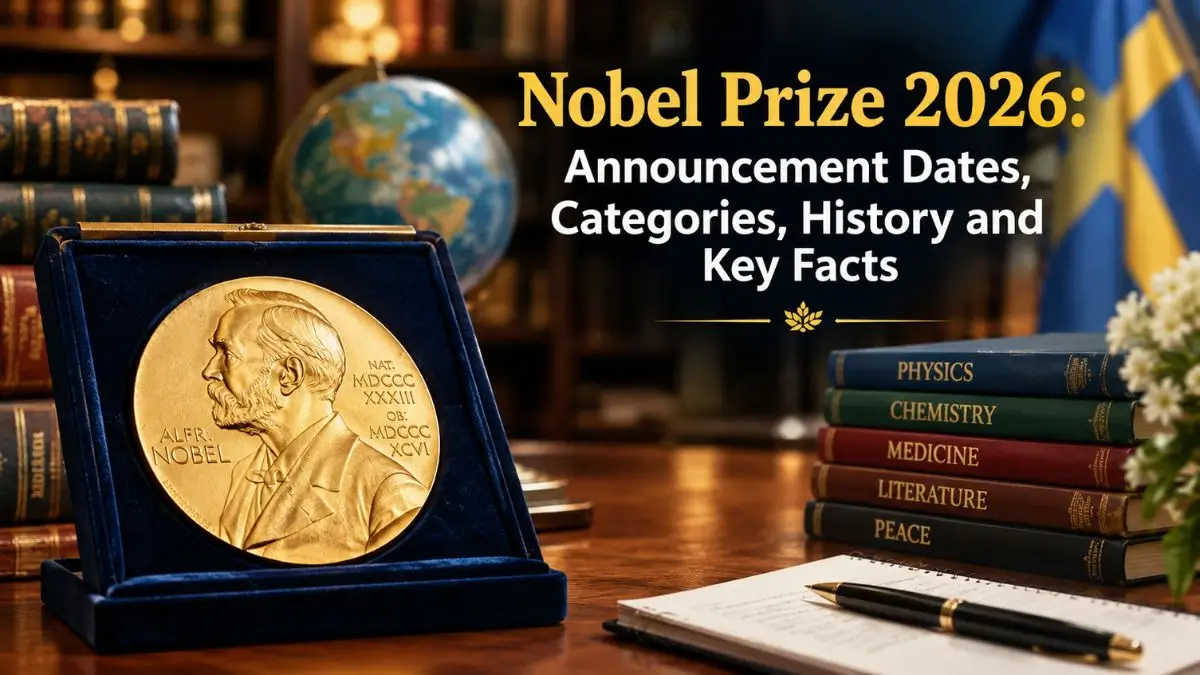
This year’s Nobel Prize announcements will take place on 5-12 October. The governing body will announce the winners in the six different categories, which are physiology or medicine, physics, chemistry, literature, peace, and economic sciences. The Nole prizes are the most prestigious awards in the world that acknowledge excellence in contributions towards humanity.
Nobel Prize 2026 Announcements
| Prize | Date of Announcement | Awarded By | Location |
| Physiology or Medicine | 5th of October, 2026 | Nobel Assembly at Karolinska Institutet` | Solna, Sweden |
| Physics | 6th of October, 2026 | Royal Swedish Academy of Sciences | Stockholm, Sweden |
| Chemistry | 7th of October, 2026 | Royal Swedish Academy of Sciences | Stockholm, Sweden |
| Literature | 8th of October, 2026 | Swedish Academy | Stockholm, Sweden |
| Peace | 9th of October, 2026 | Norwegian Nobel Committee | Oslo, Norway |
| Economic Sciences | 12th of October, 2026 | Royal Swedish Academy of Sciences | Stockholm, Sweden |
The Nobel Assembly at Karolinska Institutet announces the Medicine prize, and the Royal Swedish Academy of Sciences announces the Physics, Chemistry and Economic Sciences prizes.
The Swedish Academy announces the Literature prize, and the Norwegian Nobel Committee announces the Nobel Peace Prize.
What is the Nobel Prize?
The Nobel Prize was established according to the will of Alfred Nobel, the Swedish inventor, entrepreneur and scientist. Nobel signed his last will and testament in Paris on 27 November 1895.
He directed that most of his fortune should be used to establish prizes for people who had conferred the “greatest benefit to humankind.”
The first Nobel Prizes were awarded in 1901 in Physics, Chemistry, Physiology or Medicine, Literature and Peace.
How the Nobel Prize Started
The Nobel Prize were originated from the last will and testament of Alfred Nobel, the Swedish inventor, scientist, entrepreneur, and businessman.
Alfred Nobel signed his final will in Paris on 27th November 1895, directing that most of his fortune should be used to establish prizes for achievements benefiting humanity.
The original will provided for prizes in Physics, Chemistry, Physiology or Medicine, Literature and Peace. The first Nobel Prizes were awarded in 1901, five years after Nobel’s death in 1896.
The Sveriges Riksbank Prize in Economic Sciences in Memory of Alfred Nobel was established later. It was created by Sweden’s central bank in 1968 and first awarded in 1969.
It is commonly referred to as the Nobel Prize in Economics, although it was not one of the five original prize categories established in Nobel’s will.
Nobel Prize Selection Process
The Nobel Prize selection process begins with nominations. Thousands of eligible nominators, including university professors, scientists, members of academies, previous Nobel laureates, and members of parliamentary assemblies, are invited to nominate candidates.
Self-nomination is not permitted. The names of nominees remain confidential for 50 years.
After receiving the nominations, the relevant Nobel Committees evaluate candidates and prepare recommendations for the prize-awarding institutions. The institutions then make the final decisions.
Alfred Nobel
Alfred Nobel was an inventor, entrepreneur, scientist, and businessman who also wrote poetry and drama.
His varied interests are reflected in the prize he established and which he laid the foundation for in 1895 when he wrote his last will, leaving much of his wealth to the establishment of the prize.
Since 1901, the Nobel Prize has been honouring men and women from around the world for outstanding achievements in physics, chemistry, physiology or medicine, literature and for work in peace.
Alfred Nobel signed his last will in Paris on 27 November 1895.
He specified that the bulk of his fortune should be divided into five parts and to be used for prizes in physics, chemistry, physiology or medicine, literature and peace to “those who, during the preceding year, shall have conferred the greatest benefit to humankind.”
Quick facts
- Born: 21 October 1833
- Died: 10 December 1896
- Known for: inventing dynamite and holder of 355 patents
- Professions: chemist, inventor, engineer, entrepreneur, businessman, author
- Will: left 31 million Swedish kronor (SEK) to fund the prizes








 Dussehra 2026: Top 30 Most Important GK ...
 Dussehra and UNESCO: Ramlila, Durga Puja...
 Mysuru Dasara 2026: History, Jamboo Sava...










