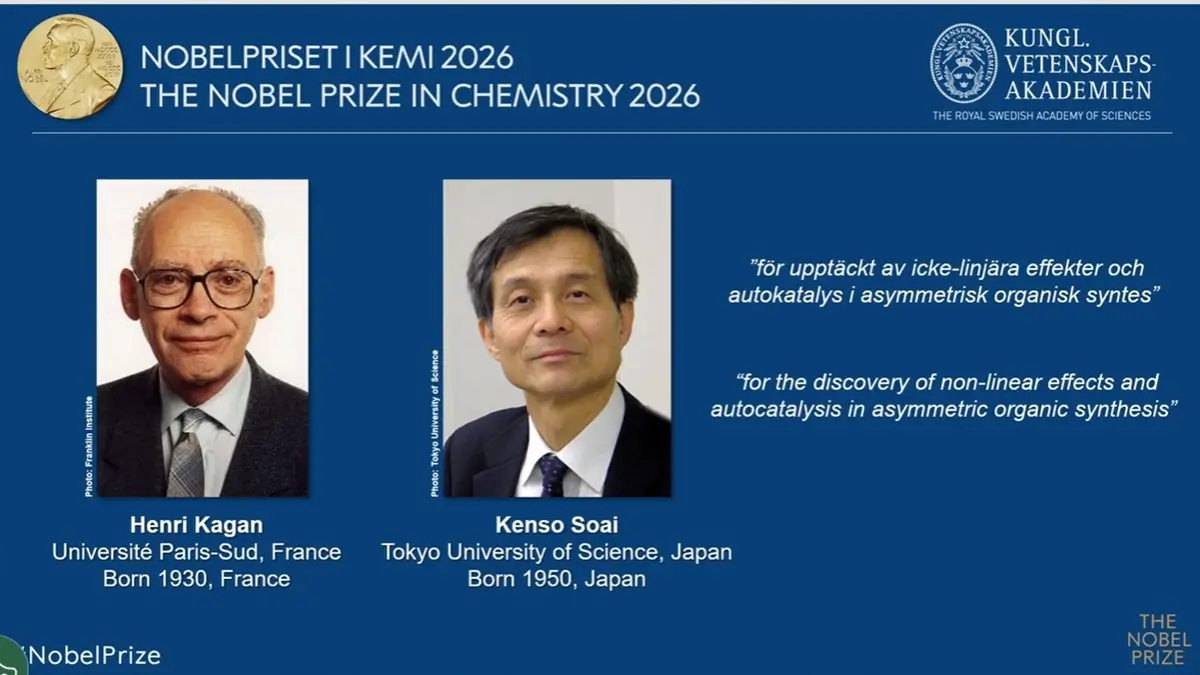
The Nobel Prize in Chemistry 2026 has been awarded jointly to Henri B. Kagan and Kenso Soai for their pioneering contributions to asymmetric organic synthesis.
The Royal Swedish Academy of Sciences honoured the two scientists “for the discovery of non-linear effects and autocatalysis in asymmetric organic synthesis.”
Both laureates will share the prize equally, with each receiving a one-half share of the 2026 Chemistry Nobel Prize.
Nobel Prize in Chemistry 2026 Winners
| Laureate | Prize Share | Recognised For |
|---|---|---|
| Henri B. Kagan | 1/2 | Discovery of non-linear effects in asymmetric organic synthesis |
| Kenso Soai | 1/2 | Discovery of autocatalysis in asymmetric organic synthesis |
What is Asymmetric Organic Synthesis?
Asymmetric synthesis is a branch of chemistry concerned with producing molecules in which one particular three-dimensional arrangement is formed preferentially over another.
Many molecules exist in two forms that are mirror images of each other. These are known as enantiomers.
Although such molecules may have the same chemical formula, their biological effects can be very different. This is particularly important in:
- Pharmaceuticals
- Agrochemicals
- Biotechnology
- Fine chemicals
- Materials science
Methods that allow chemists to selectively produce one desired molecular form are therefore extremely important.
Henri B. Kagan and Non-Linear Effects
Henri B. Kagan was recognised for his work on non-linear effects in asymmetric synthesis.
In asymmetric catalysis, the relationship between the optical purity of a catalyst and the optical purity of the resulting product does not always follow a simple linear pattern.
Kagan’s research demonstrated that small differences in the chirality of catalysts could sometimes lead to much larger changes in the selectivity of chemical reactions.
These discoveries significantly improved scientists’ understanding of how asymmetric catalytic reactions work.
Kenso Soai and Asymmetric Autocatalysis
Kenso Soai is best known for his discovery of asymmetric autocatalysis.
In an autocatalytic reaction, a product of the reaction itself acts as a catalyst and helps produce more of the same product.
Soai demonstrated that an extremely small initial imbalance between two mirror-image molecules could be amplified dramatically through autocatalysis.
This phenomenon became known as the Soai reaction and provided an important experimental model for understanding how molecular handedness, or chirality, can emerge and amplify.
What is Chirality?
Chirality refers to the property of a molecule that cannot be superimposed on its mirror image.
A common analogy is the human hand:
- The left hand and right hand are mirror images
- However, they cannot be perfectly superimposed
Molecules can behave in a similar way.
This property is extremely important in medicines because two mirror-image forms of the same molecule may interact differently with biological systems.
Why Their Research Matters
The work of Kagan and Soai has had a major impact on modern chemistry by improving scientists’ understanding of how one molecular form can become dominant during chemical reactions.
Their discoveries are important for:
- Designing more selective chemical reactions
- Developing safer and more effective medicines
- Manufacturing complex organic compounds
- Understanding the origin and amplification of molecular chirality
- Advancing modern catalytic chemistry
Their research also provides important insights into one of chemistry’s longstanding questions: how a preference for one molecular handedness could arise and become amplified.
Non-Linear Effects vs Autocatalysis
| Concept | Meaning |
|---|---|
| Non-Linear Effect | A small change in catalyst chirality can produce a disproportionately large change in product selectivity |
| Autocatalysis | A reaction product acts as a catalyst to accelerate production of more of itself |
| Asymmetric Synthesis | Production of one mirror-image form of a molecule preferentially over another |
| Chirality | Property of molecules that exist as non-superimposable mirror images |
About the Nobel Prize in Chemistry
The Nobel Prize in Chemistry is one of the original Nobel Prizes established through the will of Alfred Nobel.
It is awarded annually for discoveries and achievements that have made outstanding contributions to chemistry.
The Chemistry Nobel is awarded by the Royal Swedish Academy of Sciences.








 Delhi-Meerut Namo Bharat Corridor Wins B...
 Shabari Naturals Wins G-Mark Global Desi...
 Lionel Messi Recognized With 2026 Prince...