
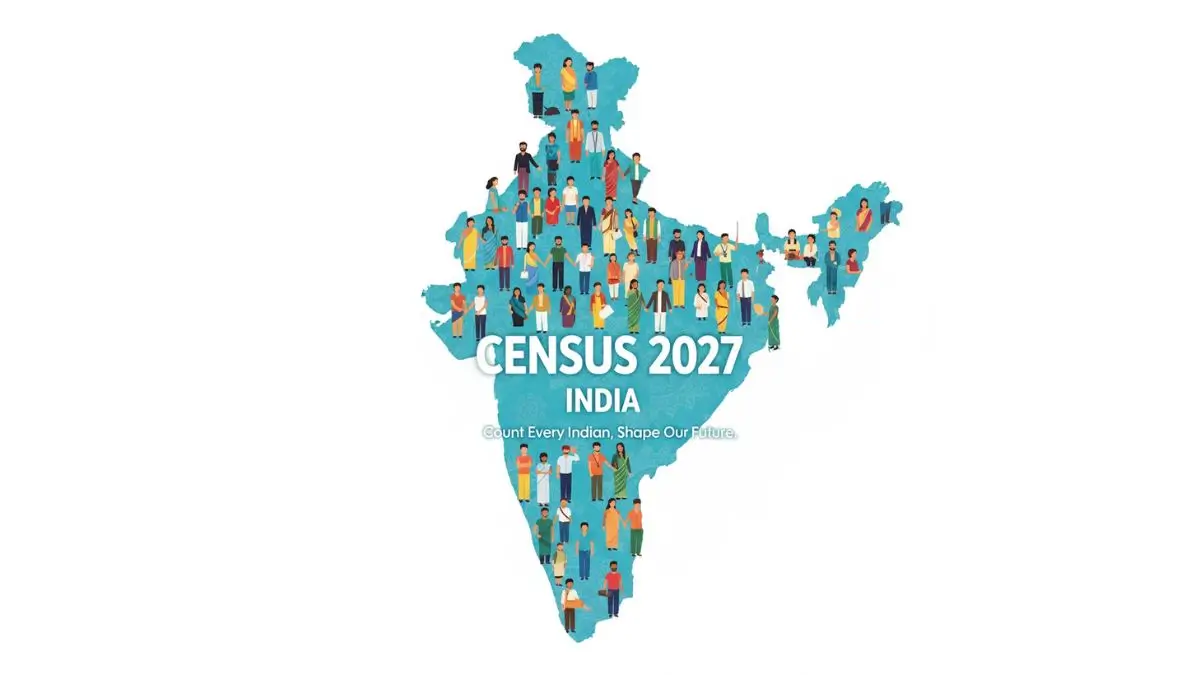
Under the leadership of the Prime Minister Narendra Modi Union Cabinet approved the proposal to conduct Census of India 2027 at a cost of Rs 11,718.24 crore . This will be India’s 16th national census and the first completely digital census, bringing major changes in how data is collected, stored, and shared. Census 2027 aims to produce faster, cleaner, and more accessible data for policy-making.
Census 2027: A Two Phased Plan
The approval marks a major step toward launching the world’s largest administrative and statistical exercise.
The census will be carried out in two phases,
- Houselisting and Housing Census: April to September 2026
- Population Enumeration: February 2027
For snow-bound regions in Ladakh, Jammu & Kashmir, Himachal Pradesh, and Uttarakhand, the Population Enumeration will be done earlier in September 2026. Nearly 30 lakh field workers will take part in this national operation.
Background Of Census
Census 2027 will be the 16th Census of India and the 8th since independence. The Census is the most important source of primary data at the village, town, and ward level. It provides information on,
- Household conditions
- Amenities and assets
- Demographics
- Religion
- SC/ST population
- Language and literacy
- Migration patterns
- Economic activity
- Fertility and social trends
Act: The Census Act, 1948 and the Census Rules, 1990 offer the legal framework for this entire exercise.
Implementation Strategy
The census will involve visiting every household and using separate questionnaires for both phases. Enumerators, mostly government school teachers, will conduct fieldwork along with supervisors and district-level officers.
A total of around,
- 30 lakh census workers will manage field operations
- 3 million personnel, including supervisors and master trainers, will support data collection and monitoring
- All workers will receive an honorarium as census duties are in addition to their regular jobs
First Time Features of Census 2027
- India’s First Digital Census: Data will be collected using a mobile application available on both Android and iOS. This will improve the speed and accuracy of the data.
- Census Management and Monitoring System (CMMS): A dedicated online portal will track the entire operation in real time, helping officials monitor progress instantly.
- Houselisting Block Creator Web Map Application: This tool will assist officers in charge to map and organize the houselisting blocks.
- Self-Enumeration Option: For the first time, people will be allowed to count themselves through a digital platform.
- Strong Digital Security: Advanced security features have been built into the system to protect personal data collected during the process.
- National Awareness Campaign: A nationwide information campaign will encourage public participation and ensure that people provide accurate and timely details.
- Caste Enumeration Included: The Cabinet Committee on Political Affairs decided in April 2025 to include caste data in Census 2027. This information will be collected electronically during the Population Enumeration phase.
Benefits of Census 2027
- The entire population of India will be covered under this exercise.
- The shift to digital methods will make data clean, machine-readable, and easy to access.
- Through Census as a Service (CAAS), ministries will receive data in actionable formats for better policy-making.
- Data dissemination will also become faster and more user-friendly, with tools that allow people to access information down to the village or ward level.
Employment Generation and Economic Impact
- Census 2027 will significantly contribute to local employment and skill development.
- Around 18,600 technical personnel will be deployed for nearly 550 days.
- And generating around 10.2 million man-days of employment
These workers will gain experience in digital data handling, monitoring, and coordination, improving their future job prospects. The project will also strengthen digital capacity at district and state levels.
Key Takeaways
- Union Cabinet approved Census 2027 at ₹11,718.24 crore.
- Conducted in two phases: Houselisting Census (Apr–Sep 2026) and Population Enumeration (Feb 2027).
- First-ever digital census using mobile apps and a monitoring portal.
- Caste enumeration to be included electronically during the PE phase.
- 30 lakh workers to handle field operations; 3 million total personnel involved.
- Expected to generate 10.2 million man-days of employment.
- Data will be more accessible, machine-readable, and available down to village/ward level.
- Digital tools include CMMS portal and HLB Creator app.


 ECINet KYC Feature Explained: How Voters...
 BIRAC-BioNEST Incubation Centre Inaugura...
 E20 Petrol India 2026: Nationwide Rollou...











