
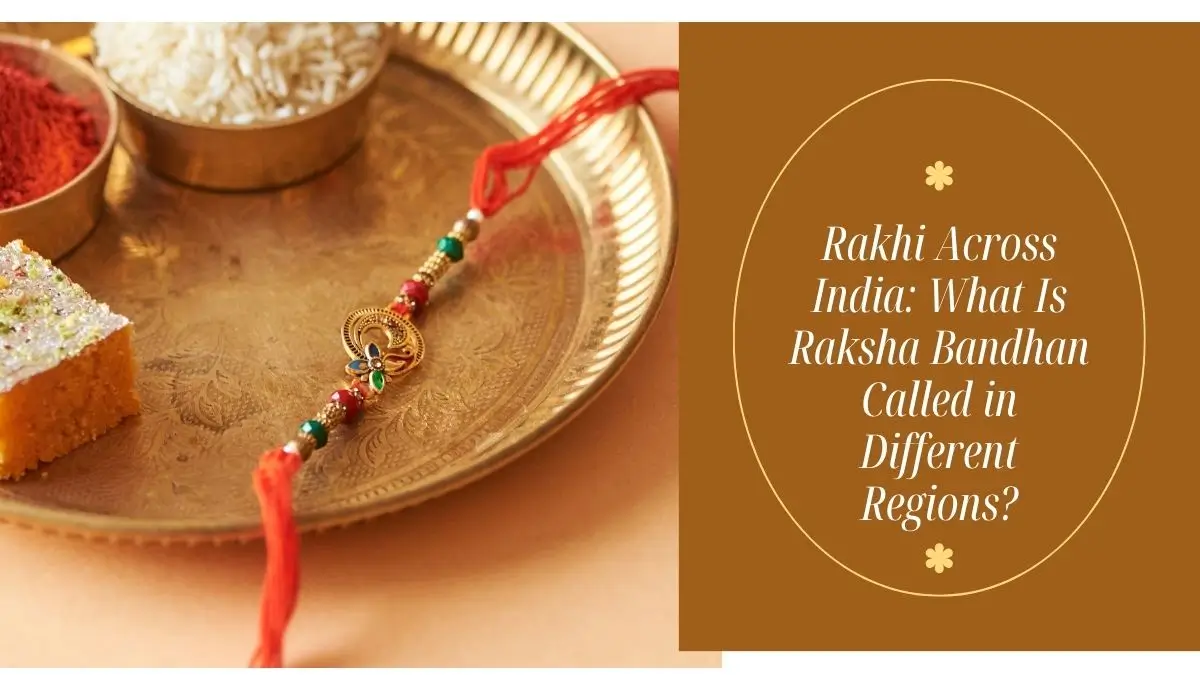
Raksha Bandhan, commonly known as Rakhi, is celebrated throughout India as a festival of love, affection, and bond between siblings. Although the ritual of tying a rakhi continues to be integral to the festival, Rakhi is celebrated under a different name in different regions in the country.
Whether it is Lumba Rakhi in Rajasthan, Gamha Purnima in Orissa, or Balev in Maharashtra and Karnataka, the diverse culture of India is enriched with its own unique style of celebrating the festival.
Thus, what do you call Raksha Bandhan in different parts of India? Let’s learn more about the names and rituals of Rakhi.
Raksha Bandhan Names Across Various States of India
The festival is usually known as Raksha Bandhan or Rakhi in the northern parts of India, but various other festivals like Shravana Purnima may also be celebrated in different states.
Raksha Bandhan or Rakhi in North India
In north India, the festival is mostly referred to as Raksha Bandhan or Rakhi. It is mainly practiced in states like Uttar Pradesh, Punjab, Haryana, Himachal Pradesh, and Bihar.
The ritual requires the sister to put the sacred thread, rakhi, around her brother’s wrist and apply tilak and perform aarti. In turn, the brother is expected to give a gift to his sister and promise to take care of her and protect her.
Raksha Bandhan nowadays has developed an extended meaning. The relationship between siblings now is seen more in terms of mutual love, trust, care and commitment instead of the brother’s duty towards his sister.
Lumba Rakhi in Rajasthan
Rajasthan has a special practice of Rakhi that is called Lumba Rakhi. It means that the celebration may also involve not just brother and sister, but a sister-in-law, bhabhi.
The Lumba rakhi is usually made as an ornamental hanging decoration which can be attached to a bangle or bracelet. Sisters present such rakhis to their sisters-in-law as part of Raksha Bandhan celebration.
The tradition shows how important the sister-in-law is for the family.
Gamha Purnima in Odisha
In Odisha, Raksha Bandhan is also celebrated as Gamha Purnima. The celebration combines the traditional celebration of relations between brothers and sisters with local cultural elements.
There are some traditions when cows are being worshiped and rakhis can be tied to their horns as a part of festivities. Folk traditions, songs, and community celebrations also form a part of the event in different regions.
Hence, Gamha Purnima shows how the festival of Shravana Purnima involves local traditions but still keeps its connection with Rakhi.
Balev in Maharashtra and Karnataka
In some regions of Maharashtra and Karnataka, the event is called Balev. For Brahmins, this day means changing the sacred thread, called Janeu.
Such custom resembles the ceremony of changing sacred threads that takes place in other parts of India under different names. On the other hand, people also use the occasion to strengthen ties with siblings by tying rakhis.
So, the combination of religious rituals and family traditions makes this celebration more culturally significant than just a tying of a rakhi.
Janai Purnima in Nepal
Even though Nepal is not included in India, the tradition should be mentioned because of the cultural connection with the whole Himalayan region. The corresponding celebration is called Janai Purnima.
It is a religious event, especially for Hindus, including the tradition of changing sacred threads. In some communities, there are rituals related to protection and relations within families.
Why Are There Varied Names For Raksha Bandhan?
In India, many festivals have varied expressions depending on the regional culture, language, community, and religious practices that define the celebrations.
Shravana Purnima, the full moon night when Raksha Bandhan takes place, has a history of being linked with many customs and beliefs. The celebration of these customs with time has led to varied naming and practices among the communities.
However, the essence of Rakhi is still the same: building relationships and showing affection.







 Who Is Navi Pillay? Nobel Peace Prize 20...
 Vande Bharat vs Amrit Bharat Express: Ke...
 Asian Games to LA28: Which Sports Earned...










