
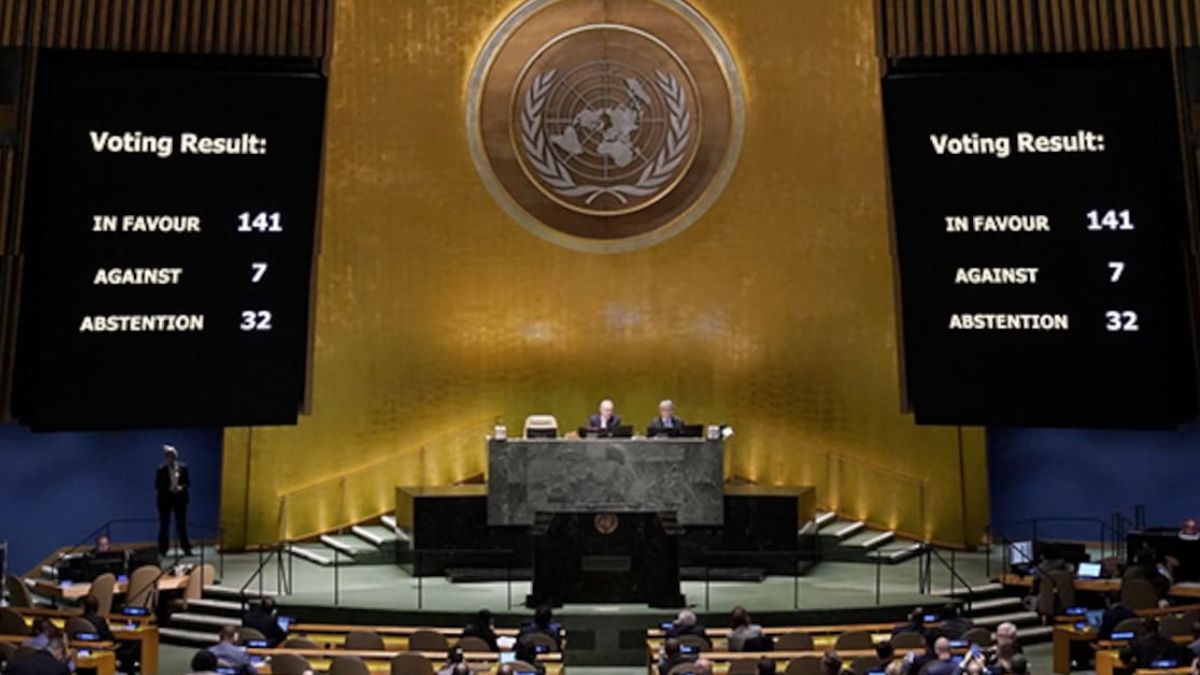
India’s voting behavior at the United Nations (UN) has seen a notable evolution, especially in recent years. A significant increase in abstentions—reaching a historic high in 2025—marks a new phase in India’s foreign policy strategy. This shift reflects India’s efforts to adapt to a polarised global order, while preserving its strategic autonomy and emerging as a middle power with a more assertive global role.
Historical Background of India’s UN Voting Pattern
Since 1946, India has voted on over 5,500 UN resolutions, with its pattern changing over time,
- 1946–late 1960s: Highly volatile voting; ‘yes’ votes ranged from 20% to 100%, with fluctuating abstentions.
- 1970–1994: More consistency with 74%–96% ‘yes’ votes and 8%–19% abstentions.
- Mid-1990s–2019: Stabilised further; ‘yes’ votes at 75%–83%, abstentions at 10%–17%.
- Post-2019: Marked change; by 2025, ‘yes’ votes dropped to 56%, and abstentions peaked at 44%, the highest since 1955.
- This trend reflects India’s transition from a non-aligned observer to a strategically autonomous actor.
Reasons Behind the Shift to Strategic Abstentions
Polarised Global Order
Growing divisions among major global powers (e.g., US, China, Russia) have reduced scope for consensus. India avoids aligning with any single bloc, preferring neutrality.
Complexity of Resolutions
Modern UN resolutions are often multi-dimensional, with conflicting clauses—dubbed “Christmas trees” by diplomats. Abstention helps India avoid endorsing or rejecting overly complicated proposals.
Assertion of Sovereignty
Abstentions today reflect sovereign diplomatic judgment rather than indecision. This enables India to maintain strategic flexibility and protect bilateral interests without alienating key allies.
Strategic Implications of India’s Abstentions
- Sign of Autonomy: Abstentions showcase India’s independent foreign policy and alignment with non-alignment principles in a modern context.
- Diplomatic Balancing Act: India avoids taking hard sides in contentious issues (e.g., Russia-Ukraine, Myanmar, Israel-Palestine).
- Global Perception Risks: Allies might see abstentions as lack of commitment, especially on human rights or security issues.
Case Studies and Practical Impact
Though the analysis does not name specific resolutions, India’s abstentions have been notable in,
- Russia-Ukraine war resolutions
- Human rights violations in Myanmar and China
- Israel-Palestine conflict debates
- In all cases, abstention served India’s interest by preserving key partnerships and subtly signalling concern.
Future Outlook
India’s strategy of “strategic abstention” is expected to persist as it pushes for a UNSC permanent seat and enhances its middle-power status. This approach allows India to be a balancing force in international relations—engaging without compromising.


 Preeti Saran Re-Elected as UN Committee ...
 Global Trade Hits New High in 2025: Key ...
 Iran–US Ceasefire: Iran’s 10 Conditions ...











