
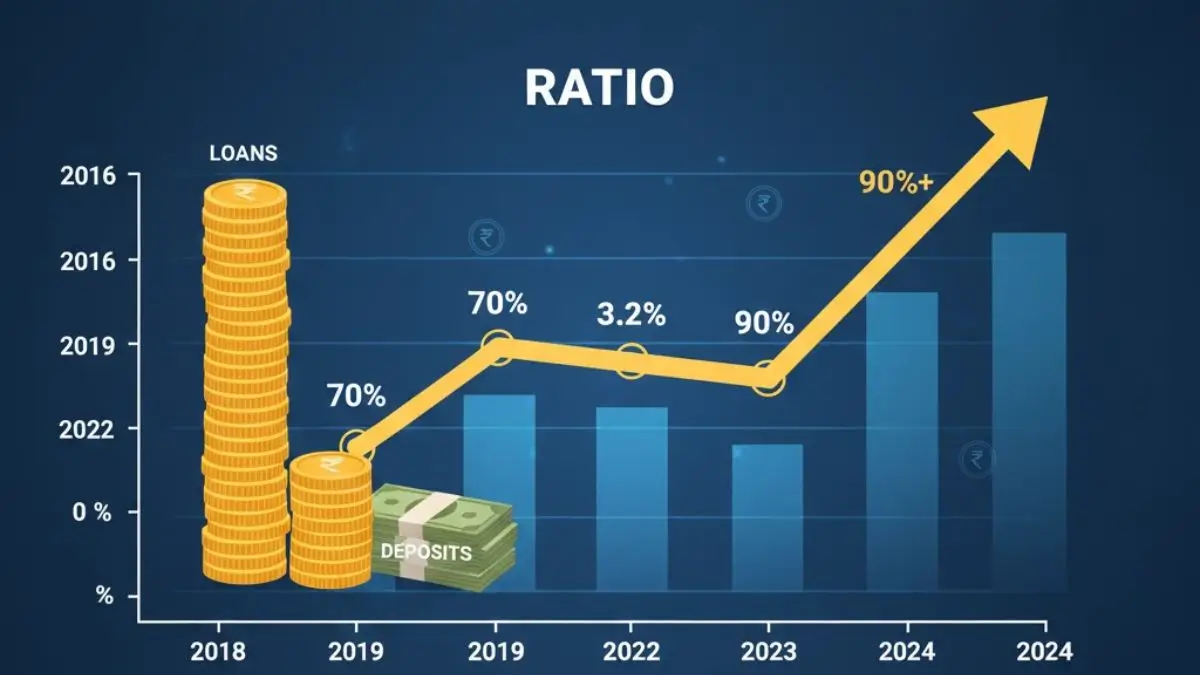
India’s banking system is witnessing a growing imbalance between loans and deposits. In the December quarter, banks loan-to-deposit ratios reached a record high, showing that credit growth is outpacing deposit mobilization. While lending demand remains strong, slower deposit growth is creating liquidity pressure. This trend has raised concerns about higher deposit rates and reduced flexibility for banks in responding to future monetary policy easing.
Why in the News?
Loan-to-deposit ratios across Indian banks touched an all-time high of 81% in the December quarter, highlighting a widening gap between credit growth and deposit mobilisation.
What Is Loan-to-Deposit Ratio (LDR)?
- Understanding the basic indicator used to assess banking liquidity.
- Loan-to-deposit ratio measures how much of deposits are used for lending.
- A higher ratio indicates aggressive lending relative to deposits.
- Very high LDRs may signal liquidity stress for banks.
- Moderate LDRs help banks balance growth and financial stability.
- Regulators and investors closely track this indicator.
System-Level Banking Trends
- Overall banking data shows deposits lagging behind loans.
- Banking system LDR rose to 81% in the December quarter.
- Credit growth has remained strong across public and private banks.
- Deposit growth has slowed compared to earlier quarters.
- The gap reflects strong loan demand amid weaker savings flows.
- Analysts warn this trend could persist in the near term.
Performance of Major Banks
- Large lenders show mixed but concerning trends.
- HDFC Bank loans grew 12%, deposits 11.5%, pushing LDR close to 100%.
- Bank of Baroda saw advances grow faster than deposits.
- Punjab National Bank and Union Bank of India showed similar trends.
- Among private banks, Axis Bank and Kotak Mahindra Bank reported relatively balanced growth.
Concerns Highlighted by Experts
- High LDRs limit banks operational flexibility.
- Banks may need to raise deposit interest rates to attract funds.
- Higher deposit rates can compress net interest margins.
- Passing on RBI rate cuts to borrowers may become difficult.
- Liquidity stress could impact future credit expansion.
- Sustained improvement depends on stronger deposit growth.
Key Summary at a Glance
| Aspect | Details |
| Why in News? | Banking system LDR hits 81% |
| Key Concern | Credit growth faster than deposits |
| Major Banks | HDFC Bank, Bank of Baroda, Axis Bank |
| Possible Impact | Higher deposit rates, margin pressure |
| Expert View | Limited scope to pass RBI rate cuts |
Question
Q. What does a high loan-to-deposit ratio mainly indicate?
A. Excess deposits with banks
B. Weak credit demand
C. Higher lending compared to deposits
D. Strong foreign inflows


 India Records All-Time High UPI Transact...
 New ATM Rules in India 2026: Daily Limit...
 RBI Tightens Forex Market Controls With ...











