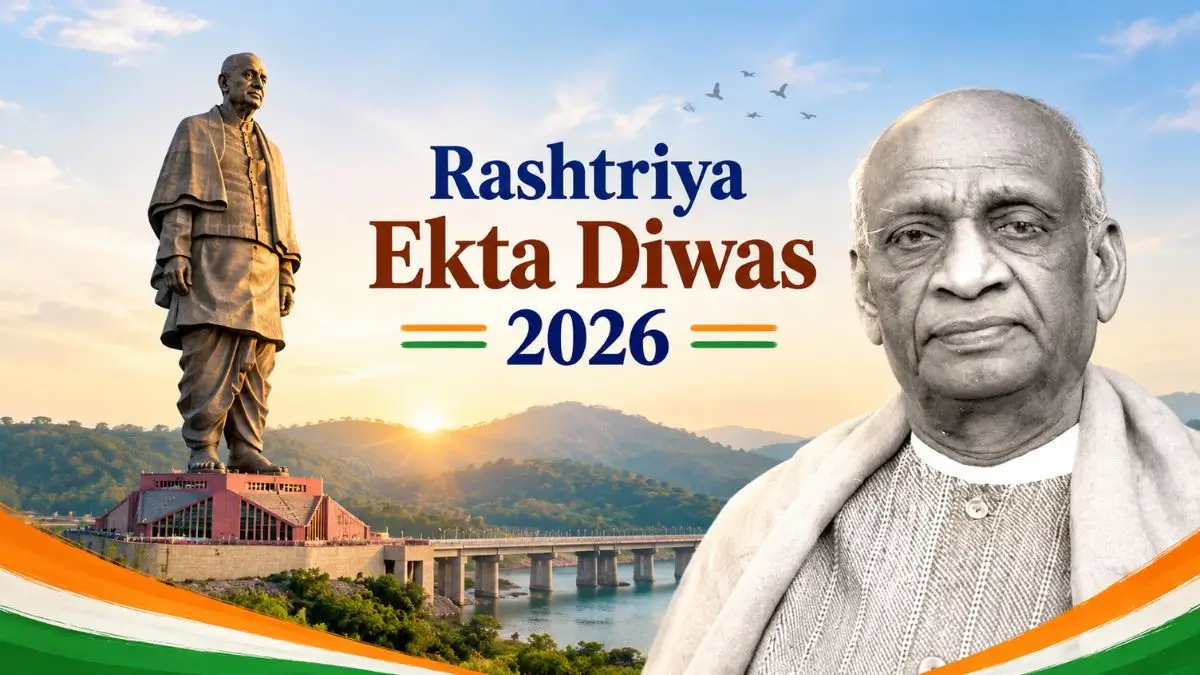
India will observe the 151st Birth Anniversary of Sardar Vallabhbhai Patel on 31 October 2026. He is popularly known as the ‘Iron Man of India’, Patel was instrumental in the freedom struggle of the India and the integration of over 560 princely states into the Indian Union after Independence. His birth anniversary is observed as ‘Rashtriya Ekta Diwas’ (National Unity Day), which signifies the importance of national unity, integrity, and solidarity.
Sardar Vallabhbhai Patel Jayanti 2026
Every year, on 31st October Sardar Vallabhbhai Patel Jayanti is observed; it is the birth anniversary of country’s first Deputy Prime Minister and Home Minister.
- Date of Observance: 31st October, 2026
- 151st Birth Anniversary
- Born on: 31st October, 1875
- Birthplace of Patel: Nadiad, Gujarat
- Known as: Iron Man of India
- National Observance of the Day: Rashtriya Ekta Diwas (National Unity Day)
Rashtriya Ekta Diwas 2026: National Unity Day
Rashtriya Ekta Diwas, which is also known as National Unity Day, is celebrated every year on 31 October in memory of the birth anniversary of Sardar Vallabhbhai Patel.
Rashtriya Ekta Diwas was initiated by the Government of India in 2014 to acknowledge the contributions of Sardar Vallabhbhai Patel in nation-building and unity.
This day celebrates the notion that the cultural, linguistic and regional diversity in India can coexist in a nation. It also remembers the role played by Sardar Patel in uniting the nation in the tough times after independence.
Objectives of Rashtriya Ekta Diwas
- Pay tribute to the Sardar Vallabhbhai Patel’s contribution to nation-building.
- Celebrate the national unity, integrity and solidarity.
- Acknowledge the role of Patel to integrating princely states in the Indian Union.
- Engage people in activities for strengthening the nation.
Sardar Vallabhbhai Patel: Biography and Early Life
Sardar Vallabhbhai Patel was one of the most significant politicians and lawyers in India who fought for freedom. He played a central role in the consolidation of Independent India.
Early Life & Education
- Vallabhbhai Patel was born on 31st October 1875 in Nadiad, Gujarat. His parents were Jhaverbhai Patel and Ladba Patel. Patel graduated in law before travelling to England to train at the Middle Temple in London.
- Upon returning to India, Patel developed a successful career as a lawyer in Ahmedabad. However, he became increasingly active in public life.
Freedom Struggle
- Patel was influenced by Mahatma Gandhi and became heavily involved in India’s fight for independence. He became well known due to his leadership of the Kheda (1918) and Bardoli (1928) Satyagraha movements.
- The organisation and leadership that he showed during the Bardoli movement meant that he gained the name Sardar, meaning Leader/Chief
Role in Indian National Congress
- Patel was elected as the President of the Indian National Congress during its Karachi session in 1931.
- The Karachi session is very important as some resolutions regarding Fundamental Rights and the National Economic Programme were passed by Congress under Patel’s presidency. The resolutions were very important for fundamental rights, labour rights, and economic policy.
Role Post-Independence
- Post-independence, after the freedom of India in 15 August 1947, Patel became the first Deputy Prime Minister and Home Minister of India.
- He held an important position regarding the integration of princely states and the administrative system.
Demise of Patel
- Sardar Vallabhbhai Patel was died in Bombay, now known as Mumbai, on 15th December 1950. His contribution to the India’s national and administrative development is always honoured through various national memorials.
Contributions Made by Sardar Patel
1. Integration of Princely States
- One of Patel’s greatest contributions was integrating over 560 different princely states into the Indian Union.
- Integration was necessary after independence as the princely states needed to choose their political futures. Patel as Deputy Prime Minister and Home Minister, took charge of the political and administrative aspects of integrating the Princely states. He worked closely with V.P Menon as the Secretary to the States Department.
- Negotiations were made, and agreements were reached. In some instances, the government had to take decisive steps. This included integrating states such as Hyderabad, Junagadh etc.
2. Farmers’ movements
- Patel had a big contribution to mobilising farmers against the colonial revenue policies.
- Kheda Satyagraha (1918): Patel helped Mahatma Gandhi organise farmers demanding relief from land revenue due to bad harvests.
- Bardoli Satyagraha (1928): Patel led the farmers’ movement against increased land revenue in Bardoli, Gujarat.
- Patel was known for his leadership in the Bardoli movement and gained the title Sardar.
3. All India Services
- Patel believed that having a neutral, efficient and disciplined civil service was very important to help create unity within the country.
- He famously called the All India Services the “steel frame of India”.
- Important parts of this were the Indian Administrative Service (IAS) and Indian Police Service (IPS).
4. Administrative Contributions
- Patel played an important role in creating administrative structures within India during the early years of independence.
- As a senior member of the Constituent Assembly, Patel chaired important committees. He chaired the Advisory Committee on Fundamental Rights, Minorities and Tribal and Excluded areas.
- He also chaired the Provincial Constitution Committee.
5. Rebuilding of Somnath Temple
- In 1948 Patel supported the rebuilding of the historic Somnath Temple in Gujarat.
- He visited the site and supported the public rebuilding of the temple. It was rebuilt using public funding and by leaders such as K.M Munshi.
- The temple was ceremonially opened in 1951 (after Patel’s death).
6. National Unity
- Patel helped to keep political stability and national unity during the difficult times post-partition.
- His leadership in integrating the princely states helped create a strong base for the Indian Union.
- His style of leadership focused on creating administration, national unity and a strong central structure.
Awards and Recognition Given to Sardar Vallabhbhai Patel
The contribution of Sardar Vallabhbhai Patel to the freedom movement of India, political integration, and public administration has been acknowledged in India with various national awards and memorials.
| Name of Award/Recognition | Year of Recognition | Significance |
| Bharat Ratna | 1991 | Awarded posthumously for his contributions to the country |
| Iron Man of India | — | His popular nickname due to his role in national integration |
| Rashtriya Ekta Diwas | 2014 | Introduced as a national observation in commemoration of his birthday |
| Statue of Unity | 2018 | National memorial built in his memory |
Bharat Ratna: He was conferred the highest civilian award of India, the Bharat Ratna, posthumously in 1991.
Iron Man of India: The title was granted to him due to his strong leadership in the integration process.
Father of all India Services: Patel has earned the reputation of the builder of the All India Services.



 October 29: Why the UN Observes the Inte...
 Vigilance Awareness Week 2026: Theme, Da...
 Indo-Tibetan Border Police (ITBP) Raisin...