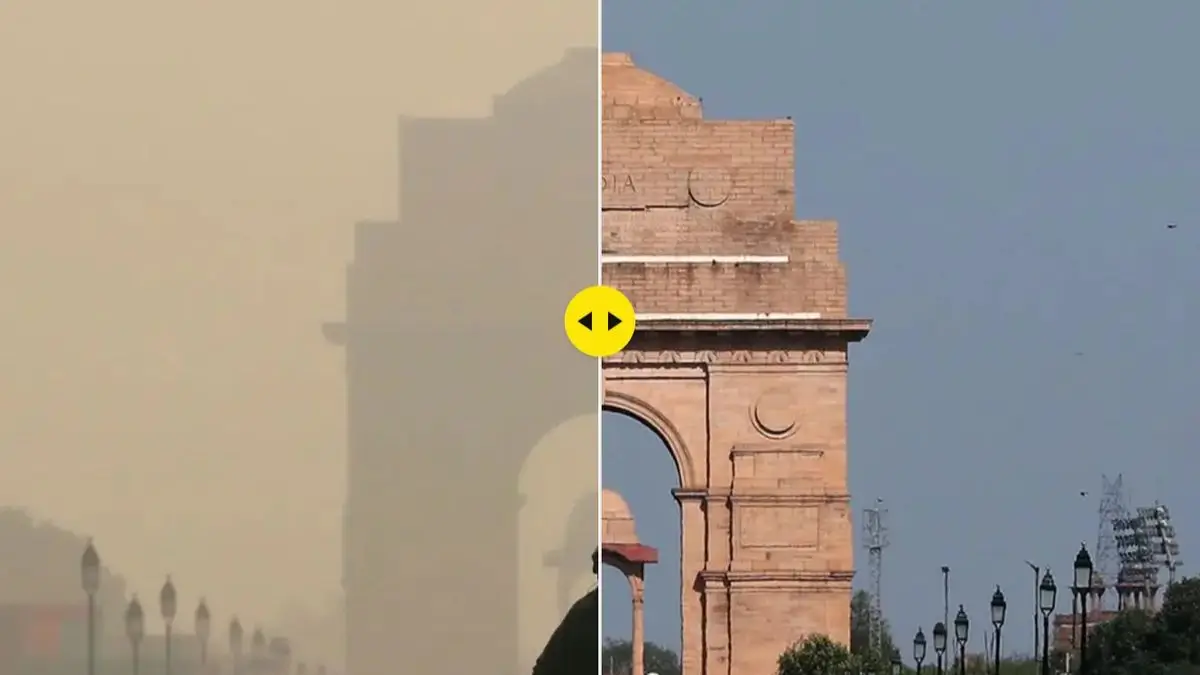
Lucknow tops among the million-plus cities in the Swachh Vayu Sarvekshan 2026 with respect to steps taken to curb air pollution. Indore and Jabalpur have been awarded the second and third positions, respectively. The annual survey rates cities and towns for the measures taken to mitigate major sources of air pollution, namely road dust, construction debris, vehicular and industrial pollution.
The findings also bring out a crucial point. A city may rank high on the criteria of measures taken to control air pollution, without having achieved the stipulated ambient air quality standards.
Topping Million-Plus Cities
Lucknow topped in the ranking with a score of 198 in Category-I, which consists of cities with populations exceeding 10 lakh.
Measures taken by Lucknow includes,
- Enhancing the usage of electric vehicles in waste collection.
- Use of mechanized road sweepers to curb dust.
- Managing legacy-waste.
- Steps to reduce major sources of particulate pollution.
Indore, which holds the top position among Indian cities in Swachh Survekshan rankings for cleanliness, came second with a score of 197. Jabalpur bagged third position with a score of 195.
Measures taken by Jabalpur include waste-to-energy plant, waste collection and scientific waste disposal, mechanized street sweeping and electric vehicle
Here is Full Category Wise List Winners
Category-I: Population Above 10 Lakh
Lucknow emerged as the highest-ranked city with a score of 198, narrowly ahead of Indore.
| Rank | City | Score |
| 1 | Lucknow | 198 |
| 2 | Indore | 197 |
| 3 | Jabalpur | 195 |
| 4 | Bhopal | 192 |
| 4 | Agra | 192 |
| 5 | Surat | 191 |
| 6 | Raipur | 189 |
| 7 | Thane | 187 |
| 7 | Chandigarh | 187 |
| 7 | Rajkot | 187 |
| 8 | Ahmedabad | 186 |
| 8 | Vijayawada | 186 |
| 9 | Ghaziabad | 184 |
| 9 | Navi Mumbai | 184 |
| 10 | Nagpur | 183.8 |
Category-II: Population 3 -10 Lakh
Rourkela topped the 3–10 lakh population category with a score of 198.5. Firozabad and Guntur followed with scores of 195 each.
| Rank | City | Score |
| 1 | Rourkela | 198.5 |
| 2 | Firozabad | 195 |
| 2 | Guntur | 195 |
| 3 | Amravati | 194 |
| 4 | Bhubaneswar | 193.5 |
| 5 | Jhansi | 192.5 |
| 6 | Alwar | 192 |
| 7 | Latur | 188.5 |
| 8 | Moradabad | 187.5 |
| 8 | Noida | 187.5 |
| 8 | Udaipur | 187.5 |
| 9 | Nellore | 187 |
| 10 | Korba | 186.5 |
Category-III: Population Below 3 Lakh
Kalinga Nagar secured the first position with a score of 198.5, followed by Angul at 196.5 and Talcher at 193.5.
| Rank | City | Score |
| 1 | Kalinga Nagar | 198.5 |
| 2 | Angul | 196.5 |
| 3 | Talcher | 193.5 |
| 4 | Eluru | 193 |
| 5 | Haldia | 190.6 |
| 6 | Vizianagaram | 189.5 |
| 7 | Dewas | 188 |
| 8 | Sangareddy | 186.8 |
| 9 | Damtal | 186 |
| 10 | Nalgonda | 185.8 |
Ward-Level National Awards
The Swachh Vayu Sarvekshan 2026 also recognised wards for their performance in different population categories.
Category-I: Wards Above 30,000 Population
- Lucknow – Zone 4, Ward 70
- Bhopal – BMC Ward 60
- Nashik – NMC Ward 7
Category-II: Wards With 10,000–30,000 Population
- Bhubaneswar – BMC Ward 36
- Bhubaneswar – BMC Ward 30
- Vijayawada – Vija_Ward60
- Allahabad – Pryj31
Category-III: Wards Below 10,000 Population
- Rourkela – RMCWD13
- Nalgonda – NLGW16
- Nagaon – Naga-WARD8
State-Level Awards
The survey also listed state/UT-level awardees across the three population categories. Some important entries includes,
- Andhra Pradesh: Guntur, Vijayawada and Nellore
- Assam: Guwahati and Silchar
- Bihar: Patna and Gaya
- Chandigarh: Chandigarh
- Chhattisgarh: Raipur and Bhilai
- Delhi: Delhi
- Gujarat: Ahmedabad and Rajkot
- Haryana: Faridabad
- Himachal Pradesh: Paonta Sahib and Parwanoo
- Jammu & Kashmir: Jammu
- Jharkhand: Ranchi and Dhanbad
- Karnataka: Bengaluru and Davanagere
- Madhya Pradesh: Indore, Bhopal and Dewas
- Maharashtra: Pune and Amravati
- Nagaland: Kohima
Lucknow Is Yet To Meet the PM10 Standard
Although Lucknow was ranked first in the million-plus category, it is yet to meet the annual ambient air quality standard of 60 µg/m³.
The annual average PM10 level has dropped significantly from 250 µg/m³ in 2017–18 to 137 µg/m³.
This indicates why Swachh Vayu Sarvekshan ranking cannot be seen simply as the ranking of least polluted cities because it ranks cities based on interventions taken by cities to reduce pollution.
Delhi and Mumbai’s Performance
Delhi has been ranked 30th with a score of 172, whereas Mumbai stands at the 37th position with 160.8.
Chennai, Jamshedpur, Kota, Kolkata, and Madurai are some of the cities that have performed poorly in the lower range of Category-I.
How are the Rankings in the Swachh Vayu Sarvekshan Determined?
The assessment is based on the efforts made by the cities in addressing various causes of air pollution.
Key indicators are,
- Solid waste management
- Controlling road dust
- Control of dust caused by construction and demolition waste
- Reducing vehicle pollution
- Reducing industrial pollution
- Steps to reduce particulate matter
One key factor in the evaluation is that the improvement in PM10 levels carries only 2.5% weightage in the rankings. Consequently, the evaluation assesses mainly how effective pollution-control efforts have been.
Award for Wards Launched
The survey conducted in 2026 also launched ward-level awards for recognition of local-level efforts to enhance the air quality.
Among the wards with a population of over 30,000, the first three ranks went to,
- Lucknow – Zone 4, Ward 70
- Bhopal – BMC Ward 60
- Nashik – NMC Ward 7
In the wards with the population of between 10,000 and 30,000, Bhubaneswar’s BMC Ward 36 and Ward 30 got the first position.
Rourkela’s RMC Ward 13 topped among the wards with the population of less than 10,000.
Conducting of the Survey
Several levels of evaluation take place in the process of assessment. Cities and towns are evaluated by the State Level Monitoring Committee and CPCB. Independent committees do the field verification.
First three cities/towns of each population category get cash prizes and mementos.
Linkage With the National Clean Air Programme
The National Clean Air Programme (NCAP) was initiated in January 2019 with the objective of addressing air pollution in Indian cities. Initially, NCAP included 130 cities and aimed at bringing about reduction in particulate pollution.
The first period of reduction targets up to 2025–26 is intended to reduce PM10 concentration by up to 40 percent compared to the base year 2019-20.
Financial resources for air quality improvement are sourced from different sources, such as Union Environment Ministry allocations, 15th Finance Commission grants, and convergence with schemes/programmes of the Ministry of Housing & Urban Affairs and the Ministry of Heavy Industries.






 PM-VBRY Scheme: EPFO Offers Up to ₹15,...
 Global Hunger Index 2026: India Ranks 10...
 Sudhakar Dalela Appointed as India’s N...