
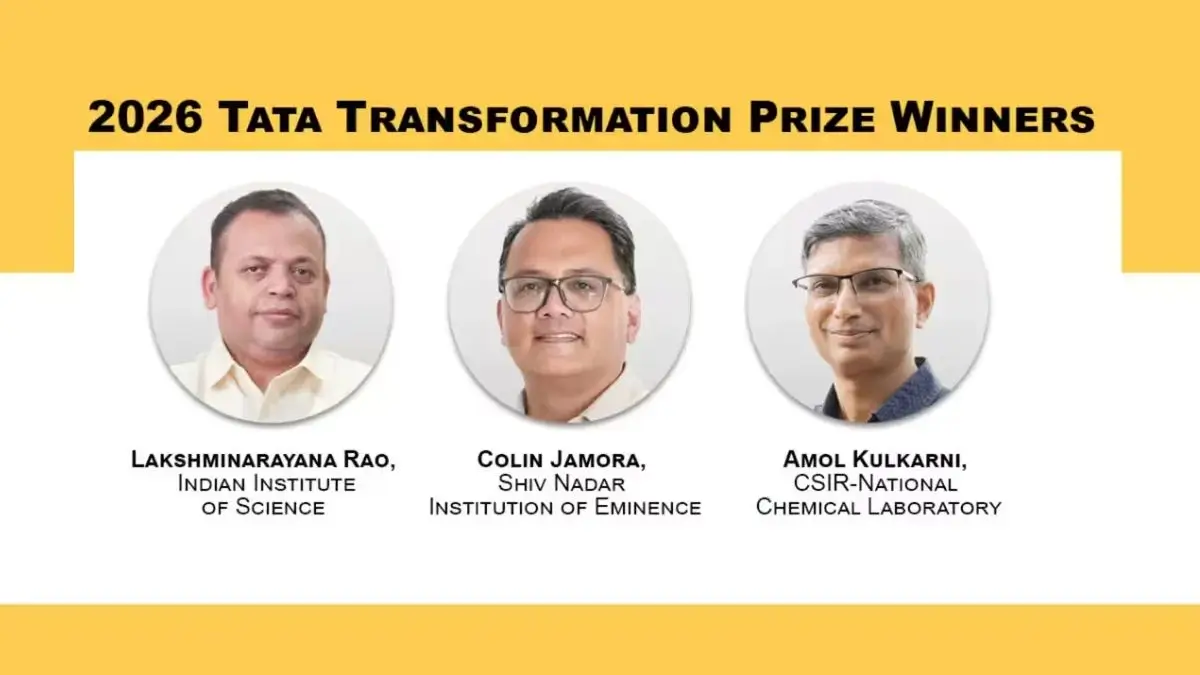
Three Indian scientists have been honoured by the 2026 Tata Transformation Prize for innovative scientific work which can help in areas such as food security, sustainability and healthcare. On 23 November 2026, the New York Academy of Sciences and Tata Sons announced the recipients: Lakshminarayana Rao, Amol Kulkarni and Colin Jamora. Each of them will be awarded a prize of ₹2 crore to continue their research and to facilitate the implementation of their innovations. A total of 217 nominations were received from 19 different Indian states.
Tata Transformation Prize 2026: Key Highlights
- Name: Tata Transformation Prize
- Year: 2026
- Announced On: 23 November 2026
- Announced By: New York Academy of Sciences and Tata Sons
- Number Of Winners: 3
- Areas Of Study: Food Security, Sustainability and Healthcare
- Prize Amount: ₹2 crore
- Total Nominations: 217
- States Involved: 19
- Venue Of Ceremony: Mumbai
- Date Of Ceremony: December 2026
- Chairman Of Tata Sons: N. Chandrasekaran
Tata Transformation Prize 2026 Winners
The three recipients were honoured for their potentially applicable scientific work which relates to agriculture, industry and medicine.
| Area of Study | Winner | Organisation | Innovation |
| Food Security | Lakshminarayana Rao | Indian Institute of Science (IISc) | Plasma-activated water as a sustainable substitute for nitrogen fertiliser |
| Sustainability | Amol Kulkarni | CSIR-National Chemical Laboratory | Screw reactor-based, solvent-less techniques for synthesising dyes, zeolites and medicines |
| Healthcare | Colin Jamora | Shiv Nadar Institution of Eminence | Stem cell research on hair follicles for the treatment of diabetic foot ulcers |
Information Regarding Innovations by the Recipients
1. “Lakshminarayana Rao (IISc): Food Security Winner”
Organisation: Indian Institute of Science (IISc)
Lakshminarayana Rao was honoured for his innovation of plasma-activated water (PAW), which acts as a sustainable alternative to standard nitrogen fertiliser.
PAW is water which has been treated with plasma so that it contains reactive species of oxygen and nitrogen. This could therefore be utilised within agriculture, for example to increase the bioavailability of nutrients and to encourage sustainable farming.
Key facts,
- PAW consists of reactive oxygen and nitrogen species.
- Compared to untreated water, it tends to have a reduced pH and increased electrical conductivity.
- Water is treated with plasma (which may be ‘cold’ atmospheric plasma) to generate PAW.
2. “Amol Kulkarni CSIR-National Chemical Laboratory: Sustainability Winner”
Organisation: CSIR-National Chemical Laboratory
Amol Kulkarni was honoured for his innovation of solvent-less synthesis of dyes, zeolites and medicines, using screw reactors.
This research is designed to improve the environmental impact of chemical manufacture by minimising (or even avoiding) the use of traditional solvents in specific chemical manufacturing routes.
Key facts,
- Screw reactors are employed for both mixing and continuous processing.
- Solvent-less techniques can help to minimise solvent use and therefore reduce solvent-related waste.
- This research can be applicable to both the chemical and medicine industries.
3. “Colin Jamora Shiv Nadar Institution of Eminence: Healthcare Winner”
Organisation: Shiv Nadar Institution of Eminence
Colin Jamora was honoured for his research on the use of stem cells derived from hair follicles in the treatment of diabetic foot ulcers.
People with diabetes can suffer from chronic diabetic foot ulcers. These can then give rise to severe secondary issues. Stem cells derived from hair follicles have the capacity to regenerate and are currently being studied for their potential involvement in both skin regeneration and wound repair.
Key facts,
- Hair follicle stem cells are present in specific areas of the hair follicle for instance, the bulge region of the outer root sheath.
- These cells are involved in the regeneration of hair follicles.
- They are also involved in skin regeneration and wound repair.
Prize Money And Selection
Each recipient will be granted a prize of ₹2 crore, to allow continued research and to assist in the implementation of innovations.
A global judging panel identified the 3 recipients from the 217 nominations originating from 19 Indian states. Priority is given to research which can utilise science to help resolve critical issues.
The awards ceremony will be held in Mumbai in December 2026.
About Tata Transformation Prize
The Tata Transformation Prize is given to Indian scientists whose scientific research has the potential to help overcome key issues. It is linked to both the New York Academy of Sciences and Tata Sons.
It encourages research and innovation in fields which can further India’s development, such as food security, sustainability and healthcare.







 Children's Booker Prize 2027 Shortlist: ...
 Global Peace Honours 2026: Divyaj Founda...
 Pooja Pal Develops Low-Cost Dust-Free Th...