
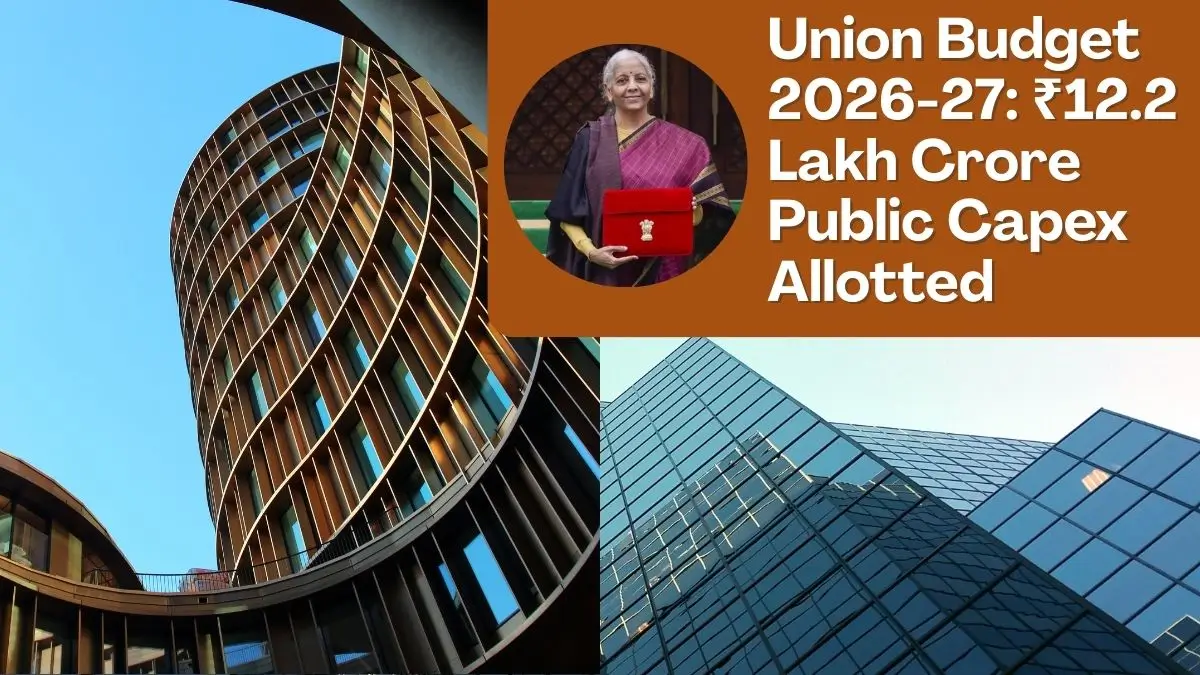
The Union Budget 2026-27 has sent a strong signal that infrastructure-led growth remains India’s core economic strategy. Presented in Parliament, the Budget proposes a record ₹12.2 lakh crore public capital expenditure, underlining the government’s commitment to productivity, competitiveness and resilience. From high-speed rail corridors and freight connectivity to green cargo movement and carbon capture, the announcements aim to crowd in private investment while preparing India for long-term sustainable growth. This makes the Budget crucial for exam-oriented current affairs.
₹12.2 Lakh Crore Public Capex
- Public capital expenditure has risen sharply over the last decade, increasing from ₹2 lakh crore in FY2014-15 to ₹11.2 lakh crore in FY2025-26.
- For FY2026-27, the government has proposed ₹12.2 lakh crore, signalling continuity in infrastructure-led growth.
- This sustained capex is intended to boost private investment, improve logistics efficiency, and enhance economic resilience.
- The Budget also emphasised innovative financing tools like REITs and InVITs, and proposed setting up dedicated REITs for CPSE real estate assets to accelerate asset monetisation.
Infrastructure Risk Guarantee Fund
- To address concerns of private developers during the construction and early development phase, the Budget announced an Infrastructure Risk Guarantee Fund.
- This fund will provide partial credit guarantees to lenders, reducing perceived risks and lowering the cost of capital.
- By sharing risk with the private sector, the government aims to crowd in private investment in large infrastructure projects.
Green Cargo Movement: Freight Corridors and Waterways
- The Budget focuses strongly on environmentally sustainable cargo movement.
- A new Dedicated Freight Corridor connecting Dankuni (East) to Surat (West) has been proposed.
- Additionally, 20 new National Waterways will be operationalised over the next five years, beginning with NW-5 in Odisha linking mineral-rich regions to ports.
- The aim is to raise the share of inland waterways and coastal shipping from 6% to 12% by 2047, supported by a Coastal Cargo Promotion Scheme.
7 High-Speed Rail Corridors: Connecting Growth Centres
- To promote clean and efficient passenger transport, the Budget announced seven High-Speed Rail corridors acting as growth connectors.
- These include Mumbai–Pune, Pune–Hyderabad, Hyderabad–Bengaluru, Hyderabad–Chennai, Chennai–Bengaluru, Delhi–Varanasi, and Varanasi–Siliguri.
- These corridors aim to reduce travel time, decongest roads and airports, and support regional economic integration. For competitive exams, the routes and environmental angle are especially important.
Seaplane VGF Scheme: Boosting Connectivity and Tourism
- To improve last-mile and remote connectivity, the Budget proposed a Seaplane Viability Gap Funding (VGF) Scheme.
- The scheme will incentivize indigenous manufacturing of seaplanes and support their operations.
- This is expected to boost tourism, island connectivity, and regional access, while aligning with the Make in India initiative.
- It also reflects the government’s push to integrate aviation and infrastructure development.
CCUS and City Economic Regions
- Aligning with India’s climate roadmap, the Budget proposed ₹20,000 crore over five years for Carbon Capture, Utilisation and Storage (CCUS) across power, steel, cement, refineries and chemicals.
- In urban development, City Economic Regions (CERs) will be mapped in Tier II, Tier III cities and temple towns, with ₹5,000 crore per CER over five years to unlock agglomeration-driven growth and balanced regional development.
Question
Q1. What is the proposed public capital expenditure for FY2026-27?
A. ₹10.5 lakh crore
B. ₹11.2 lakh crore
C. ₹12.2 lakh crore
D. ₹13.5 lakh crore</p


 ECINet KYC Feature Explained: How Voters...
 BIRAC-BioNEST Incubation Centre Inaugura...
 E20 Petrol India 2026: Nationwide Rollou...











