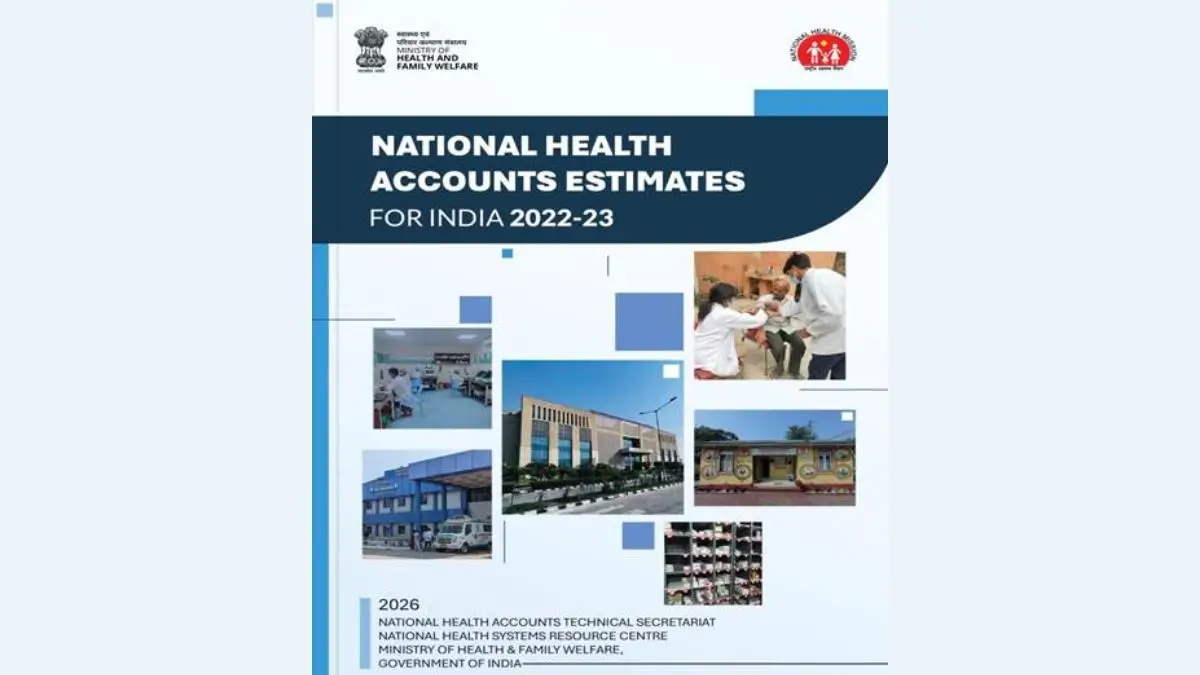
Union Health Ministry. released the National Health Accounts (NHA) Estimates for the year 2022-23 and it highlights the significant improvements in to the India’s healthcare financing system over the past 10 years. This report shows the steady rise in the government health expenditure and a reduction in out of pocket medical expenses for the citizens and stronger public investment in healthcare infrastructure and financial protection schemes.
What is the National Health Accounts (NHA) Report?
The National Health Accounts (NHA) report provides the estimates of healthcare expenditure in India.
It tracks the,
- Government health spending
- Private healthcare expenditure
- Household medical spending
- Insurance coverage
- Social security healthcare spending
The report is prepared by the,
- National Health Accounts Technical Secretariat (NHATS)
- Under the National Health Systems Resource Centre (NHSRC)
- Ministry of Health and Family Welfare
The estimates reports formally accepts the System of Health Accounts (SHA) 2011 framework.
This 2022-23 report is the 10th NHA report released by the India.
Government Health Expenditure Increased Significantly
One of the major highlights of this report is the steady increase in Government Health Expenditure (GHE).
Key Growth Figures
GHE as % of GDP are,
- In year 2013-14: 1.15%
- In year 2022-23: 1.43%
- Under a new GDP base year (2022-23): 1.48%
GHE share in to the General Government Expenditure increased from 3.78% to 4.89%
This shows rising government prioritization of the healthcare spending.
Per Capita Health Spending Nearly Tripled
Government health spending per person has been grown significantly over the last decade.
Per Capita GHE,
- 2013-14: ₹1,042
- 2022-23: ₹2,786
This represents an increase of nearly to 2.7 times.
The rise signals the expanded healthcare program, infrastructure investment and welfare schemes.
Out-of-Pocket Expenditure Declined
The report also highlights a major decline in the Out-of-Pocket Expenditure (OOPE).
OOPE refers to those medical expenses directly paid by households.
Decline in OOPE
- 2013-14: 64.2% of the total health expenditure
- 2022-23: 43.4%
This decline showcases the improved public financing and better financial protection for the citizens.
And to reduce the OOPE has been one of the government’s major healthcare policy goals.
COVID-19 Pandemic Spending Impact
The report also highlights the increased public healthcare spending during the COVID-19 pandemic.
Key COVID Spending Figures
The government health expenditure rose to the 1.84% of GDP in the year 2021-22.
This included the,
- Emergency COVID Response Packages (ECRP-I & II)
- Mass vaccination program
- Pandemic management expenditure
Public Financing Share Increased
The share of the Government Health Expenditure in Total Health Expenditure has increased substantially.
GHE Share in THE
- 2013-14: 28.6%
- 2022-23: 43.7%
This reflects that the growing role of the public financing in India’s healthcare system.
It also indicates a progress towards the affordable and equitable healthcare access.
Social Security and Insurance Coverage Improved
The report also shows the increased spending on to the healthcare through social security systems.
Social Security Expenditure (SSE)
- 2013-14: 6%
- 2022-23: 9.9%
This includes the,
- Ayushman Bharat PM-JAY
- Government employee reimbursements
- Social health insurance programmes
Private Health Insurance Growth
Private health insurance share in the Total Health Expenditure increased from 3.4% to 9.2%.
And This indicates the,
- Rising health awareness
- Improved health-seeking behaviour
- Growing insurance penetration







 SC Verdict Upholds The Election Commissi...
 What Is SARTHAK-PDS? Key Features and Be...
 PM Modi Reviews ₹30,000 Crore Infrastr...