
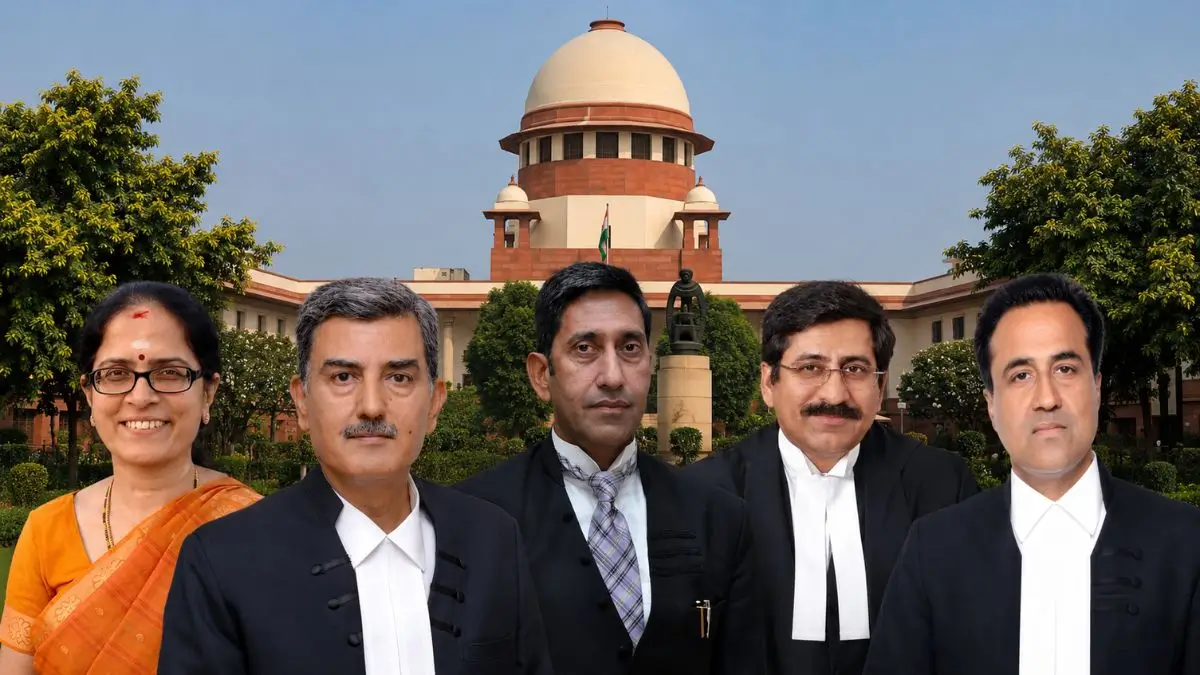
The Supreme Court Collegium led by the Respectable Chief Justice of India Surya Kant has recommended the appointment of the five new judges to the top court after the recent increase in the court’s sanctioned strength from 34 to 38 judges. This recommendations has included the four High Court Chief Justices and senior advocate V Mohana. V Mohana’s elevation is truly historic as she is set to become only the second woman directly appointed from the bar to the Supreme Court after Justice Indu Malhotra.
Supreme Court Judge Strength Increased to 38
Recently, the Honorable President has promulgated an ordinance to increasing the sanctioned strength of Supreme Court judges from 34 to 38 judges.
The move was aimed at addressing the,
- Rising case pendency
- Judicial workload
- Faster disposal of cases
Following this expansion, the collegium has recommended the five new appointments to fill the increased vacancies.
If it gets approved, the Supreme Court’s working strength will rise from 32 to 37 judges and leaving only one vacancy.
Who Are the Recommended Judges?
The collegium has recommended the following names,
- Justice Sheel Nagu
- Justice Shree Chandrashekhar
- Justice Sanjeev Sachdeva
- Justice Arun Palli
- Senior Advocate V Mohana
These recommendations were finalized after the extensive discussions within the collegium.
V Mohana’s Historic Elevation
Senior advocate V Mohana is set to create a history with her appointment as judge in top court.
She will become the second woman directly elevated from the bar to the Supreme Court
The first women was Justice Indu Malhotra.
About V Mohana
She comes from Coimbatore and a first-generation lawyer.
She became an Advocate-on-Record in the year 1996.
She also designated as Senior Advocate in 2015 and had over the 37 years of legal practice.
Her elevation is can be seen as the significant moment for the gender representation in the higher judiciary.
Justice Sheel Nagu
Justice Sheel Nagu is currently serving as the Chief Justice of the Punjab and Haryana High Court.
He appointed judge of Madhya Pradesh HC in the year 2011 and then became the Chief Justice of Punjab & Haryana HC in July 2024.
He was also member of inquiry panel related to Justice Yashwant Varma matter.
His retirement scheduled to 31 December 2029.
He is expected to have the tenure around three and a half years in the Supreme Court.
Justice Shree Chandrashekhar
Justice Shree Chandrashekhar, is currently the Chief Justice of Bombay High Court, has also been recommended to to court.
He earlier served on the Judges Inquiry Committee related to the Justice Yashwant Varma inquiry.
He will hold the office until 24th May, 2030.
Justice Sanjeev Sachdeva
Justice Sanjeev Sachdeva, who is currently Chief Justice of Madhya Pradesh High Court has been also elevated to the top court.
He is expected to have around 3.5 years of tenure in the Supreme Court.
Justice Arun Palli
CurrentChief Justice of Jammu & Kashmir and Ladakh High Court Justice Arun Palli has also been recommended.
He is expected to serve around 3 years and 4 months as Supreme Court judge..
Collegium Discussion and Selection Process
The recommendations reportedly followed with the intense discussions within the collegium.
The collegium currently comprises the,
- CJI Surya Kant
- Justice Vikram Nath
- Justice J.K. Maheshwari
- Justice B.V. Nagarathna
- Justice M.M. Sundresh
Some of the names were reportedly dropped after differences of opinion among members.
The final recommendations were approved after the consensus-building.
What is the Supreme Court Collegium System?
The collegium system is the mechanism through which the judges are appointed and transferred in the higher judiciary.
Composition
For the Supreme Court appointments, the collegium consists of the,
- Chief Justice of India
- Four senior-most Supreme Court judges
This system has been evolved with the multiple Supreme Court’s judgments and is not directly mentioned in the Constitution.








 Tukaram Mundhe Appointed Secretary of Co...
 Prakash Rajpurohit Appointed Deputy Elec...
 Press Council of India Reconstituted Wit...










