
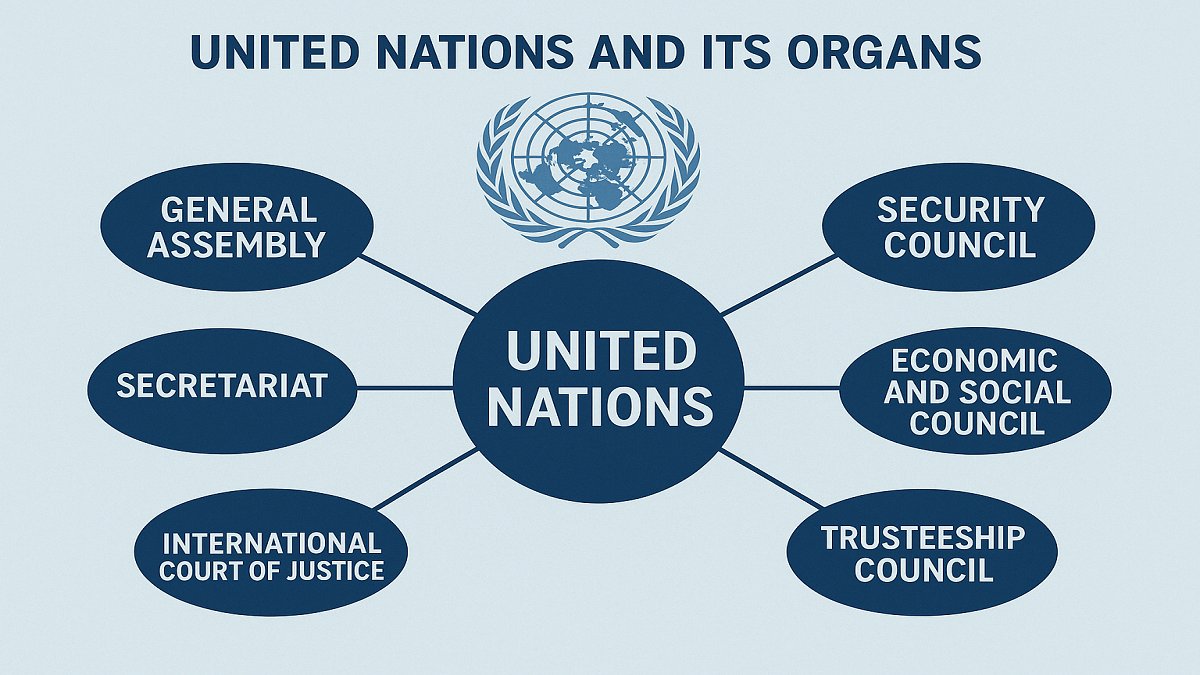
The United Nations (UN) was established on 24 October 1945, in the aftermath of World War II, with the goal of preventing future global conflicts. Its main objectives are to maintain international peace and security, promote friendly relations among nations, protect human rights, and support economic and social development. Today, the UN has 193 member states and functions as the most comprehensive platform for international cooperation.
The UN carries out its work through six principal organs, each with distinct roles and responsibilities.
Organs of the United Nations
1. General Assembly (GA)
-
Consists of all 193 member states, each having one vote.
-
Discusses global issues and makes recommendations.
-
Approves the UN budget and elects members to other organs.
-
Resolutions are not legally binding but have strong political and moral weight.
2. Security Council (UNSC)
-
Composed of 15 members: 5 permanent (USA, UK, Russia, China, France) and 10 non-permanent elected for 2 years.
-
Permanent members (P5) enjoy veto power.
-
Responsible for maintaining international peace and security.
-
Can impose sanctions, deploy peacekeeping forces, and authorize military action.
3. International Court of Justice (ICJ)
-
Headquarters: The Hague, Netherlands.
-
Composed of 15 judges elected for 9 years.
-
Settles legal disputes between states.
-
Provides advisory opinions on international law to UN organs and agencies.
4. Economic and Social Council (ECOSOC)
-
Has 54 members elected for 3 years.
-
Coordinates the UN’s economic, social, and humanitarian work.
-
Works closely with agencies like WHO, UNESCO, and UNICEF.
-
Plays a vital role in development, poverty eradication, and sustainable growth.
5. Trusteeship Council
-
Created to oversee trust territories and guide them toward self-government.
-
Became inactive in 1994 after Palau, the last trust territory, gained independence.
-
A symbol of the UN’s role in decolonization and self-determination.
6. The Secretariat
-
Administrative arm of the UN.
-
Headed by the Secretary-General (currently António Guterres).
-
Handles the day-to-day work of the UN, prepares reports, conducts research, and supports other organs.
-
Secretary-General acts as a global diplomat and spokesperson for peace and cooperation.


 Who is known as the Father of Mobile Pho...
 Which is the Highest Airport in the Worl...
 Which Country is the Largest Exporter of...











