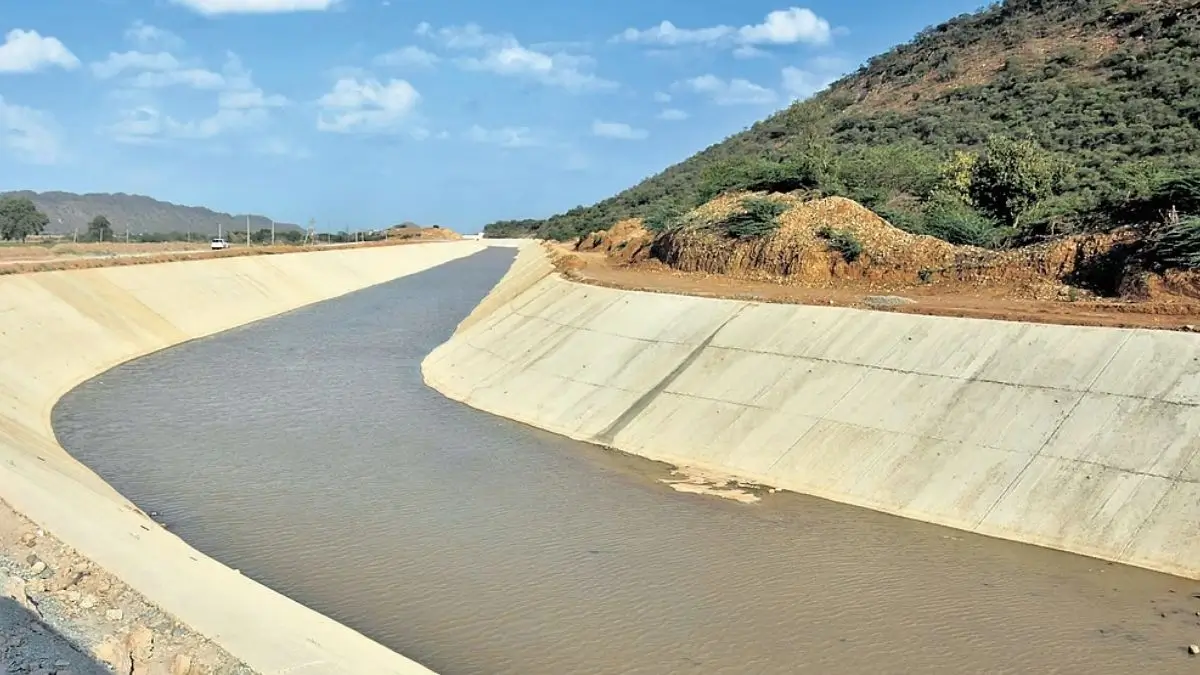
After almost thirty years of laying the first stone of the project, Chief Minister of Andhra Pradesh, N. Chandrababu Naidu, inaugurated Phase-I of the Pula Subbaiah Veligonda Project in Gottipadiya on August 31, this project set to be a landmark moment for the parched areas of Andhra Pradesh.
Naidu laid the first bhoomi puja of the project at Gottipadiya on March 5, 1996. The project is expected to have a significant impact on the irrigation and drinking water supply in parts of Prakasam, Nellore and Kadapa districts.
Pula Subbaiah Veligonda Project: A Gravity Water Scheme
According to the plan of the Pula Subbaiah Veligonda project, 43.50 TMC of excess flood water from Krishna river is supposed to be diverted from the foreshore area of Srisailam reservoir at Kollamvagu.
A special feature of the project is its gravity flow scheme. While lift irrigation schemes consume huge amounts of electricity for pumping water, in the case of Veligonda, it would flow naturally due to its location.
Water will move through two tunnels under the Nallamala hills.
Phase-I for Irrigation of 1.19 Lakh Acres
In Phase-I, about 10.70 TMC of water will get stored in the new Nallamala Sagar Reservoir.
The following benefits would accrue in Phase-I,
- Irrigation of around 1.19 lakh acres of agricultural land.
- Safe drinking water supply to about 4 lakh people.
- Beneath the drought affected areas in Western part of Prakasam, Nellore and Kadapa districts.
- Fluoride free drinking water to 1,657 habitations.
The project becomes very significant for those places that are facing problem of scarcity of underground water with presence of high level of fluoride.
Ayacut in Phase-II
With the completion of distribution network system in Phase-II, irrigation would reach out in nine Assembly constituencies.
The ayacut proposed comprises Yerragondapalem with 66,300 acres, Markapur with 82,900 acres, Giddalur with 59,100 acres, Kanigiri with 1,00,400 acres, Darsi with 23,000 acres, Kondepi with 4,400 acres, Udayagiri with 63,000 acres, At
Major Engineering Challenges
Some major engineering challenges faced during the implementation of the Veligonda project include construction of the 53.85 TMC Nallamala Sagar reservoir. This has been achieved through the closure of three natural mountain passes at Sunkesula, Gottipadiya, and Kakarla.
This is a total length of about 1.46 km and will require about 14.77 lakh cubic metres of concrete.
Intake structures have also been some of the major components of this project due to its huge size. Tunnel-I is about 18.82 km long, with a final diameter of 7 metres and a design capacity of 3,001 cusecs.
Tunnel-II is also 18.787 km long with a bigger diameter of 9.2 metres and a design capacity of 8,580 cusecs.
During the excavation process of Tunnel-I, there has been a difficult challenge of a soft fault zone which entombed the tunnel boring machine for about 16 months. The international tunnelling experts had to help solve this issue using an overhead bypass tunnel and resin and foam grouting.
Rehabilitation of Displaced People
Rehabilitation and resettlement of people has also been one of the focuses of this project.
According to Water Resources Minister Nimmala Ramanaidu, over ₹756 crore has been sanctioned from June 2024 for the compensation of more than 6,110 displaced families. The government has further stated that rehabilitation of the rest 1,115 displaced families has also been in progress.
The project involves the submergence of 11 villages.
1989 Concept to 2026 Milestone
The history of the project is an old one. The idea itself can be dated back to 1989, after reports were prepared by engineer Dr Kuditapudi Srirama Krishnaiah. However, the need for diversion of Krishna water into the drought-hit regions can be traced back to earlier times when former Markapuram MLA Poola Subbaiah spearheaded agitations in 1978.
After all the delays and construction difficulties, the project has finally come to a significant juncture. It is being reported that from June 2024 to August 2026, the state government spent ₹2,402 crore on pending rehabilitation issues, tunnel work completion and feeder canal lining.
Since the first phase is set for inauguration on August 31, the Veligonda project marks a long awaited initiative to increase irrigation facilities and agricultural production in several drought-prone districts of Andhra Pradesh.





 Lakshadweep Becomes India’s First 100%...
 Ayodhya Ram Temple Receives FSSAI’s â€...
 Ambaji Mohanthal Gets GI Tag: Gujarat’...