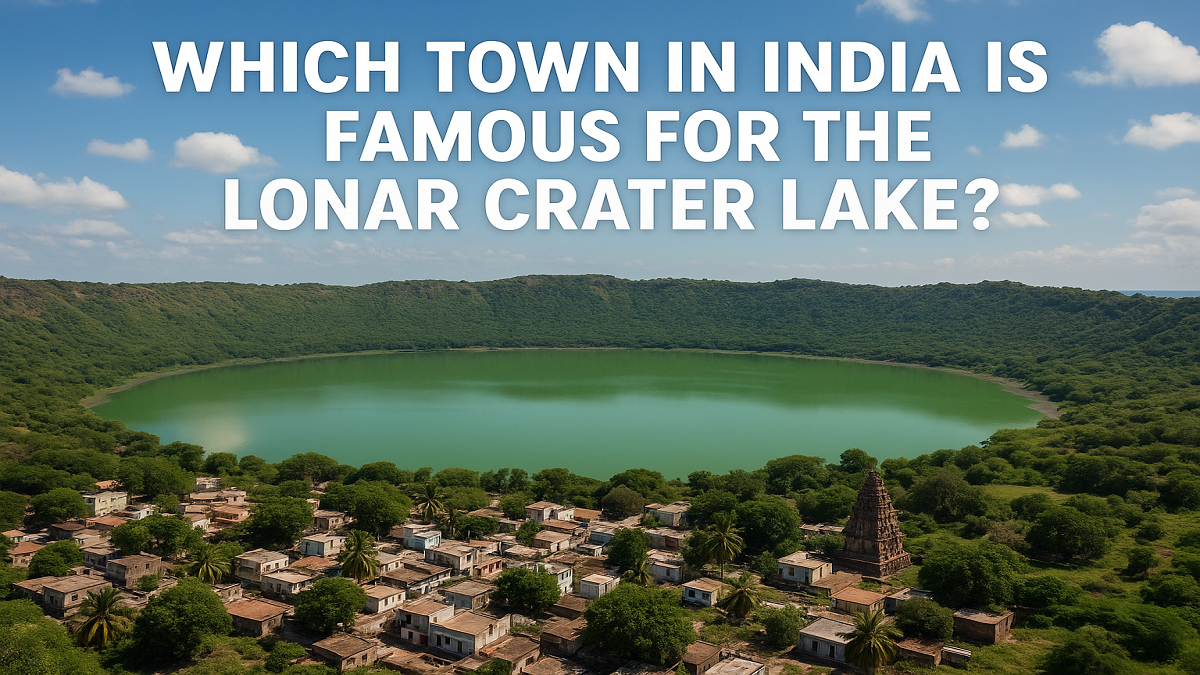
Lonar, a small town in the Buldhana district of Maharashtra, India, is renowned for Lonar Lake, a rare and scientifically significant meteoritic impact crater. The town’s surroundings blend geology, biodiversity, ancient temples, and ecological importance, making Lonar a vital topic for current‑affairs sections in competitive exams.
Historical and Cultural Context
Lonar’s heritage stretches through centuries. The Daityasudana Temple, attributed to the Chalukya dynasty, is built in the Hemadpanthi architectural style and honors Vishnu’s slaying of the demon Lonasura. Around the crater are other temples like Kamalaja Devi, Gomukha (Sita Nahani), Shankara Ganesha, and Motha Maruti—each rooted in local folklore and beliefs. This intertwining of geology and religion emphasizes why Lonar is not only scientifically fascinating but also culturally significant.
Geological Significance
Lonar Lake is one of only four hyper‑velocity impact craters in basaltic rock worldwide. Carved out of the Deccan Traps, the crater offers a rare terrestrial analog to lunar features. Its diameter is approximately 1.8 km, and depths range from 137 m to 150 m, with the rim rising sharply above the surrounding terrain. Although earlier estimates dated the impact to around 52,000 ± 6,000 years ago, more recent analyses suggest a much older age: 576,000 ± 47,000 years.
Ecological and Scientific Marvel
The lake’s water is both saline and alkaline, resulting in two distinct zones—one neutral and the other highly alkaline—with unique flora and fauna. The site hosts around 160 bird species, 46 reptiles, and 12 mammals, with the area protected as the Lonar Wildlife Sanctuary since 2008, spanning roughly 365 hectares. Significantly, the lake was designated a Ramsar wetland site in November 2020, reflecting its global ecological importance.
Extreme Microbial Life
Lonar Lake exhibits exceptional microbial diversity, including methanogens, methanotrophs, nitrogen‑fixers, phototrophs, sulfur‑cyclers, and others, adapted to its extreme conditions. In 2007, biological nitrogen fixation was confirmed in the lake ecosystem. A study at IIT Bombay revealed that minerals in the crater soil closely resemble those found in Moon rocks retrieved during the Apollo missions—highlighting Lonar’s relevance in planetary science.
Intriguing Phenomena: Color Change
In June 2020, Lonar Lake’s water turned pink/red within days due to reduced water levels and high salinity, which allowed halophilic bacteria like Halobacterium—with their carotenoid pigments—to flourish. This dramatic change captivated scientists and later turned into a valuable case study of microbial ecology and climate sensitivity.
Conservation Challenges
Lonar Lake faces multiple threats:
-
Agricultural runoff, household effluents, and pilgrimage activities cause pollution and disrupt water quality.
-
Deforestation, illegal grazing, and excavation degrade the ecosystem.
-
Unregulated tourism and religious festivities increase waste and disturb wildlife.
While the site is legally protected, conservation efforts require stronger implementation, public education, and consistent funding to preserve both its ecological and heritage value.
Why It Matters for Exams
Lonar touches on multiple spheres:
-
Geology: Only basaltic impact crater in India, age revision from ~50,000 to ~576,000 years.
-
Ecology: Ramsar site, rich biodiversity, unique microbes.
-
Cultural heritage: Ancient temples and mythology blend with natural wonder.
-
Science: Lunar analog, microbial extremophiles with nitrogen fixation.
These facts align with current affairs and geography‑based questions in competitive exams, especially under themes like natural heritage, scientific research, and environmental conservation.


 Which Hobby is known as the King of Hobb...
 Who is known as the Father of Mobile Pho...
 Which is the Highest Airport in the Worl...