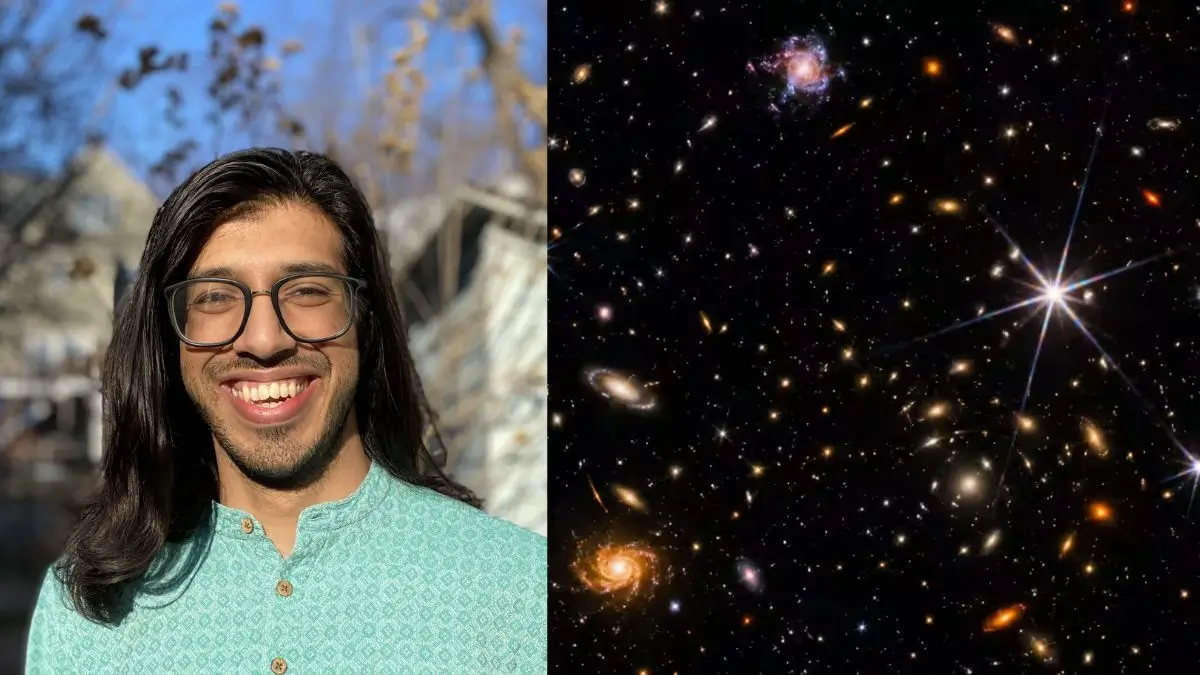
Indian-origin astronomer, Dr. Rohan Naidu, discovered a unique cosmic object that is known as “Black Hole Star.” This finding, which appeared in the journal Nature in the month of August 2026, may provide the vital information into how some of the earliest supermassive black holes formed and it grew rapidly in the universe.
This finding is also drawing light on how the unique career path of Naidu evolved. Unlike most Indian students, who go for a conventional engineering education, Naidu went with his heart by pursuing astronomy in various universities, such as Harvard and MIT, eventually becoming an Assistant Professor at the University of Hawaii.
Who Is Rohan Naidu?
Dr. Rohan Naidu is an Indian-origin astronomer who works on researching galaxies and the universe. His unique career path started with a unique decision in the year he was 18 years old.
When he was studying in an engineering college in Hyderabad, he decided to quit the course and follow his interests in physics and astronomy. In this pursuit, he moved to Singapore and joined the very first batch of Yale-NUS College.
Later, he pursued his academic path through Harvard University from where he obtained his PhD in astronomy. His studies involved looking at ancient galaxies that lie hidden in the Milky Way.
He was awarded NASA Hubble Fellowship and the Pappalardo Fellowship at MIT among other fellowships. He is an Assistant Professor at the University of Hawaii now.
What Is the Black Hole Star Discovery?
By using observations from the James Webb Space Telescope (JWST), Naidu and his research team examined an unusual object in the early universe. This object is called MoM-BH-1.
At first sight, scientists were sure that this was a giant red star. However, further studies show that this object cannot be described as a normal star.
Unlike usual stars like our Sun which produce energy because of nuclear fusion reactions, the energy production in MoM-BH-1 is supposed to happen due to a huge black hole located at the core of the object.
Scientists suggest that the mass of the black hole could be 100 thousand times bigger than the mass of our Sun. In addition, the object is surrounded by the dense hydrogen cloud, making it look like a huge star.
A Black Hole Hidden Inside a Star-Like Structure
The most amazing feature of the discovery is the incredible size of the object. In particular, the outer hydrogen layer of the object can be as wide as the Solar system.
Moreover, the scientists suggest that the luminosity of the discovered object is extremely high. It emits energy that is nearly 100 billion times more than the Sun.
Such unusual combination of a huge black hole surrounded by a hydrogen envelope gives astronomers the opportunity to find the answer to the question how such enormous black holes could form in the earliest epochs of the Universe.
How Does It Explain the Universe’s Little Red Dots?
By the use of the James Webb Space Telescope, the scientists discovered many unusual objects called “little red dots”. They were really bright and compact, which puzzled the scientists and made them think about the origin of such objects.
The discovery of the Black Hole Star could give scientists the answer to this question. The astronomers suggest that MoM-BH-1 represents an early stage of evolution of a massive black hole.
In case the theory is supported by other researches, this could explain the way in which some supermassive black holes became so huge so fast after the Big Bang.
Career Journey of Naidu
The career of Naidu is unusual not only due to his success but also due to the unusual path that he took towards becoming an astrophysicist.
Leaving the engineering college at the age of 18 years and going abroad was a major step, especially considering that at that point, he had no conventional academic path in astronomy.
Later on, studying in Yale-NUS College and Harvard, doing research in NASA and MIT, and finally getting a professorship in Hawaii made him take an unusual path in life.
His career shows that passion for a subject may lead to unexpected paths.








 NASA’s PUFFINS Mission: Indian-Origin ...
 ISRO Successfully Completes Crew Moduleâ...
 Elon Musk Shows Tesla Roadster Performin...