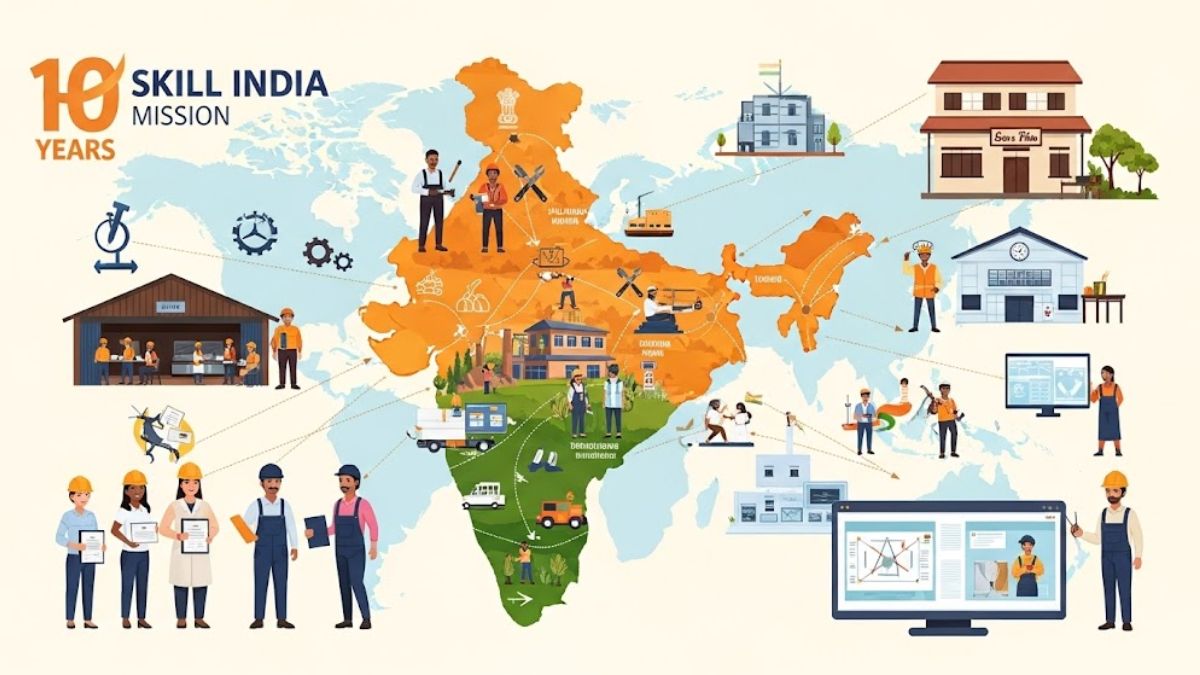
The Skill India Mission, launched on 15th July 2015, marked a pivotal step toward equipping India’s youth with job-relevant skills in a rapidly transforming economy. Aimed at transforming India into the “Skill Capital of the World”, the mission has now completed a decade, with several flagship schemes such as PMKVY, PM-NAPS, and JSS playing a central role. The initiative has trained over 6 crore individuals, driving progress in employability, entrepreneurship, and industry-readiness across traditional and emerging sectors.
Background
The need for a large-scale skilling program was triggered by India’s demographic dividend, where over 65% of the population is under 35 years of age. However, skill gaps across sectors and a low rate of formal skilling demanded strategic government intervention. The UNGA-declared World Youth Skills Day (15 July) became the launchpad for the Skill India Mission, which consolidated multiple schemes under the Ministry of Skill Development and Entrepreneurship (MSDE).
Significance
Skill India serves as a backbone for India’s economic transformation. It aims to meet industry demand, promote self-reliance, reduce unemployment, and foster inclusion. By training individuals in AI, robotics, green energy, and Industry 4.0 technologies, it ensures future-readiness. The Mission has direct implications on national programs like Digital India, Make in India, and Atmanirbhar Bharat, aligning workforce capabilities with strategic goals.
Objectives
- Provide industry-aligned, short-term and long-term training to youth.
- Foster entrepreneurship and apprenticeship through structured programs.
- Ensure recognition of prior learning (RPL) and certification.
- Promote inclusive skilling for marginalized communities including school dropouts and women.
- Strengthen linkages with employment opportunities and digital governance frameworks.
Key Features
- Unified structure with integration of PMKVY 4.0, PM-NAPS, and JSS under one Central Sector Scheme (2022–26).
- All certifications aligned with National Skills Qualification Framework (NSQF) and integrated with DigiLocker and the National Credit Framework (NCrF).
- Use of Skill India Digital Hub (SIDH) for monitoring, tracking outcomes, and enabling Aadhaar-based skilling verification.
- Sector-specific training in manufacturing, healthcare, IT, green jobs, and traditional crafts.
- Establishment of Centres of Excellence at NSTIs (e.g., Hyderabad and Chennai) for cutting-edge skilling in AI and robotics.
Major Initiatives and Achievements
1. Pradhan Mantri Kaushal Vikas Yojana (PMKVY)
- Trained over 1.63 crore individuals in 10 years.
- Four phases completed with focus on short-term skilling, Covid-19 warriors, and integration with Green Hydrogen Mission and PM Vishwakarma.
2. Jan Shikshan Sansthan (JSS) Scheme
- Community-based program for non-literates and school dropouts.
- Over 26 lakh individuals trained between FY 2018–24.
3. PM National Apprenticeship Promotion Scheme (PM-NAPS)
- Offers 25% DBT-based stipend support.
- Over 43.47 lakh apprentices engaged till May 2025.
4. RSETIs and DDU-GKY
- RSETIs: Over 5.67 million rural youth trained in entrepreneurship.
- DDU-GKY: Ensures wage employment for rural youth under NRLM.
5. PM Vishwakarma Yojana
- Launched in 2023 to support traditional artisans with tools, digital payments, and credit.
Emerging Focus Areas
- AI and Digital Skills: 2025 theme emphasizes future-ready learning.
- Green Jobs: Integration with national environmental goals.
- Micro-Credentials and Credit Portability: Via NCrF and ULLAS.
- Public-Private Partnerships: Encouraging industry-academia collaboration.


 Ministry of Textiles Extends RoSCTL Sche...
 Delhi Government Launches the Lakhpati B...
 What Is Amrit Bharat Station Scheme? Gov...