

Why the Scheme is in News?
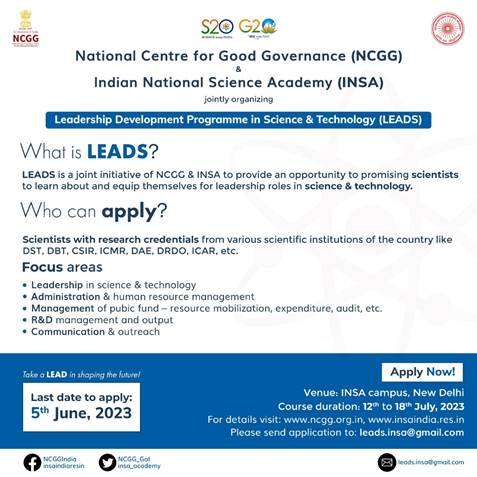
In order to achieve Prime Minister Shri Narendra Modi’s vision for scientific and technological progress in India by 2047, the National Centre for Good Governance (NCGG) and the Indian National Science Academy (INSA) have collaborated to introduce the ‘NCGG – INSA Leadership Programme in Science & Technology (LEADS).
Buy Prime Test Series for all Banking, SSC, Insurance & other exams
Introduction
Leadership Programme in Science & Technology (LEADS) program aims to support and enhance the scientific leaders’ ability to effectively lead and adapt to the constantly changing field of science and technology. It acknowledges the crucial role that scientific leadership plays in driving scientific advancements and provides them with the necessary tools and skills for success.
About Leadership Programme in Science & Technology (LEADS)
The Amrit Kaal of Independence is a significant milestone in India’s scientific journey, representing the country’s strong commitment to fostering excellence. Prime Minister Shri Narendra Modi has played a crucial role in creating an environment that promotes innovation and empowers scientists, recognizing their exceptional potential. This approach reflects his unwavering belief in the transformative power of scientific research and technology to drive India’s progress.
Leadership Development in Science & Technology (LEADS): Key Objectives
- India is actively pursuing ambitious initiatives in various fields, including space exploration, deep ocean exploration, supercomputing, semiconductors, hydrogen technology, and drone advancements.
- As these initiatives continue to grow, there is a need to empower scientists with essential leadership skills.
- To address this need, a leadership program in Science & Technology has been developed.
- This program aims to provide participants with a valuable experience and a deep understanding of emerging areas in the field.
- Over the course of seven days, scientists will be exposed to a wide range of subjects, including institution building, governance, research excellence, management, gender and diversity issues, scientometrics, recruitment and mentoring of scientific talent, industry collaboration, financial management, interpersonal relations, national requirements, resource generation, administration, digital governance, and more.
- The program will highlight the challenges that scientists may face in science and technology administration and equip them with the necessary skills to overcome these obstacles.
- Participants will learn effective team leadership, efficient resource management, and the development of comprehensive strategies to achieve organizational goals.
- Special attention will be given to building resilience to handle stress, fostering effective teamwork, and managing conflicts that may arise within organizations.
Leadership Development in Science & Technology: Importance
Scientific research and technological advancements require individuals who not only possess technical expertise but also demonstrate strong leadership capabilities. Leadership in the science and technology domain is essential for multiple reasons:
- Driving Innovation: Leaders in science and technology are responsible for driving innovation by identifying research opportunities, setting strategic goals, and creating an environment conducive to experimentation and creative thinking. They inspire and motivate their teams to push boundaries, explore new frontiers, and develop breakthrough solutions.
- Collaborative Endeavors: The complexities of modern scientific research often demand interdisciplinary collaboration. Leaders with the ability to build and nurture diverse teams, encourage effective communication, and facilitate collaboration across disciplines are critical for tackling complex scientific challenges.
- Resource Management: Science and technology projects often require substantial resources, including funding, equipment, and personnel. Effective leaders possess the skills to manage and optimize these resources, ensuring efficient utilization and maximum impact.
- Ethical Considerations: In an era of rapid technological advancements, leaders in science and technology must navigate ethical challenges. They should be equipped with the skills to make informed decisions, consider societal implications, and promote responsible scientific conduct.
Structure and Components of LEADS:
LEADS is designed to provide a comprehensive leadership development experience tailored specifically for individuals working in science and technology. The programme typically includes the following components:
- Leadership Training: LEADS offers a range of training modules and workshops that focus on developing essential leadership skills. These may include communication, team-building, strategic thinking, decision-making, and conflict resolution. Participants learn to adapt their leadership styles to different situations and cultivate the ability to motivate and inspire others.
- Mentoring and Coaching: LEADS often pairs participants with experienced mentors or coaches who provide guidance, support, and feedback throughout the programme. Mentors share their knowledge and experiences, help participants navigate challenges, and assist in their personal and professional growth.
- Exposure to Industry and Policy Makers: LEADS aims to broaden participants’ perspectives by providing exposure to industry leaders, policymakers, and influencers in the science and technology sector. This exposure allows participants to understand the broader context of their work, network with influential individuals, and gain insights into the challenges and opportunities in the field.
- Collaborative Projects: LEADS encourages participants to work on collaborative projects that address real-world scientific challenges. These projects foster teamwork, problem-solving skills, and the ability to lead multidisciplinary teams. Participants learn to navigate complex projects and develop innovative solutions.
- Networking and Community Building: LEADS fosters a strong sense of community among participants. Networking events, conferences, and forums provide opportunities to interact with fellow participants, alumni, and industry professionals. These interactions facilitate knowledge exchange, peer learning, and long-lasting professional relationships.
Benefits and Impact of LEADS:
Participation in LEADS offers numerous benefits and can have a profound impact on individuals, organizations, and the scientific community as a whole:
- Enhanced Leadership Skills: LEADS equips participants with the necessary skills to excel as leaders in the science and technology domain. They develop the ability to effectively communicate their ideas, build high-performing teams, and make strategic decisions that drive scientific progress.
- Increased Collaboration: LEADS fosters a collaborative mindset among participants. By working on interdisciplinary projects and engaging in networking opportunities, participants develop the skills and mindset necessary for effective collaboration. This collaborative spirit extends beyond the duration of the program, as participants often form long-lasting professional relationships and networks.
- Scientific Excellence: LEADS focuses on nurturing scientific excellence by providing participants with the tools, resources, and support needed to excel in their respective fields. Through mentorship, exposure to industry leaders, and collaborative projects, participants are encouraged to pursue groundbreaking research and contribute to scientific advancements.
- Leadership Pipeline: LEADS plays a crucial role in developing a strong leadership pipeline in the science and technology sector. By identifying and nurturing talented individuals, the program helps organizations and institutions cultivate a pool of competent leaders who can drive innovation, lead research initiatives, and shape the future of the industry.
- Impact on Organizations and Institutions: Organizations and institutions that invest in LEADS benefit from a more capable and effective workforce. The program not only enhances the leadership skills of individual participants but also creates a culture of leadership within the organization. This leads to improved decision-making, better resource management, increased innovation, and a more collaborative and productive work environment.
- Societal Impact: LEADS participants, equipped with strong leadership skills and a deep understanding of the societal implications of their work, are well-positioned to address global challenges and make a positive impact on society. They are more likely to consider ethical considerations, promote responsible research practices, and contribute to the advancement of science and technology for the betterment of humanity.
Leadership Development in Science & Technology (LEADS): Vision
- To translate Prime Minister Shri Narendra Modi‘s vision into reality, Dr. Jitendra Singh, Minister of State (MoS) for Science & Technology as well as Personnel, Public Grievances & Pensions, is actively collaborating with scientists, motivating them, and cultivating a supportive environment with research and development (R&D) institutions.
- Through these efforts, a more united and cooperative atmosphere has been nurtured, where scientific breakthroughs seamlessly integrate into policies and programs, leading to significant benefits for the people of India.
- Scheduled to commence on July 12th, 2023, the one-week fully residential program will be held at the esteemed INSA Campus in New Delhi.
- Scientists from renowned scientific institutions, including those under the Department of Science & Technology (DST), Department of Biotechnology (DBT), Council of Scientific & Industrial Research (CSIR), Indian Council of Medical Research (ICMR), Department of Atomic Energy (DAE), Defence Research & Development Organisation (DRDO), Indian Council of Agricultural Research (ICAR), as well as other laboratories and institutions, have been invited to participate.
The program aims to bring together scientists who have demonstrated promising research credentials and shown potential for leadership roles.
Also Read:
- Mission Karmayogi: Annual Capacity Building Plan by MoHFW
- NEP SAARTHI and NEP 2020: A Transformative Vision for India’s Education System
- Unlocking Financial Freedom: An Insight into the Liberalized Remittance Scheme (LRS)
- Pradhan Mantri Matsya Sampada Yojana: Revolutionizing India’s Fisheries and Aquaculture Sector
Find More News Related to Schemes & Committees










 World Iodine Deficiency Day 2026: Causes...
 Nigeria Reports Imported Case of Ebola B...
 DCGI Approves Zytorvi (Toripalimab) for ...










