
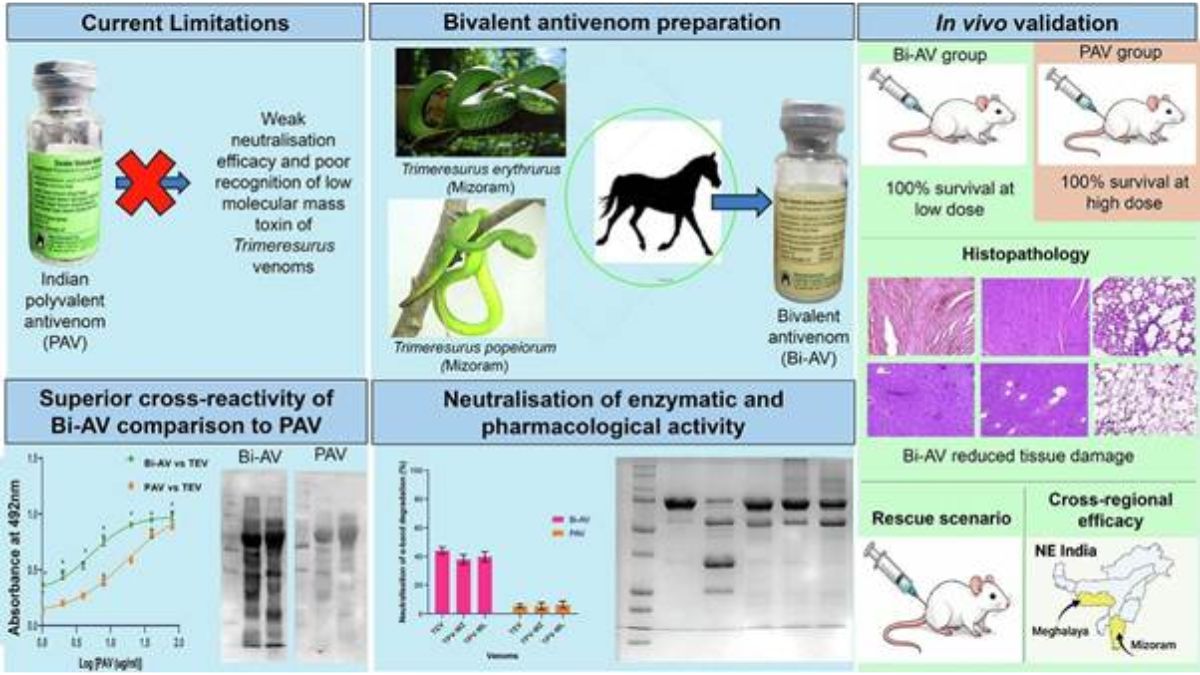
Scientists from the Institute of Advanced Study in Science and Technology (IASST), Guwahati, have produced a bi-valent antivenom for use in the northeast of India. This antivenom is effective against Pope’s pit viper (Trimeresurus popeiorum) and the red-tailed bamboo pit viper (Trimeresurus erythrurus). Laboratory and pre-clinical studies have demonstrated that this antivenom provides improved protection compared to the typical Indian polyvalent antivenom. Further clinical and regulatory evaluation is needed before it can be used in practice.
What has been developed for the Northeast?
Scientists have developed a horse-derived (equine) bi-valent F(ab) 2 antivenom which is effective at countering the venom of the two pit viper species.
Both species are,
- Pope’s pit viper (Trimeresurus popeiorum) – a venomous pit viper species which can be found in parts of Northeast India.
- Red-tailed bamboo pit viper (Trimeresurus erythrurus) – another important venomous pit viper species found in Northeast India.
Venoms were obtained from Mizoram and Meghalaya.
This development is important as current Indian polyvalent antivenom has been found to be relatively ineffective against several important venomous species present in Northeast India.
Why was a regional antivenom required?
Whilst India’s commercially available polyvalent antivenom is mainly effective against the so called ‘Big Four’ venomous snakes – Russell’s viper, spectacled cobra, common krait and saw-scaled viper – the Northeast region is home to a wide variety of venomous snakes.
In addition to this, there are pit viper species which are important from a medical perspective. Again, current antivenoms have been found to be relatively ineffective against the venoms of some of these species.
The ineffectiveness of antivenoms against pit viper venoms is one aspect of the snakebite issue in the Northeast. The newly developed antivenom aims to overcome this by being species specific.
Research Highlights
Pre-clinical and laboratory studies have shown that the new bi-valent antivenom is considerably more effective than the typical Indian polyvalent antivenom at countering envenomation by the two targeted pit viper species.
The study highlighted that the antivenom was effective at,
- Alleviating coagulopathy – Pit viper venom can affect a person’s blood coagulation. The antivenom was highly effective at countering this effect.
- Minimising localised tissue damage – The antivenom also proved effective at minimising localised damage resulting from envenomation.
- Reducing internal organ tissue damage – Furthermore, the antivenom was effective at countering organ tissue damage caused by venom.
These results emphasise the value of regional antivenoms in providing improved care for those envenomed by species not sufficiently addressed by current antivenoms.
Organisations and Scientists
This research was led by Prof. Ashis K. Mukherjee, Director of the Institute of Advanced Study in Science and Technology (IASST), Guwahati.
IASST is a self-governing institute which falls under the Department of Science and Technology (DST), Government of India.
Scientists from the following organisations worked together on this research,
- IASST, Guwahati
- Premium Serums and Vaccines Pvt. Ltd., Pune
- Amrita Research Center, Delhi-NCR
- Mizoram University
- Aaranyak, Guwahati
This illustrates how academic bodies, industry and research organisations can work together to develop regionally relevant healthcare provision.
What is equine F(ab) 2 bi-valent antivenom?
- Equine – Refers to horses. Horse antibodies are used in the production of this antivenom.
- F(ab) 2 – A section of an antibody which still has the capacity to bind to antigens.
- Bi-valent – Formulated to counteract venom from two particular snake species.
- Antivenom – A biological product which can counteract venom toxins.
This antivenom has been formulated to counteract the venoms of both Trimeresurus popeiorum and Trimeresurus erythrurus.
Snakebite – A Public Health Issue
The World Health Organization (WHO) classifies snakebite envenoming as a neglected tropical disease and identifies it as a medical emergency.
Snakebites can lead to severe health issues such as coagulopathy and localised and internal tissue damage. Prompt access to a suitable antivenom is therefore important in order to minimise the risk of such severe consequences.
As illustrated by the situation in Northeast India, antivenom development should take into account the various species of venomous snake present within a region.
Further Clinical Evaluation Required
Although encouraging pre-clinical and laboratory data has been obtained, currently the newly developed antivenom has not been formally recognised as a standard medical treatment.
Prof. Ashis K. Mukherjee explained that additional clinical and regulatory evaluation will be essential if the antivenom is to be formally implemented for standard medical use.
This research has been published in the International Journal of Biological Macromolecules. It emphasises the importance of formulating regionally relevant antivenoms which are specific to the important venomous snake species present in various regions of India.








 India Launches Indigenous Bird Flu Vacci...
 AI Kavach: IIT Kanpur and Bharat1.ai Lau...
 Voyager 1 Nears One Light-Day from Earth...