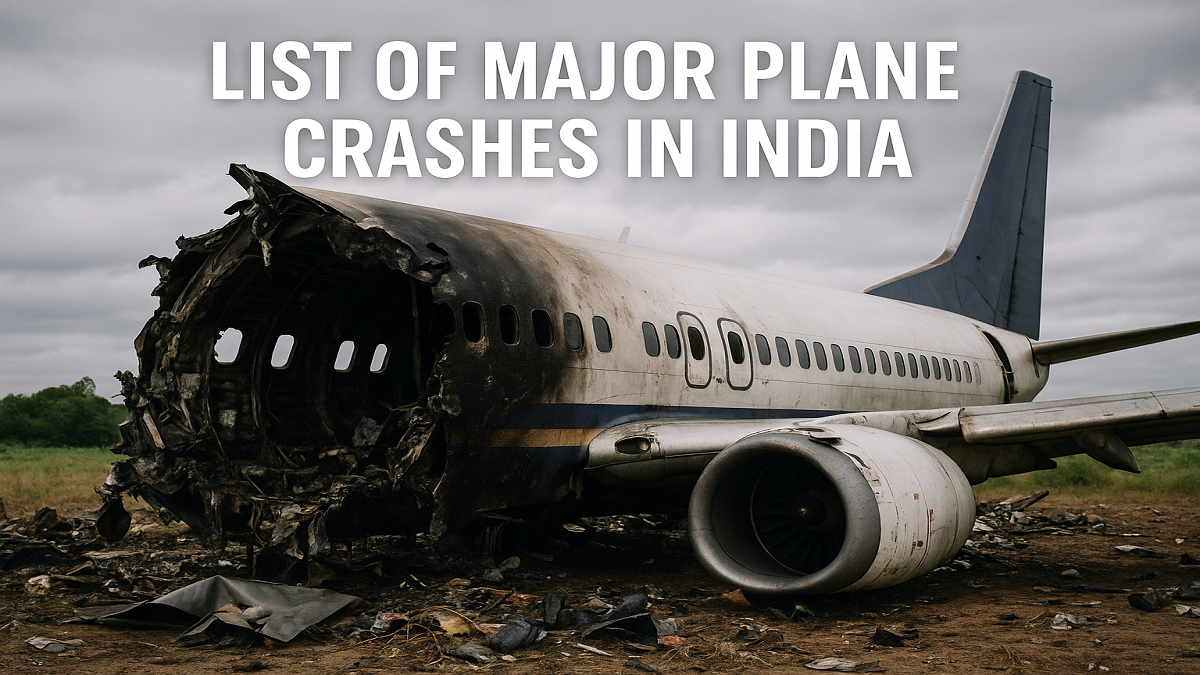
India, with one of the fastest-growing aviation industries in the world, has witnessed several tragic plane crashes over the decades. While air travel is statistically one of the safest modes of transportation, when disasters occur, they often leave a lasting impact on national memory and aviation safety protocols. This article presents a detailed look at the major aircraft accidents in India, examining their causes, consequences, and the transformations they triggered in aviation regulation and safety.
Understanding Aviation Accidents in India
Plane crashes in India have occurred under varied circumstances — from technical failures and pilot errors to severe weather conditions and runway overruns. Some of these incidents happened during the early years of aviation, while others took place in modern, highly regulated environments. Each crash not only resulted in tragic loss of life but also contributed to major overhauls in the aviation safety framework, airport infrastructure, and emergency response systems.
Timeline of Major Plane Crashes in India
Below is a chronological overview of significant aviation disasters in India, each highlighting different challenges in the evolution of the country’s aviation system.
Air India Flight 855 (1978) – Arabian Sea Tragedy
One of India’s earliest aviation tragedies occurred on January 1, 1978, when Air India Flight 855, a Boeing 747, crashed into the Arabian Sea shortly after takeoff from Mumbai (then Bombay). The aircraft was bound for Dubai but lost control due to instrument failure combined with pilot disorientation. All 213 people on board were killed. The accident shocked the nation and led to changes in instrument redundancy checks and pilot training procedures.
Indian Airlines Flight 605 (1990) – Bangalore Crash
On February 14, 1990, Indian Airlines Flight 605 crashed on its approach to Bangalore Airport. The Airbus A320 overshot the runway and landed short due to pilot misjudgment during final descent. The aircraft broke apart, resulting in 92 fatalities out of 146 passengers. This incident raised questions about A320 cockpit ergonomics and forced reevaluation of pilot competency standards for newer aircraft models.
Charkhi Dadri Mid-Air Collision (1996) – Deadliest in Indian Airspace
On November 12, 1996, one of the most catastrophic aviation incidents in Indian history occurred when a Saudi Arabian Airlines Boeing 747 collided mid-air with a Kazakhstan Airlines Ilyushin Il-76 near Charkhi Dadri, Haryana. A total of 349 people died in what became one of the world’s deadliest mid-air collisions. The cause was traced to communication failure and non-adherence to air traffic instructions. Following this, India implemented mandatory use of Traffic Collision Avoidance Systems (TCAS) in all aircraft.
Air India Express Flight 812 (2010) – Mangalore Runway Overrun
On May 22, 2010, Air India Express Flight 812, flying from Dubai to Mangalore, overshot the runway and plunged into a valley. The crash killed 158 of 166 people on board. The airport’s tabletop runway, combined with pilot fatigue and misjudged landing, were key contributors. This crash emphasized the need for stringent terrain-based landing protocols and led to improvements in airport safety infrastructure at high-risk locations.
Air India Express Flight 1344 (2020) – Kozhikode Crash
Another tragic crash involving a tabletop runway occurred on August 7, 2020, when Flight 1344 from Dubai skidded off the runway at Kozhikode Airport during heavy rain. The aircraft broke into pieces, killing 21 people, including both pilots. The incident highlighted ongoing concerns with weather-based landing protocols, runway extension, and emergency response timing at vulnerable airports.
Broader Impact and Regulatory Response
Each major aviation disaster in India has spurred a significant regulatory response. Agencies like the Directorate General of Civil Aviation (DGCA) have continually updated safety norms, enforced aircraft maintenance checks, and enhanced pilot training programs. Technologies such as Enhanced Ground Proximity Warning Systems (EGPWS), Runway Awareness Systems, and Automated Weather Reporting have been prioritized following recurring patterns of certain crash causes.
The Airports Authority of India (AAI) has also invested in better runway lighting, emergency firefighting infrastructure, and terrain awareness systems, particularly for airports in challenging geographic locations such as Mangalore and Kozhikode.








 India’s Classical Languages: 5 More La...
 Agasthyamalai Biosphere Reserve Records ...
 Vastra Utsav 2026 Celebrates India's Tex...