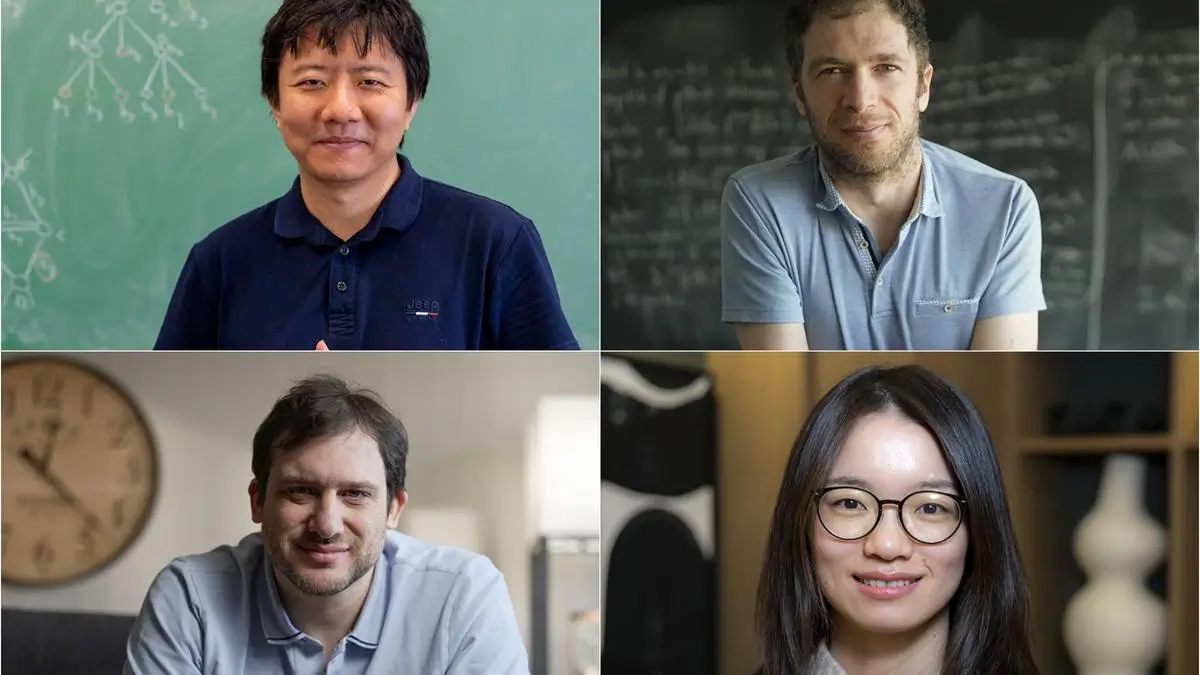
The Fields Medal 2026, regarded as the highest honour in mathematics, was awarded to Hong Wang, Yu Deng, John Pardon, and Jacob Tsimerman for their groundbreaking contributions to various branches of mathematics. The awards were presented at the International Congress of Mathematicians (ICM) 2026.
Among this year’s recipients, Hong Wang created history by becoming one of the first Chinese nationals to receive the prestigious award. Another Chinese mathematician, Yu Deng, was also among the winners, making it a rare occasion when two mathematicians from the same country were honoured in the same edition.
The Fields Medal recognizes outstanding mathematical achievements as well as the potential for future contributions, making it one of the most prestigious and selective awards in the scientific world.
What is the Fields Medal?
The Fields Medal is widely regarded as the “Nobel Prize of Mathematics.” It is awarded every four years to mathematicians who are under the age of 40 and have made exceptional contributions to mathematical research.
Unlike the Nobel Prize, the Fields Medal emphasizes both existing achievements and the promise of future discoveries.
Key Features
- Awarded every four years.
- Presented by the International Mathematical Union (IMU).
- Only mathematicians below 40 years of age are eligible.
- Recognizes outstanding research and future potential.
- Considered the world’s highest honour in mathematics.
Purpose of the Fields Medal
The Fields Medal is awarded to recognize:
- Outstanding mathematical achievements.
- Original and influential research contributions.
- Exceptional promise for future discoveries in mathematics.
The medals and cash prizes are funded through a trust established by J. C. Fields at the University of Toronto. For the 2026 edition, the prize fund was supplemented by support from the Fields Institute.
Fields Medal 2026 Winners
The 2026 Fields Medal was awarded to four distinguished mathematicians for their remarkable contributions across different branches of mathematics.
Hong Wang
Hong Wang received the Fields Medal for her pioneering work in harmonic analysis and geometric measure theory.
Her research includes:
- Applications of multiscale and decoupling techniques.
- Advances related to the local smoothing conjecture for the planar wave equation.
- Significant contributions to Fourier restriction theory.
- Research on Falconer distance sets.
- Work on Furstenberg sets in the plane.
- Major progress on the Kakeya problem in three dimensions.
Hong Wang also made history as one of the first Chinese nationals to receive the Fields Medal.
Yu Deng
Yu Deng was honoured for his outstanding work in partial differential equations (PDEs).
His major contributions include:
- Rigorous derivation of the Boltzmann equation from hard-sphere dynamics for rarefied gases.
- Derivation of wave kinetic equations from nonlinear dispersive systems.
- Development of probabilistic approaches to nonlinear Schrödinger dynamics.
His work has significantly advanced the mathematical understanding of complex physical systems.
John Pardon
John Pardon received the award for his exceptional contributions to symplectic geometry, topology, and geometric analysis.
His achievements include:
- New approaches to virtual fundamental cycles.
- Advances in Fukaya categories.
- Counting holomorphic curves.
- Contributions to group actions on three-dimensional manifolds.
- Important work in knot theory.
His research has influenced several areas of modern geometry and topology.
Jacob Tsimerman
Jacob Tsimerman was recognized for transforming o-minimality into a fundamental tool in arithmetic geometry and complex algebraic geometry.
His key achievements include:
- Major role in proving Griffiths’ Conjecture on the algebraicity of images of period maps.
- Contributions to the proof of the André–Oort Conjecture for Siegel modular varieties.
- Advancing modern number theory and algebraic geometry.
His work has solved several longstanding mathematical problems.
Why the Fields Medal Matters
The Fields Medal is considered the most prestigious recognition in mathematics because it honours researchers whose work has transformed the discipline and has the potential to influence future scientific discoveries.
Mathematical research recognized by the Fields Medal often finds applications in:
- Artificial Intelligence (AI)
- Cryptography
- Data Science
- Physics
- Engineering
- Economics
- Computer Science
Significance of the 2026 Awards
The 2026 Fields Medal highlighted major advances across several mathematical disciplines, including harmonic analysis, partial differential equations, symplectic geometry, topology, arithmetic geometry, and algebraic geometry.
The recognition of Hong Wang and Yu Deng also marks a historic milestone for China, reflecting the country’s growing influence in advanced mathematical research.








 Sangeet Natak Akademi Selects 106 Artist...
 Raji Doshi Wins 2026 3M Young Scientist ...
 Mizoram Farmer Mari ZT Lalrithangi Recei...