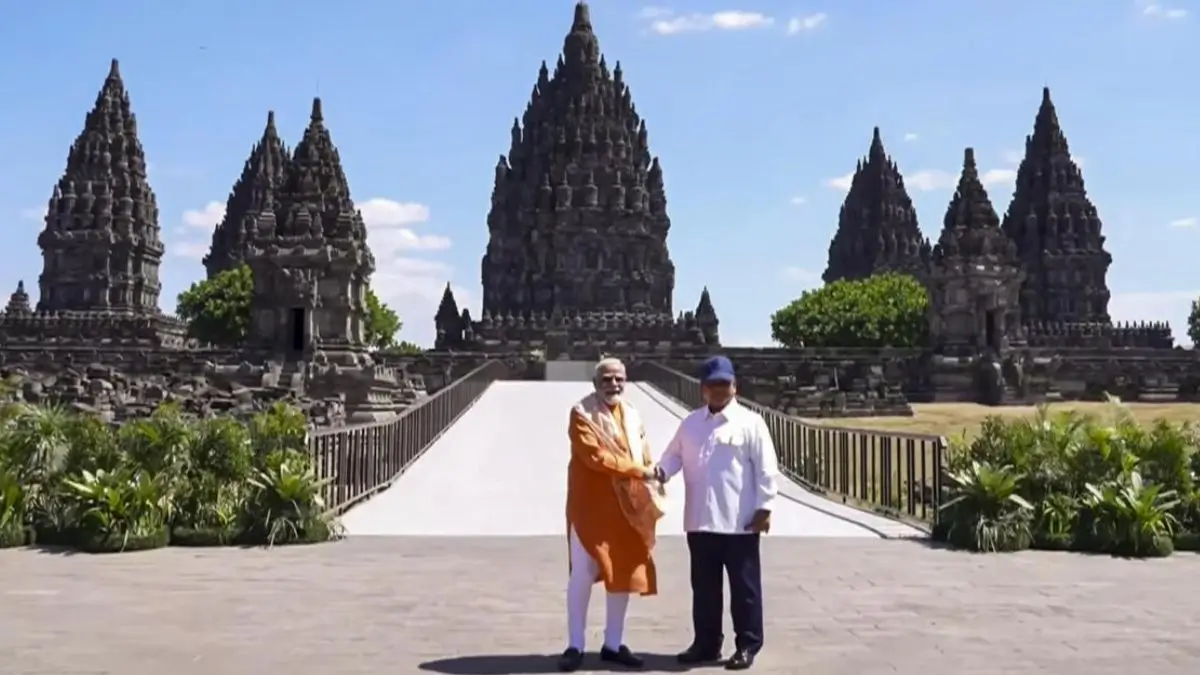
Honorable Prime Minister Narendra Modi paid visit to iconic Prambanan Temple Complex in Yogakarta, Indonesia on 8th of July, 2026, it reaffirms centuries old cultural and civilizational ties between India and Indonesia. Along with him, Indonesian President Prabowo Subianto accompanied the Indian Prime Minister during the visit, and both leaders unveiled a commemorative plaque which marks the commencement of the Archaeological Survey of India (ASI)’s conservation and restoration project.
PM Modi Visits the Historic Prambanan Temple Complex
Honorable PM Modi visited the Prambanan Temple Complex, it is Indonesia’s largest Hindu temple complex, and it is one of Southeast Asia’s most remarkable examples of Hindu architecture.
This visit was marked by the unveiling of a plaque, which launched the ASI-led conservation and restoration project at the UNESCO World Heritage Site.
This restoration initiative follows the understanding reached during the Honorable President Prabowo Subianto’s State Visit to India in the year 2025, when both countries agreed to explore India’s assistance into preserving the historic temples.
About Prambanan Temple
The Prambanan Temple Complex is located in the Sleman Regency, Yogyakarta, on the island of Java and it is the largest Hindu temple complex in Indonesia.
It was constructed during the 9th century by the Sanjaya Dynasty. This temple was built to honor the Hindu Trimurti,
- Lord Shiva
- Lord Vishnu
- Lord Brahma
which are the three principal deities of Hinduism.
This temple was locally known as the Roro Jonggrang or the Temple of the Slender Virgin, this complex remained buried and abandoned for centuries before begin rediscovered and gradually restored during the 19th century.
To recognize its its outstanding cultural and architectural value, UNESCO has designated Prambanan as a World Heritage Site in 1991.
Recognizing its outstanding cultural and architectural value, UNESCO designated Prambanan as a World Heritage Site in 1991.
Architectural Significance of Prambanan Temple
Many consider Borobudur Temple as the finest representation of classical Hindu architecture in the Southeast Asia. Its architecture reflects both native Javanese traditions and Indian architectural styles, thus depicting the historical ties between the Indian sub-continent and the islands of Indonesia.
This complex originally comprised around 240 complexes, the central sacred zone features eight principal temples and eight smaller shrines which were constructed on a raised platform.
The three main temples are dedicated to the,
- Lord Shiva
- Lord Vishnu
- Lord Brahma
Among all of them, the Shiva Temple is the largest and most important, it rising to approximately 47 meters, and it is one of the tallest Hindu temples in Southeast Asia and serves as the architectural centerpiece of this complex.
The wall of temple are richly decorated with intricate stone carvings and depict scenes from the Ramayana, along with various Hindu legends and mythological narratives which describe the exceptional craftsmanship of 9th-century artisans.
Interestingly, Prambanan is primarily a Hindu temple complex, but there are several Buddhist temples and shrines are located nearby, which reflects the religious harmony and cultural coexistence that characterized ancient Java.
ASI to Restore Shared Civilizational Heritage
The Archaeological Survey of India (ASI) will perform the conservation and restoration work at Prambanan and it is bringing extensive expertise in monument preservation to one of Southeast Asia’s most important heritage sites..
This initiative also symbolizes the civilizational links between India and Indonesia, where Hinduism, Buddhism, trade, art, and culture have flourished through centuries of maritime exchanges.








 Swachh Vayu Sarvekshan 2026: City Rankin...
 India Clarifies Stand on UN Map Resoluti...
 Centre Appoints 8 Chief Justices Across ...