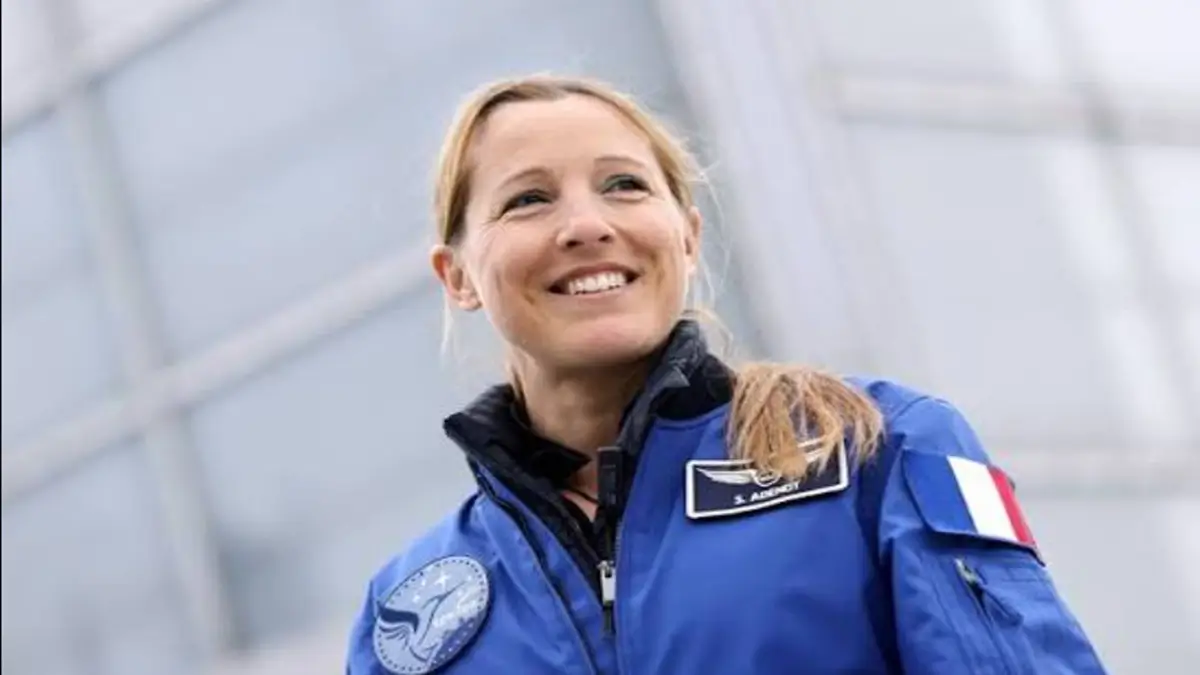
Sophie Adenot is a French engineer, helicopter test pilot, military officer and European Space Agency (ESA) astronaut who has recently made history in space exploration. On 18 August 2026, she became the first French woman to perform a spacewalk, stepping outside the International Space Station (ISS) alongside NASA astronaut Anil Menon.
Her journey to the ISS is notable not only because of her historic spacewalk, but also because of her background as an aerospace engineer, helicopter pilot and test pilot.
Who Is Sophie Adenot?
Sophie Adenot was born in France in 1982. She studied engineering at ISAE-SUPAERO in Toulouse, specialising in aircraft and spacecraft flight dynamics. She later earned a Master of Science in Human Factors Engineering from MIT in the United States.
Before becoming an astronaut, Adenot built an extensive career in aviation and the French Air and Space Force.
She became a helicopter pilot and later a helicopter test pilot, eventually becoming France’s first female helicopter test pilot in 2018. ESA says she has accumulated more than 3,000 hours of flight time on more than 22 types of helicopters.
Sophie Adenot’s Education
Her educational background includes:
- ISAE-SUPAERO, Toulouse – Aerospace engineering
- MIT, United States – Master of Science in Human Factors Engineering
- Empire Test Pilots’ School, UK – Test-pilot training
Her studies and professional experience gave her expertise in aerospace systems, flight operations and human performance—skills that later became important in her astronaut training.
Sophie Adenot’s Career Before Becoming an Astronaut
Adenot began her professional career in aerospace engineering and later joined the French Air Force in 2005.
She served in helicopter units involved in search-and-rescue and combat search-and-rescue missions. She later worked with the French government transport squadron before becoming a test pilot with France’s DGA, the country’s defence procurement and technology agency.
Her career gave her experience across engineering, military aviation, helicopter operations and flight testing.
She also holds military qualifications including a military parachuting certificate, along with licences for light aircraft and gliders.
When Did Sophie Adenot Become an ESA Astronaut?
Adenot was selected as a career astronaut by the European Space Agency in November 2022.
She was chosen as part of ESA’s 2022 astronaut class after a highly competitive selection process involving more than 22,500 valid applications from across Europe.
She began her basic astronaut training in April 2023 at the European Astronaut Centre in Cologne, Germany.
Her training included:
- Spacecraft systems
- Spacewalking
- Robotics
- Life-support systems
- Flight engineering
- Survival training
- Medical training
She received her official astronaut certification on 22 April 2024.
Sophie Adenot’s First Space Mission
In May 2024, ESA assigned Adenot to her first long-duration mission aboard the International Space Station.
She launched to the ISS on 13 February 2026 aboard a SpaceX Dragon spacecraft as part of the Crew-12 mission. The spacecraft docked with the ISS on 14 February 2026, officially beginning her εpsilon mission.
Her mission is planned as a long-duration stay aboard the ISS.
Adenot became the second French woman to travel to space, following French astronaut Claudie Haigneré, who became the first French woman in space in 1996.
Sophie Adenot Makes History With ISS Spacewalk
On 18 August 2026, Adenot achieved another major milestone.
She performed her first spacewalk outside the ISS with NASA astronaut Anil Menon.
The spacewalk lasted approximately 6 hours and 23 minutes. It was designated U.S. Spacewalk 97 and became the 282nd spacewalk supporting ISS assembly, maintenance and upgrades.
Adenot became the first French woman to conduct a spacewalk and the second European woman to do so, following Italy’s Samantha Cristoforetti.
What Did Sophie Adenot Do During the Spacewalk?
The primary objective was to work on a space-to-ground communication antenna mounted on the ISS’s Z1 truss.
The antenna is part of the station’s communications system and is used for high-speed communication and data transmission.
Adenot and Menon successfully removed the failed antenna and secured it. However, they did not have enough time to install the replacement because disconnecting electrical cables and loosening bolts took longer than expected.
NASA subsequently scheduled another spacewalk for 25 August 2026 to continue the antenna work.
Sophie Adenot’s Major Achievements
| Achievement | Details |
|---|---|
| ESA Astronaut | Selected in November 2022 |
| Engineer | Studied aerospace engineering at ISAE-SUPAERO |
| MIT Graduate | Master’s in Human Factors Engineering |
| Helicopter Test Pilot | Became France’s first female helicopter test pilot |
| Military Officer | Colonel in the French Air and Space Force |
| Flight Experience | 3,000+ hours on 22+ helicopter types |
| First Space Mission | Launched to ISS in February 2026 |
| Second French Woman in Space | After Claudie Haigneré |
| First French Woman to Spacewalk | Historic EVA on 18 August 2026 |
Awards and Recognition
Adenot’s achievements extend beyond aviation and spaceflight.
She was appointed a Knight of the National Order of Merit (Ordre national du Mérite) in 2022. She also received recognition from the French National Assembly for actions promoting gender equality in science.
Her achievements have made her an important role model for women pursuing careers in science, engineering, aviation and space exploration.
What Is Sophie Adenot’s Mission Called?
Adenot’s first ISS mission is called εpsilon (epsilon).
According to ESA, the name reflects the idea that small contributions can have a significant impact. The mission focuses on science and activities aboard the International Space Station during her long-duration stay.







 UNESCO World Heritage Sites of India - D...
 Siang Upper Multipurpose Project: Why Ar...
 Who Named Cyclone Arnab? Meaning and How...