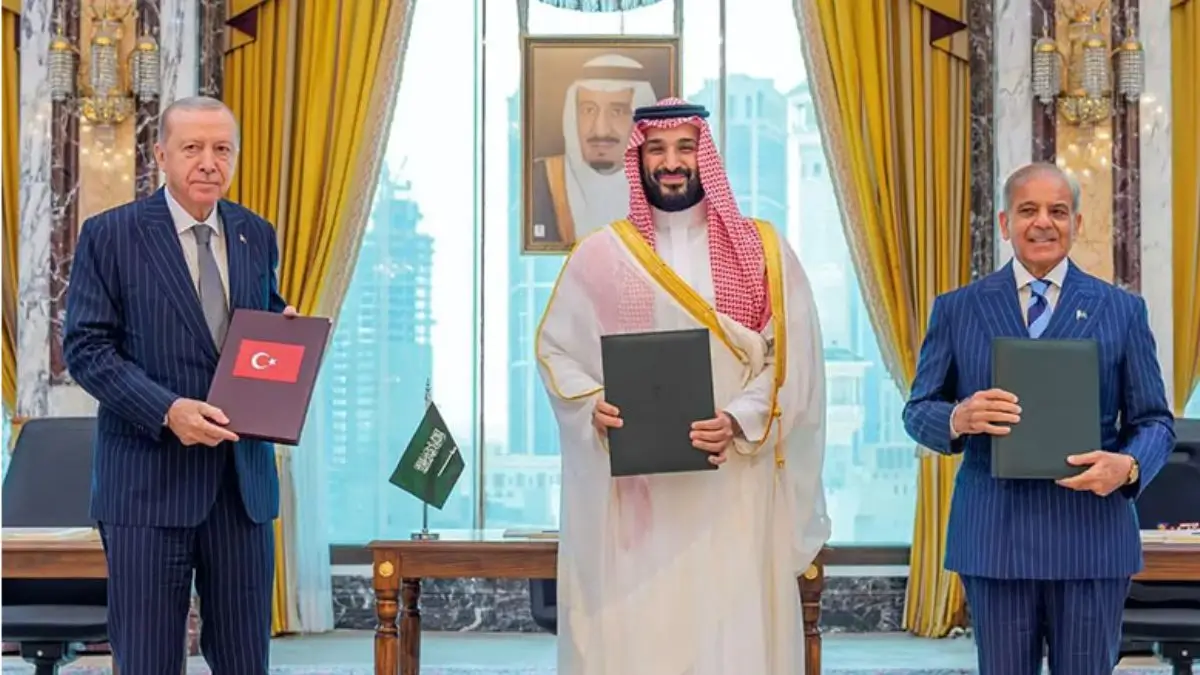
Saudi Arabia, Türkiye and Pakistan signed the Makkah Joint Defence Agreement (MJDA) at Al-Safa Palace in Makkah, Saudi Arabia. This development is an example of how the security dynamics of West Asia are developing. The agreement revolves around the principle of collective defence, which means that if one country suffers an armed attack, it will be considered an attack on all three countries.
It can be regarded as a new “triple alliance” or “Sunni security triangle,” and its purpose is to enhance military cooperation, collective deterrence and coordination of security in the region. In particular, the agreement emerged due to the growing tension in the region after the conflict in February 2026 between the US, Israel and Iran.
What is the Makkah Joint Defence Agreement?
The Makkah Joint Defence Agreement (MJDA) is a security cooperation agreement between Saudi Arabia, Türkiye and Pakistan. It develops from the Saudi-Pakistan Strategic Mutual Defence Agreement (SMDA) that was signed in September 2025.
Türkiye entered into the agreement in August 2026 and thereby transformed the bilateral framework into a trilateral framework. This agreement emerged during the period of increasing tension in the region because of the issues relating to Iran, regional proxy war and tension between Türkiye and Israel.
Thus, the agreement attempts to establish a collective security arrangement by merging the finances of Saudi Arabia, the defence industry of Türkiye and the military strength of Pakistan.
Key Features of the Makkah Joint Defence Agreement
Collective Defence and Deterrence
- The first key feature of the MJDA is the promise of collective defence. According to this feature, any armed aggression against one of the three members will be viewed as an attack against all three states.
- The mechanism bears certain resemblance to the mutual defence principle embodied in NATO’s Article 5. At the same time, at the moment, this agreement cannot be deemed an analogical treaty since the specifics of its operation and military obligations remain undefined.
Joint Military Coordination
- Military cooperation between the three countries will include such activities as joint military training and exercises, which will allow the armed forces of the states concerned to become more coordinated and ready for actions.
Intelligence Sharing
- The framework also envisages the creation of mechanisms for exchanging strategic intelligence and security information.
Why Did Saudi Arabia, Türkiye and Pakistan Form This Pact?
The treaty is a result of both regional insecurity and the new geopolitical considerations.
Strategic Independence Quest of Saudi Arabia
- Saudi Arabia has increasingly been seeking diversification of security relationships and lessening its dependence on the US security guarantees. Houthi attacks and regional instabilities, as well as critical points, like the Strait of Hormuz and Bab-el-Mandeb, have shown security weaknesses of Saudi Arabia.
- The security and protection of the Red Sea, Strait of Hormuz and Bab-el-Mandeb is vital for Saudi Arabia since disruption of those areas will endanger energy exports, trade routes, and maritime transportation, thus affecting its oil industry, economic projects and tourism.
Türkiye’s Regional Aspirations
- For the Turks, the evolving situation in Gaza and Syria, especially the increasing militarization of Israel, is an issue of security. Meanwhile, it wants to bolster its own strategic importance in West Asia as a major defence power in the region.
- This could also provide an opportunity for Türkiye’s burgeoning defence industry, specifically in sectors like drones, aerospace and defence exports.
Pakistan’s Strategic Interests
- With regard to Pakistan, the deal could enhance its strategic significance in West Asia, while consolidating its established relationship in terms of defence with the Saudis.
- Besides, Pakistan would gain from closer economic and energy relations with Saudi Arabia.
Background History: Past Efforts at Pan-Arab and Pan-Islamic Collective Security Arrangements
The MJDA is one among the attempts for establishing collective security arrangements including the Muslim-majority states.
In 1950, the Treaty of Joint Defense and Economic Cooperation among the States of the Arab League was established with a collective security mechanism based on Pan-Arabism and including a mutual-defence clause.
Political disputes and military uncooperation hampered the effective operation of this collective security treaty.
The 1955 Baghdad Pact, which was known as the Central Treaty Organization (CENTO) and included such states as Iraq, Türkiye, Pakistan, Iran and the United Kingdom, aimed at preventing Soviet influence in the Middle East.
As Iraq left the arrangement following a military coup of 1958, this arrangement came to be named as CENTO and was ultimately disbanded in 1979 with the Islamic Revolution in Iran.
Another example of the past efforts is the Peninsula Shield Force, which was founded by the Gulf Cooperation Council in 1984 during the Iran-Iraq War with the purpose of defending the Arabian Peninsula. Peninsula Shield Force was used in Bahrain in 2011.
Furthermore, the Islamic Military Counter Terrorism Coalition (IMCTC) was founded in 2015 under Saudi leadership and united more than 40 countries in cooperation against terrorism through military, financial, ideological and media aspects.
Implications for the India
This newly formed partnership may have significant strategic ramifications for India in light of its strong connection to the Gulf, Pakistan worries and broader Indian Ocean interests.
A Potentially Strengthened Pakistan-Türkiye-China Bloc?
- The enhanced security collaboration between Saudi Arabia, Pakistan and Türkiye may enhance the security network in proximity to India’s western strategic periphery considering the connections maintained by both Pakistan and Türkiye with China.
- The growing presence of Türkiye in the Gulf defense market could potentially increase competition for India’s developing defense sales, which include systems such as BrahMos and Akash.
Indian-Saudi Arabia Relations Could Be Tested Again
- Pakistan and Türkiye have traditionally been vocal in expressing anti-India stances on the Kashmir problem at international platforms like the UN and the Organisation of Islamic Cooperation.
- Any potential increase in Saudi-Pakistan’s security cooperation could potentially increase the diplomatic clout available to Pakistan. However, this doesn’t mean automatically that India-Saudi Arabia relations are going to suffer.
- India continues to be strategically valuable to Saudi Arabia as its significant consumer of energy, trading and investment partner and market. The relations are bolstered by India-Saudi Strategic Partnership Council and cooperation in energy, trade, investment, defense and technology.
Greater Activity in Western Indian Ocean
- It might be possible in the future for all three countries to increase their defense cooperation beyond West Asia into Western Indian Ocean, which could have strategic importance for India, considering its role in the region as a significant security provider.
Increased Uncertainty During India-Pakistan Conflict
- Does the collective-defence provision mean that in case of India-Pakistan conflict, Saudi Arabia and/or Türkiye would offer political and military assistance to Pakistan?
- There is uncertainty in answering the above question since there are no details about the operational responsibilities under the pact that have been made public yet.
Modernisation of Pakistan’s Military Forces
- Financing by Saudi Arabia, defensive technology provided by Turkey and expertise of Pakistan’s military forces might lead to faster modernisation of Pakistan’s military forces. Possible advancements in drone aircrafts, aircrafts and anti-aircraft defenses may have an effect on conventional military balance with India.
- Presence of nuclear capabilities in Pakistan is yet another element that might contribute to the strategic ambiguity. There is no publically acknowledged nuclear protection offered by Pakistan to Saudi Arabia.








 Mirza Fakhrul Alamgir Elected Bangladesh...
 Hunger Hotspots 2026: Which 13 Countries...
 What is SAVE America Act? Why US Preside...