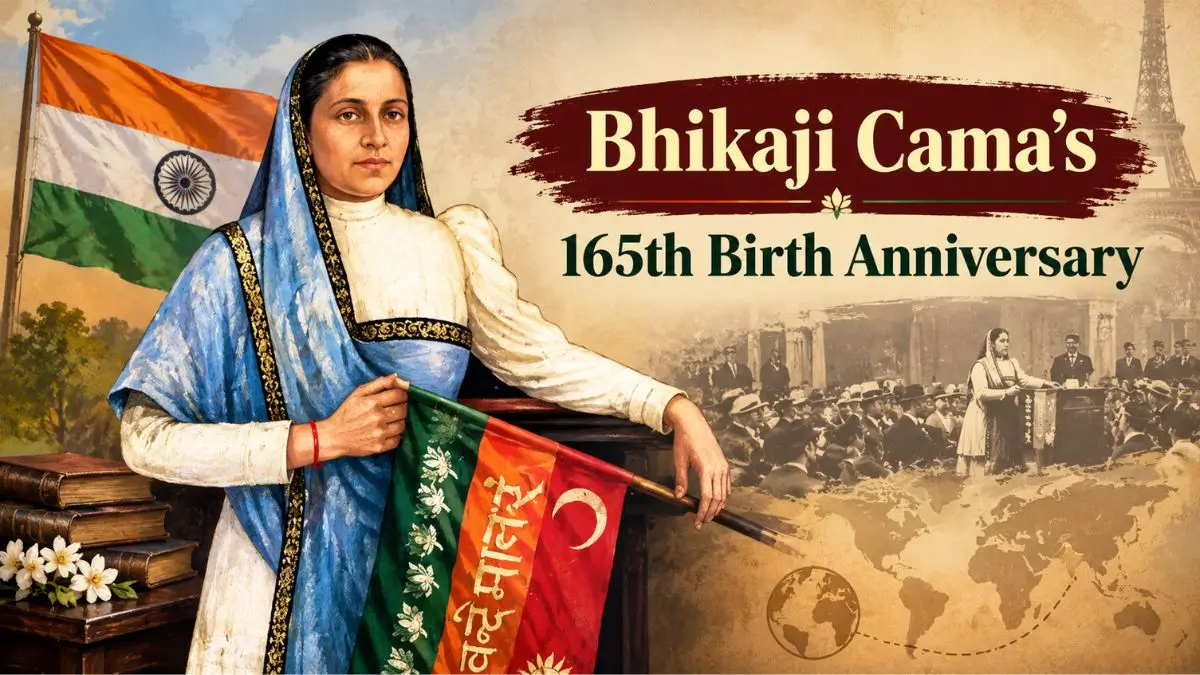
Bhikaji Cama, the Parsi nationalist known as the “Mother of the Indian Revolution”, was born on 24 September 1861 in Bombay. 24 September 2026 marks her 165th birth anniversary. She unfurled a tricolour of green, saffron and red at the International Socialist Congress in Stuttgart, Germany, on 22 August 1907. It was the first Indian national flag displayed on foreign soil. Working from London and later Paris, she supported Indian revolutionaries abroad until her death in Bombay on 13 August 1936.
Early Life and Marriage
Cama was born into a wealthy Parsi business family and educated at the Alexandra Girls’ English Institution in Bombay. She grew up as the nationalist movement was taking root. In 1885, she married Rustomji Cama, a well-known lawyer with pro-British views. Her political involvement caused differences between the couple.
In 1896, she worked among plague patients during the outbreak in Bombay and contracted the disease herself. Poor health and marital problems led her to leave for London around 1902.
London Years and Nationalist Contacts
In London, Cama met Dadabhai Naoroji, a strong critic of British economic policy in India, and began working for the Indian National Congress. She also came into contact with Vinayak Damodar Savarkar, Lala Har Dayal and Shyamji Krishnavarma. She addressed several meetings in Hyde Park.
The Stuttgart Flag of 1907
Madam Cama unfurled the flag at the Second Socialist International congress in the Stuttgart on 22nd August 1907. By raising it before an international audience, she drew attention to India’s demand for self-rule.
- Colours: green, saffron and red bands
- Symbols: eight lotuses on the green band, “Vande Mataram” on the central band, and a sun and crescent on the red band
- Reference point: it was inspired by the earlier Calcutta Flag of 1906
- Design association: Savarkar and Shyamji Krishnavarma are usually named alongside Cama in its design
Paris Indian Society and Revolutionary Publications
After Stuttgart, Cama went on a lecture tour to build opinion against British rule, especially among expatriate Indians. She also spoke for women’s rights. In 1909, amid rumours of deportation from England, she moved to Paris, where her home became a centre for those working for Indian independence.
- Paris Indian Society: co-founded in 1905 with S.R. Rana and Munchershah Burjorji Godrej. It supported exiled revolutionaries and circulated banned literature, including the poem “Vande Mataram”.
- Bande Mataram: she helped Har Dayal launch this revolutionary paper. Copies were smuggled into India.
- Madan’s Talwar (later The Talvar): a nationalist magazine brought out from Berlin in memory of the executed revolutionary Madan Lal Dhingra.
She kept contacts with Indian, Irish and Egyptian revolutionaries, and with French Socialists and Russian leaders. During World War I, after Britain and France became allies, French authorities interned her for three years for anti-British activity.
Return to India and Death
Cama was allowed to return to India in 1935, at the age of 75. She died in Bombay on 13 August 1936. Under her will, much of her estate went to the Avabai Petit Trust, which supports girls.
Static Facts Related to Bhikaji Cama
| Particular | Details |
| Born | 24 September 1861, Bombay |
| Died | 13 August 1936, Bombay |
| Known as | Madam Cama; “Mother of the Indian Revolution” |
| Spouse | Rustomji Cama (married 1885) |
| Flag unfurled | 22 August 1907, Stuttgart, Germany |
| Organisation co-founded | Paris Indian Society (1905) |
| Publications | Bande Mataram; Madan’s Talwar (The Talvar) |
| Postage stamp | India Post, 26 January 1962 |
Streets and institutions across India are named after her. Bhikaji Cama Place in New Delhi is one example.
Key Facts
- Bhikaji Cama’s 165th birth anniversary falls on 24 September 2026.
- She unfurled the first Indian national flag abroad at Stuttgart on 22 August 1907.
- The flag had green, saffron and red bands.
- She co-founded the Paris Indian Society in 1905.
- She moved to Paris in 1909 and was interned in France for three years during World War I.
- She returned to India in 1935 and died on 13 August 1936.








 World Maritime Day 2026: Theme, Date, Si...
 International Day of Sign Languages 2026...
 11th Ayurveda Day 2026: Theme, Significa...