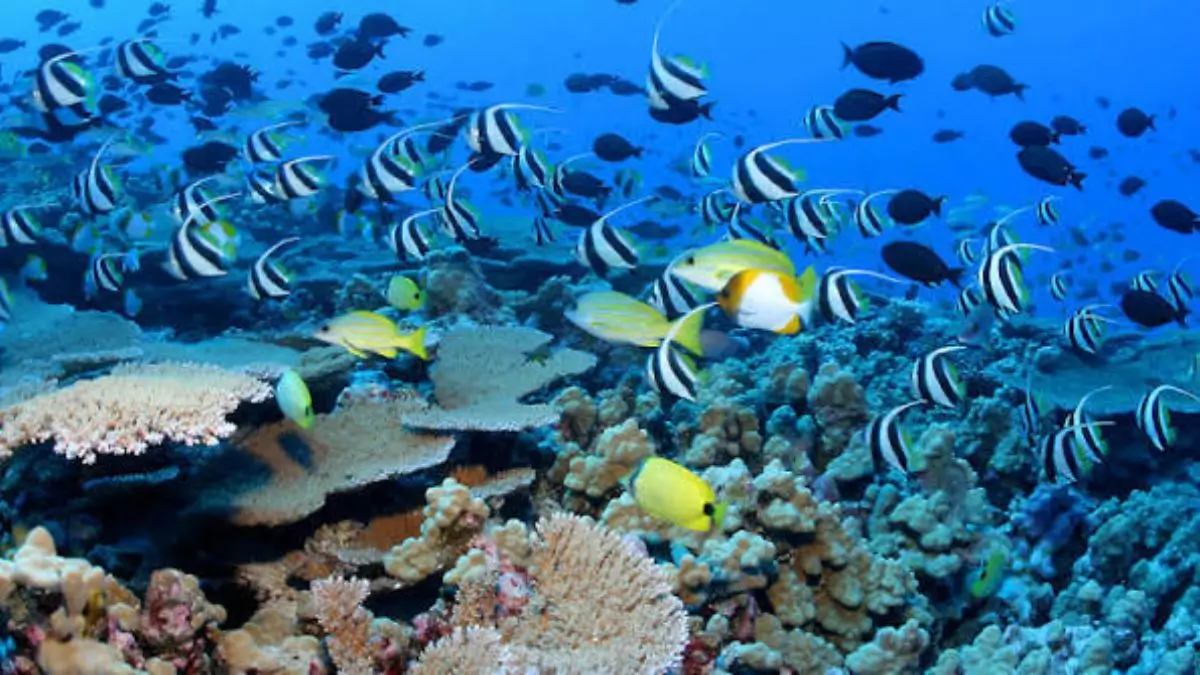
According to the International Union for Conservation of Nature (IUCN), almost all assessed shallow-water coral reef ecosystems are in danger of collapsing by 2075 due to an extremely high risk. The first global evaluation by the IUCN Red List of Ecosystems found that out of 127 ecosystems analyzed, 122, or 96% of them, were categorized as Critically Endangered. The report was launched on 22 October 2026 at CBD COP17 in Yerevan, Armenia, where climate-change-induced ocean warming and marine heatwaves are identified as the main threats.
IUCN Global Coral Reef Assessment Key Findings
The assessment was carried out in 127 tropical and subtropical marine ecoregions covering over 80 countries and territories, which is about 188,362 square kilometers of light and shallow coral reefs. More than 250 experts participated in the global assessment.
| Assessment finding | Key figure |
| Number of coral reef ecosystems assessed | 127 |
| Number of ecosystems categorized as Critically Endangered | 122 (96%) |
| Percentage of assessed reef ecosystem area made up of Critically Endangered ecosystems | 99.8% |
| Number of ecosystems currently classified as Collapsed | 1 |
| Number of ecosystems classified as Data Deficient | 4 |
| Number of ecosystems that have been categorized as Critically Endangered solely due to observed changes | 24% |
| Number of ecosystems under threat of future heat stress | 95 |
The global assessment includes significant reef ecosystems, including the Great Barrier Reef in Australia, the Coral Triangle in Southeast Asia and the Western Pacific, the Mesoamerican Barrier Reef System, and Red Sea reefs.
What Makes Coral Reefs Vulnerable?
1. Climatic Changes and Marine Heat Waves
Climate change poses the most significant risk for coral reefs. It leads to ocean warming that results in coral bleaching. Corals live symbiotically with tiny organisms called zooxanthellae that produce energy via photosynthesis.
Under conditions of excessive heat, corals get rid of their symbiotic partners and become completely white. Continued coral bleaching can lead to their deaths.
As per the IUCN report, 24% of assessed coral reef ecosystems were considered Critically Endangered due to changes observed, and the figure increased to 96% when taking into account climate change predictions in the future under the SSP2-4.5 scenario.
2. Overfishing and Ecological Imbalances
Overfishing negatively impacts reef ecosystems since it breaks the marine food chain and weakens reef resistance. Parrotfish control algae populations through grazing on them, and groupers and other fish ensure the ecological balance.
If the number of these species decreases, reef ecosystems will not be able to recover. The IUCN assessment shows that ecological imbalances that involve corals, algae, and fish can be seen in 63% of assessed coral reef ecosystems.
3. Pollutants and Coastal Development
Industrial discharge, fertilizers, coastal development, and fish farming cause harm to the coral reef ecosystems. Nutrient overload causes proliferation of algae, whereas sediment causes shading. Tourism, hurricanes, flooding from freshwater sources, and crown-of-thorns starfish contribute to the problems.
What Happens When a Coral Reef Ecosystem Is In Disarray?
When a coral reef ecosystem is in disarray, it fails to maintain its ecological identity and performs its functions. Hard corals, the biological components of coral reefs, become depleted while the presence of algae, rubble, and sponges becomes more pronounced.
A healthy coral reef ecosystem
- Reef-building corals make habitat environments where fish and other marine creatures obtain nourishment, find shelter, and breed.
Coral bleaching
- Increased heat causes the algae within corals to detach from them. When corals continue to be under stress, they may die, and coral growth may slow down.
Disrupted reef ecosystem
- The depletion of coral life forms and ecological imbalances may lead to lowered diversity of living things and weakening of food chains and webs, making it difficult for the reef to sustain marine life.
The consequences of degraded reef ecosystems are not limited to loss of biodiversity. Coral reefs serve as fishing resources, sources of tourism, and offer protection to coastlines through the structures they make.
Worldwide Distribution of Coral Reef Threats
As per the IUCN assessment, all evaluated regions are threatened with serious danger, depending upon future climate projections, despite being different from each other in terms of historicity and local threats.
| Region | Important finding from the evaluation |
| Australia | All 17 evaluated coral reef ecoregions are Critically Endangered considering the projections of future climate change. |
| East Asia | All 25 evaluated ecoregions are Critically Endangered according to overall evaluation. |
| Caribbean | All 10 evaluated ecoregions are Critically Endangered according to overall evaluation. |
| Pacific | All 21 evaluated ecoregions are Critically Endangered according to overall evaluation. |
| South Asia | All 13 evaluated ecoregions are Critically Endangered according to overall evaluation. |
| Red Sea and Gulf of Aden | All 4 evaluated ecoregions are Critically Endangered considering future climate change projections. |








 Brazil Election 2026: Lula Wins Fourth P...
 Greece Approves Social Media Ban for Chi...
 France Confirms First Human Case of Sham...