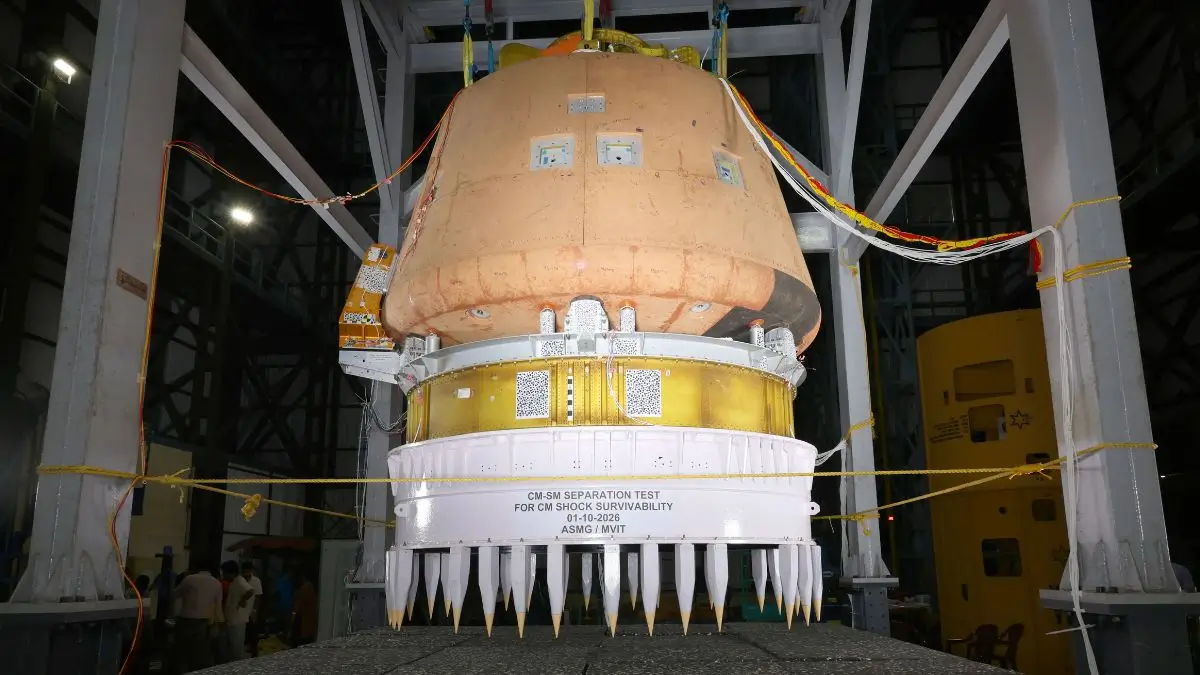
ISRO successfully carried out a series of CM-SM separation tests of its upcoming Gaganyaan human spaceflight program on October 16, 2026. The tests were conducted at the Vikram Sarabhai Space Center (VSSC) in Thiruvananthapuram, Kerala, in order to test the separation mechanism and its tolerance to the mechanical shocks related to it. The tests increase confidence in critical spacecraft mechanisms prior to the first uncrewed flight of the Gaganyaan programme, G1, slated to be launched in 2026.
What Is the Gaganyaan Mission?
Gaganyaan is the human spaceflight program of India aimed to prove the capability of sending Indian astronauts into low Earth orbit and returning them back to Earth.
Gaganyaan is being developed by ISRO with an emphasis on human-rated launch vehicles, crew safety, life support systems and spacecraft navigation and recovery operations.
G1 is going to be the first uncrewed flight to test critical systems before sending humans to orbit. The successful completion of the CM-SM separation tests is one of the steps towards that goal.
What Are Crew Module and Service Module?
The Gaganyaan Orbital Module has two major parts: the Crew Module and the Service Module. These modules are connected when launched and during the orbit phase, but their role differs.
1. Crew Module (CM)
- The Crew Module is the part of the spacecraft where the astronauts travel.
- The Crew Module has all the systems necessary for crew protection and safety during flight and entry, such as avionics, navigation and a thermal protection system. The crew module is planned to be separated from the service module before re-entry to the atmosphere.
2. Service Module (SM)
- The Service Module works when the spacecraft is in orbit. It supplies power and other services to the Crew Module. Both modules are linked via structure and umbilical connections which provide electrical and fluid servicing.
- Before the Crew Module enters the re-entry phase, the separation system separates it from the Service Module. This process is essential as the crew module has to be separated in the right order and have the ability to complete the following phases of re-entry and recovery.
How were the Tests Performed?
The ISRO created a test facility, which was highly instrumented at the VSSC to simulate the integration of the Crew Module and Service Module.
The tests were done on how the separation occurred with the removal of various umbilical connections. The testing was to measure the behavior of the systems during the separation process and the mechanical shocks generated from this process.
This test was conducted to test the reliability of some of the Crew Module subsystems, because during separation, mechanical loads are generated.
Critical Systems Verified through the Testing
ISRO claimed that the testing had validated several crucial systems fitted in the Crew Module.
System Function in the Gaganyaan mission
- Avionics systems: For electronic support of the spacecraft and control purposes
- Inertial Navigation Systems: Assist in determining the orientation and movement of the spacecraft
- Thermal Protection System: Safeguarding the Crew Module from severe heat on atmospheric re-entry
- Aft and Conical Heat Shields: Pertain to the thermal protection system of the Crew Module
- Deployable Umbilical Shield: Ensures safety of the umbilical interface of the Crew Module
- Pyro Devices: Permit controlled separation/deployment operations
- Crew Module Uprighting System: Facilitate orientation of the Crew Module
- Thermal and Humidity Control System: Maintaining proper environment inside the Crew Module
The verification of these elements is essential because a successful separation operation should not impair any of the systems needed for the return of the Crew Module.





 Elon Musk Shows Tesla Roadster Performin...
 TRISHNA Satellite Mission 2027: ISRO-Fra...
 World Bank Ranks India Among Top 10 Emer...