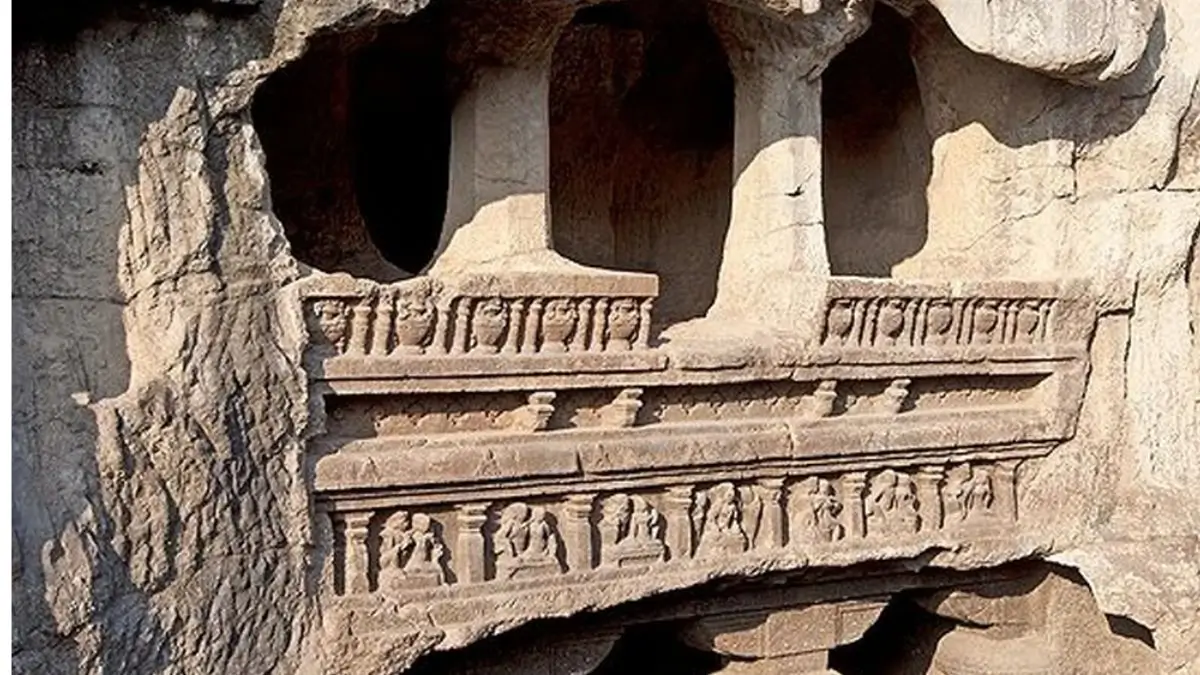
The Ellora Caves are one of the greatest examples of rock-cut architecture found in India. They are found in the Charanandri Hills in what is today known as Chhatrapati Sambhajinagar in Maharashtra. There are 34 monasteries and temples hewn out of a basalt hill that runs for 2 kilometers. The caves were developed for several centuries ago, and they symbolize Buddhism, Hinduism, and Jainism traditions. For their architectural beauty, intricate carvings, and religious tolerance, Ellora is listed on the UNESCO World Heritage Sites since 1983.
History and Evolution of the Ellora Caves
The Ellora Caves were constructed in various stages from around the 6th to the 12th centuries CE. These represent the evolution of the culture and religion of ancient India.
While other monuments are connected with only one particular religion, the Ellora Caves incorporate three different religions into one archaeological site. It comprises monasteries, sanctuaries, temples, sculptures, and paintings.
There are 34 caves in total, which are classified into three main categories:
| Category of Cave Group | Number of Caves | Religion | Significant Characteristics |
| Buddhist | 1-12 | Buddhism | Monasteries, Prayer Halls and Buddhist Sculptures |
| Hindu | 13-29 | Hinduism | Temple architecture, Mythical Sculptures and the famous Kailasa temple |
| Jain | 30-34 | Jainism | Beautiful Sculptures, Religious Icons and Paintings |
The Kailasa Temple: The Best Cave of Ellora
The Kailasa Temple can be found in Cave 16, which is devoted to Lord Shiva. It represents one of the greatest works of rock architecture created in India.
It is a monolithic building, which means that it is carved from a single mass of rock and not built from separate stone blocks. This building has been created in such a way that it demonstrates the exceptional skills of the people who have created it.
One of the most interesting sculptures in this cave shows how Ravana tries to lift Mount Kailasa, which is considered the residence of Shiva. This temple also has some other sculptures and painting fragments.
There are other caves in Ellora worth visiting, such as Cave 10 (Vishvakarma / Carpenter’s Cave), Cave 12 (Teen Tal), Cave 15 (Dashavatara Cave), Cave 21 (Rameshvara), and Cave 29 (Dhumar Lena).
Religious Importance and Cultural Heritage
Ellora is an example that shows how Buddhist, Hindu, and Jain religions lived side by side. The caves have unique styles in terms of art and architecture that are located in the same environment.
The Buddhist caves indicate monastic and devotional practices, while the Hindu caves are places of temples and sculptures which were created using Hindu mythology. The Jain caves have beautiful sculptures associated with the Digambara religion.
The complex can be regarded as an insight into Indian society in the ancient times from the perspectives of religion, culture, lifestyle, and artistic styles. Ellora is recognized as an example of religious tolerance by UNESCO.
World Heritage Status
The Ellora Caves were included in the UNESCO World Heritage List in 1983 as cultural heritage properties. The property fulfills the three UNESCO criteria of Outstanding Universal Value.
| UNESCO Criteria | Significance |
| Criterion (i) | Is a unique example of artistic creation and masterpieces of creative genius of humankind. |
| Criterion (iii) | Shows exceptionally important testimony to a civilization that has disappeared. |
| Criterion (vi) | Is directly or tangibly associated with events, living traditions, ideas and beliefs with universal significance. |
Archaeological Survey of India (ASI) is the agency managing the property, whereas the buffer zones are managed collaboratively by the ASI, Forest Department, and Government of Maharashtra.








 Siang Upper Multipurpose Project: Why Ar...
 Who Named Cyclone Arnab? Meaning and How...
 Ballon d’Or 2026: All You Need to Know...