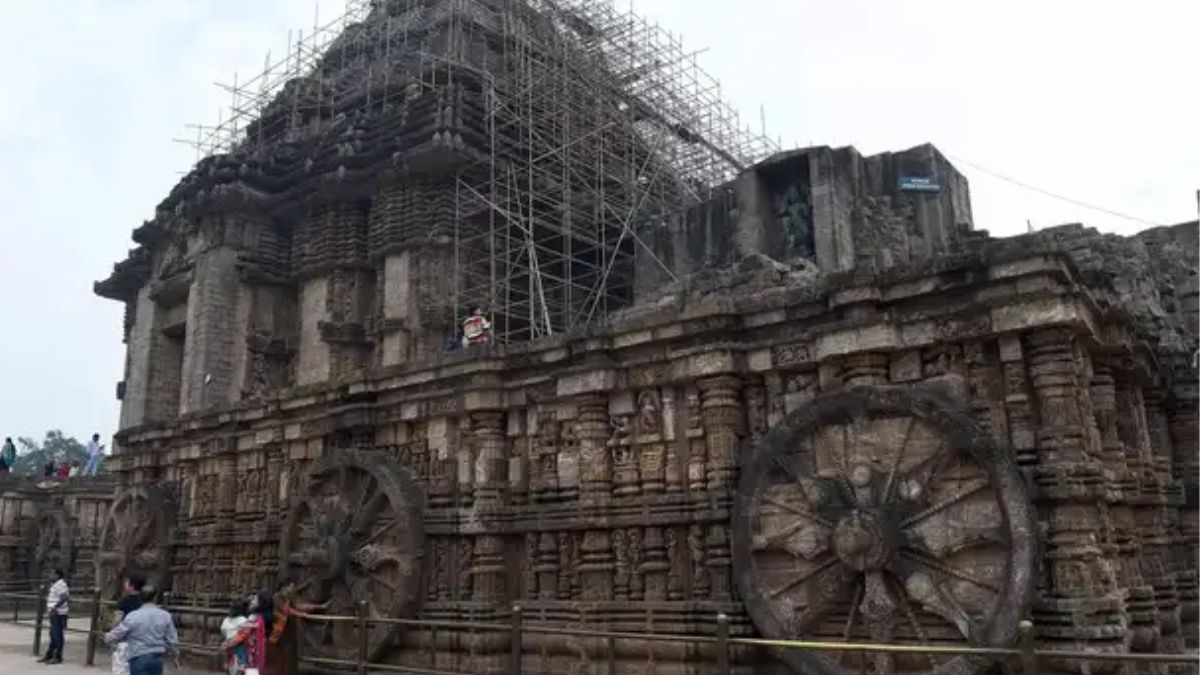
The Archaeological Survey of India (ASI) has started the important conservation operation at the Konark Sun Temple which is the UNESCO World Heritage Site. This project involves the drilling of the controlled passage into the temple’s Jagamohan which is known as the assembly hall to remove the sand which was filled by the Britishers over a century ago. This delicated process is aims to restore the structure of temple and along with to ensuring the stability and also marking one of the most important heritage conservation efforts in the recent years.
Why Was Sand Filled Inside the Temple?
Between the year 1901 and 1903 British engineers had filled the Jagamohan with sand to prevent the structure from collapsing.
At that time it was considered as the practical solution to stabilize the monument.
However this measure technique had long-term consequences lie,
- The Jagamohan remained sealed and inaccessible.
- Also the internal structure could not be studied properly.
- And the conservation efforts were limited to the exterior.
Now the modern technology allows experts to safely to reverse this century-old intervention.
Current Restoration Process: How ASI Is Doing It
The ASI has adopted the highly cautious and scientific approach to ensure that no damage is caused to the monument.
Key Steps in the Process
- The drilling in the 6×5-foot passage through the western wall.
- By using diamond drilling technology to avoid vibrations.
- And also the manual removal of sand after drilling completion.
- The continuous monitoring of the structural stability.
The officials have indicated that this phase alone could take up to the one year as noting the sensitivity of the structure.
Scientific Analysis Before Drilling
Before starting the drilling operation the ASI conducted detailed research.
- Earlier the two test holes were drilled in December.
- The samples of stone and sand were analyzed by the Indian Institute of Technology Madras.
- And the sand was found to be in stable condition.
Only after these assessments and approval from the senior authorities have permitted to the drilling work begin.
Historical Significance of Konark Sun Temple
This temple was built in the 13th century by Narasimhadeva I of the Eastern Ganga dynasty and this temple is designed as the giant chariot of the Sun God.
Key Highlights
- The construction of temple took around 12 years.
- It was built by nearly 1,200 artisans and sculptors.
- It is famous for its intricate stone carvings and architectural brilliance.








 Jantar Mantar Denotified as Protest Site...
 Supreme Court Constitutes Standing Commi...
 Aadhaar Name Change Rules Revised: Docum...