
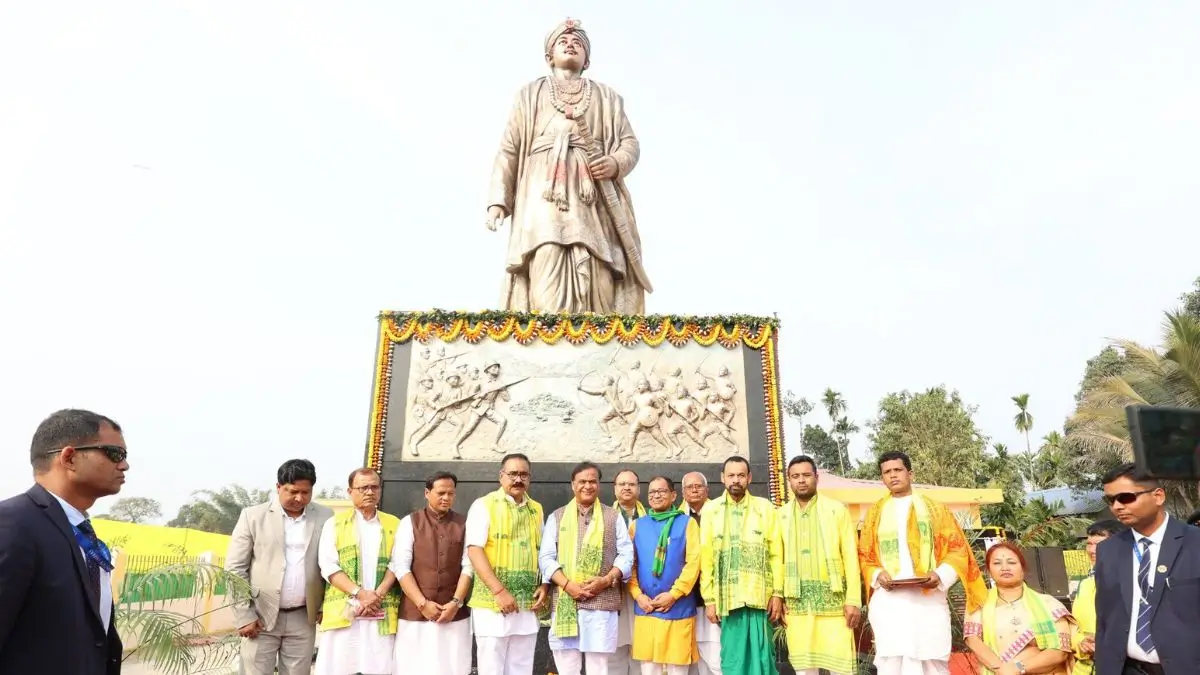
On February 2, 2026, the Assam government declared a ₹50 crore grant to preserve and restore the heritage of the Darrang kings belonging to the Koch dynasty. The announcement was made during the Mahabir Chilarai Divas celebrations in Darrang district. The move reflects the state’s effort to protect Assam’s rich past, honour indigenous rulers, and transform historical legacy into a centre of tourism and cultural pride.
Assam Govt. Grant To Preserve Koch Dynasty
- Assam Chief Minister Himanta Biswa Sarma announced financial support of ₹50 crore for preserving the heritage of the Darrang kingdom.
- The project will focus on restoring royal sites, monuments and cultural landmarks linked to the Koch dynasty.
- The Chief Minister directed the Darrang district administration and the Public Works Department to begin work immediately.
- He stressed that the restoration must reflect the dynasty’s historical importance and its contribution to Assam’s political and cultural evolution.
Who Were the Darrang Kings and the Koch Dynasty
- The Darrang kingdom was ruled by the Koch dynasty, one of the most powerful dynasties in medieval Assam.
- The Koch people rose to prominence after the decline of the Pal dynasty in ancient Kamarupa.
- The kingdom was founded by Biswa Singha and reached its peak under Maharaj Naranarayan.
- The dynasty played a central role in shaping Assam’s political boundaries, military strength and cultural identity.
Role of Mahabir Chilarai in Assam’s History
- Mahabir Chilarai, brother of Maharaj Naranarayan, is remembered as one of Assam’s greatest military leaders.
- Known for his lightning-fast battlefield attacks, he earned the name “Chilarai.”
- He built a strong and organized army with land and naval forces.
- His campaigns extended Koch influence across Ahom, Kachari, Jaintia, Tripura and Sylhet regions.
- The historic Gohain Kamal Ali Road stands as a symbol of his strategic and administrative vision.
Cultural and Religious Contributions of the Koch Rulers
- Under Naranarayan and Chilarai, Assam saw a revival of spiritual and cultural life.
- The reconstruction of important temples like Kamakhya and Hayagriva Madhav marked a renewal of religious traditions.
- These efforts strengthened Assam’s spiritual heritage and reinforced the Koch dynasty’s role not only as political rulers but also as cultural patrons who shaped Assamese identity for generations.
Additional Announcements
- During the event, the Chief Minister unveiled the statue of Maharaj Krishnanarayan of the Darrang kingdom and inaugurated Chilarai Bhawans at Mangaldoi and Golaghat.
- He also announced land allotment and construction of an office for the All Assam Koch Rajbongshi Sanmilani at Amingaon.
- These steps reaffirm the government’s commitment to preserving indigenous heritage and strengthening community identity.
Koch Dynasty (1515–1949)
| Aspect | Details |
| Dynasty Name | Koch Dynasty |
| Established | 1515 |
| Founder | Biswa Singha |
| Origin of Name | From mother’s matrilineal Koch community |
| Capital(s) | Chiknabari, Hingulabas, Bijni, Dumuria, Jogighopa, Abhayapuri, Kamatapur (Gosanimari), Cooch Behar |
| Language | Kamrupic (Assamese, Kamtapuri), Koch, Garo, Mech, Sikkimese, Sanskrit (court/religion) |
| Religion | Hinduism (royal Sanskritisation), local ethnic religions |
| Government | Hereditary monarchy |
| Currency | Narayani |
| Historical Background | Emerged from Kamata Kingdom after decline of Kamarupa; overthrew Baro-Bhuyans; consolidation under Biswa Singha around 1515 |
Key Historical Milestones
| Event | Period/Detail |
| Establishment of Koch power | 1515 by Biswa Singha |
| Coronation & Sanskritisation | Adopted Hinduism; claimed Kshatriya status; Brahmin legitimisation |
| Zenith of dynasty | Reign of Nara Narayan & Chilarai (1540–1586); military expansion & cultural renaissance |
| Religious reforms | Eksarana-namadharma propagated by Sankardev and disciples |
| Permanent division | Koch Bihar (west) & Koch Hajo (east) after Nara Narayan’s death (1587) |
| British era | Koch Bihar became princely state (1775) |
| Merger with India | 1949–1956 |
Major Branches & Rulers
| Branch | Notable Rulers/Details |
| Undivided Koch Kingdom | Biswa Singha (1515-1540), Nara Narayan (1540-1586) |
| Koch Bihar | Nripendra Narayan, Lakshmi Narayan, Bir Narayan, Pran Narayan, Jagaddipendra Narayan, etc. (absorbed into India) |
| Koch Hajo | Raghudev (son of Chilarai), Parikshit Narayan (defeated by Mughals 1612) |
| Darrang (vassal under Ahoms) | Balinarayan (brother of Parikshit Narayan), Mahendra Narayan, Chandra Narayan, etc. |
| Beltola Gaj | Narayan Dev To succession until Chandra Narayan Dev To Lakshmipriya Devi (1937–1947) |
| Bijni Raj Estate | Chandra Narayan To Joy Narayan To Mukunda Narayan To Amrit Narayan To Jogendra Narayan To Bhairabendra Narayan |
| Khaspur (Barak Valley) | Kamal Narayan (governor, son of Biswa Singha), Udita Narayan (independent 1590), Bhim Singha (merged with Kachari kingdom 1745) |
Question
Q. The Darrang kingdom was associated with which dynasty?
A. Ahom dynasty
B. Pal dynasty
C. Kachari dynasty
D. Koch dynasty


 Nitish Kumar to Take Rajya Sabha Oath on...
 Ashwini Bhide Becomes First Woman BMC Co...
 Lok Sabha Passed Resolution For Amravati...











