
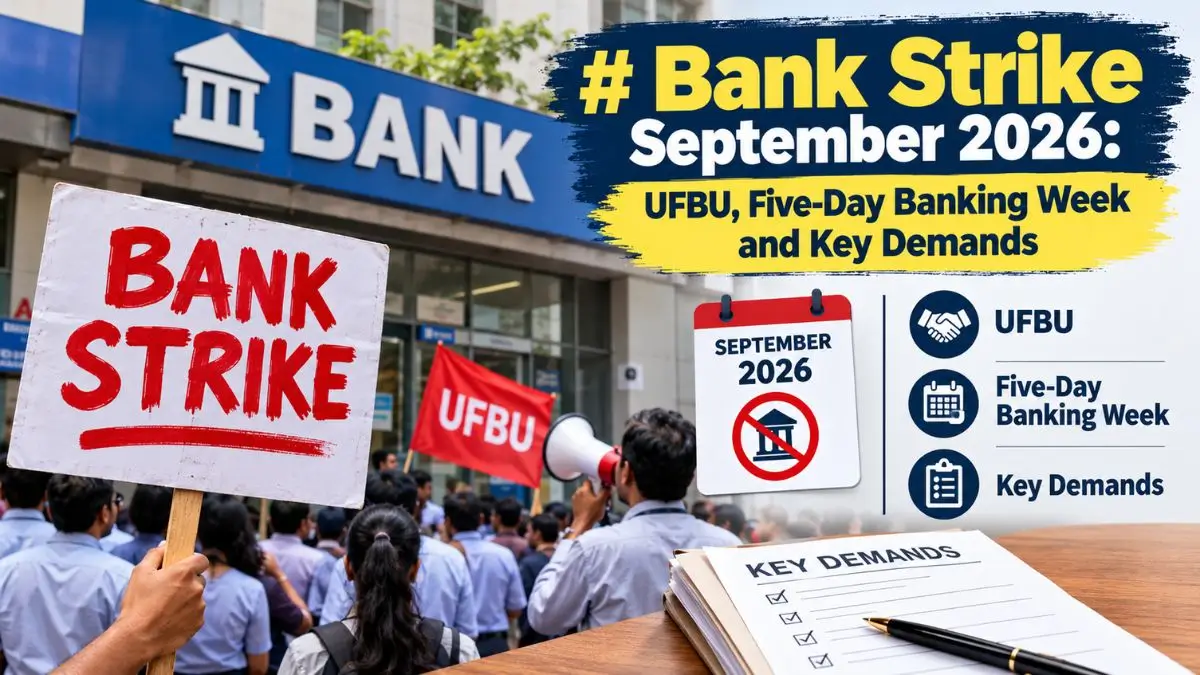
UFBU (United Forum of Bank Unions), which is the common forum for the bank employees and officers’ unions, has called a three-day nationwide strike of banks from 28 to 30 September 2026. Apart from this, the unions have also announced an indefinite strike starting from 26 October if their demands are not met.
The main demand is that the five-day banking week to be implemented under which all Saturdays would be declared holiday. Other demands include the performance-linked incentive (PLI) scheme along with some other pending matters related to recruitment, pensions, and employees’ welfare.
The immediate dispute is arise because of the failure of the conciliation proceedings between the Ministry of Labour, Department of Financial Services (DFS), Indian Banks’ Association (IBA), and the unions in the month of September 2026.
What Is the United Forum of Bank Unions?
The United Forum of Bank Unions (UFBU) is a collective platform for leading trade unions of the bank employees and officers.
As per the union documents obtained for the ongoing agitation, there are seven unions that form the part of this collective:
Abbreviation of the Union Full Name
- AIBEA: All India Bank Employees’ Association
- AIBOC: All India Bank Officers’ Confederation
- NCBE: National Confederation of Bank Employees
- AIBOA: All India Bank Officers’ Association
- BEFI: Bank Employees Federation of India
- INBOC: Indian National Bank Officers Congress
- INBEF: Indian National Bank Employees Federation
As per The Indian Express, UFBU represents around 90% of the banking industry’s workforce, whereas the union claims to represent more than 90%.
Five-Day Working Week in Banks: The Main Requirement
Banks’ branch offices are usually shut on the second and fourth Saturdays of the month. All other Saturdays are considered working days.
The requirement is to make all Saturdays holiday days and have five working days of the week—Monday to Friday.
The requirement has been raised through various rounds of wage settlements,
- 2015: Holidays have been made on second and fourth Saturdays, while other Saturdays have been converted into full working days rather than half-days.
- 2020: The issue came up in the discussion during wage settlements.
- March 2024: IBA and bank management also decided to recommend the holiday days for the remaining Saturdays with an additional 40 minutes of working hours from Monday to Friday.
- The requirement has since been sent to the Finance Ministry for their approval.
The trade unions feel that the extra working hours on weekdays will compensate for the loss of banking hours due to Saturday holidays.
Why Is There An Operation Of The Bank Branches On The Weekend?
The strike dates have given way to an extraordinary banking schedule.
On September 27, 2026, it is a Sunday just ahead of the three-day strike beginning on September 28. As such, it has been decided that all the banks operating in the public sector, including Regional Rural Banks, will be open on this Sunday to give people another chance to conduct necessary branch transactions.
According to the report, the Reserve Bank of India has given permission for the opening of bank branches, offices, ATM linked branches and currency chests on September 27.
Performance-Linked Incentive Scheme
Performance Linked Incentive (PLI) scheme is yet another significant issue in this controversy.
The PLI scheme has been introduced as a part of the wages settlement of 2020, linking incentives to individual bank performance.
The association of bank officers has lodged complaints against a new government scheme for officers at grade 4 and above but not those below grade 4 officers. It has also demanded discussion about the scheme through bilateral process.
According to the report in Indian Express, IBA and Department of Financial Services reached an agreement for putting the PLI scheme on hold during conciliation process.
Other Outstanding Demands
Apart from the above demands, there are other outstanding demands of the unions which are stated to have remained unresolved even after the March 2024 agreement.
These demands are,
- Appropriate staffing with clerical and subordinate grades.
- Reviewing and updating the benefits of pension scheme.
- Equal dearness allowance on pension.
- Revisions regarding NPS and pension schemes.
- Upward revision of gratuity ceiling.
- Reviewing ex-gratia for some pensioners.
- Recruitment of workmen and officer directors in banks.
- Establishment of Leave Bank.
- Payment of bank medical insurance premium for retired persons.
These are the demands of the participating trade unions and should be distinguished from those decisions which have been taken by the government and banking managements.
What Effect Can This Strike Have?
This strike would create the maximum disturbance at brick-and-mortar branches of banks, especially those of the public sector banks who have joined the movement.
Transactions which may be affected are,
- Cash deposits and withdrawal
- Cheque transactions
- Transactions pertaining to accounts
- Others
Yet this strike cannot bring the banking business to a halt as other modes of banking will continue to function under regular circumstances. These will include UPI, Internet banking, mobile banking, and ATMs.
The important thing is the time chosen for the strike. September 30 is the mid-year cut-off date for banks.








 Who Is Navi Pillay? Nobel Peace Prize 20...
 Vande Bharat vs Amrit Bharat Express: Ke...
 Asian Games to LA28: Which Sports Earned...










