
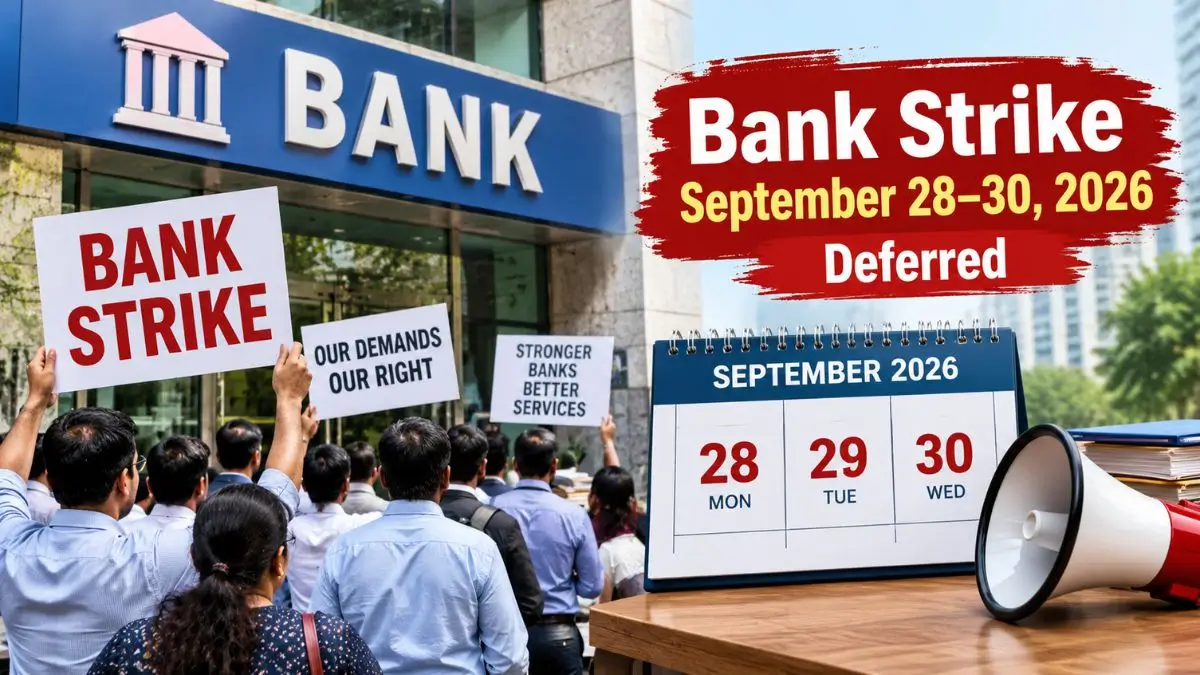
A three-day country-wide bank strike which was supposed to take place from September 28th to 30th 2026 has been put off after the Indian Banks’ Association (IBA) and United Forum of Bank Unions (UFBU) came to an understanding on September 27. The development resulted from a meeting that was held between the two groups on Sunday night. According to UFBU, a high level committee will examine immediately the issue of declaring remaining Saturdays as bank holidays. The strike proposal was mainly based on the demand for five-day banking week.
What Did IBA and UFBU Come To An Understanding On?
There is an agreement to continue deliberations on the demands made by bank trade unions. A high level committee consisting of the members of IBA and UFBU will examine the demand to declare remaining Saturdays as bank holidays.
The committee will look at alternative suggestions, make consultations and come up with a solution that will also serve the interests of the customers. Thereafter, UFBU decided to defer the strike and other protest activities.
Points of the Understanding
- Five-day working week: An IBAN-UFBU high-level committee will review the request for declaring remaining Saturdays as holidays.
- PLI Scheme for senior officers: Talks will be held regarding the PLI scheme for Scale IV and above officers.
- Government proposal: The IBA will make a proposal to the government in view of the observations made by the unions/associations.
- Other issues: The other residual issues to be taken up will include those which have been noted in the minutes of March 8, 2024.
- Strike: Strike from September 28-30 and planned agitation programs will be rescheduled.
Why was the Bank Strike Scheduled?
The UFBU had scheduled the three-day strike based on a number of demands raised by the employees, with five-day banking being the main one.
Other demands made by the trade unions include improvements in pension, common dearness allowance rate formula for pensioners, and also provision for those employees enrolled under National Pension Scheme (NPS) to switch to Old Pension Scheme (OPS). In fact, the trade unions had already planned a countrywide strike on September 11 following failure in reaching any agreement over their demands.
Five-day banking would basically mean that all the banks would be open only on five days of the week – that is Monday through Friday. Currently, most of the bank branches are open only on Monday through Thursday, while Fridays are holidays.
What Would Have Happened With Bank Activities?
Given that the strike was postponed, the plan to disrupt the banks from September 28 to 30 all across the country would no longer be implemented. As of now, normal activities would proceed at the banks during those dates; however, each bank may still release its own notice regarding their operations.
The planned strike came after the weekend of September 26-27. In order to minimize the possible effect on the customers, the government had made sure to schedule public sector banks and regional rural banks to open on Sunday, September 27.








 PM-VBRY Scheme: EPFO Offers Up to ₹15,...
 Global Hunger Index 2026: India Ranks 10...
 Sudhakar Dalela Appointed as India’s N...










