
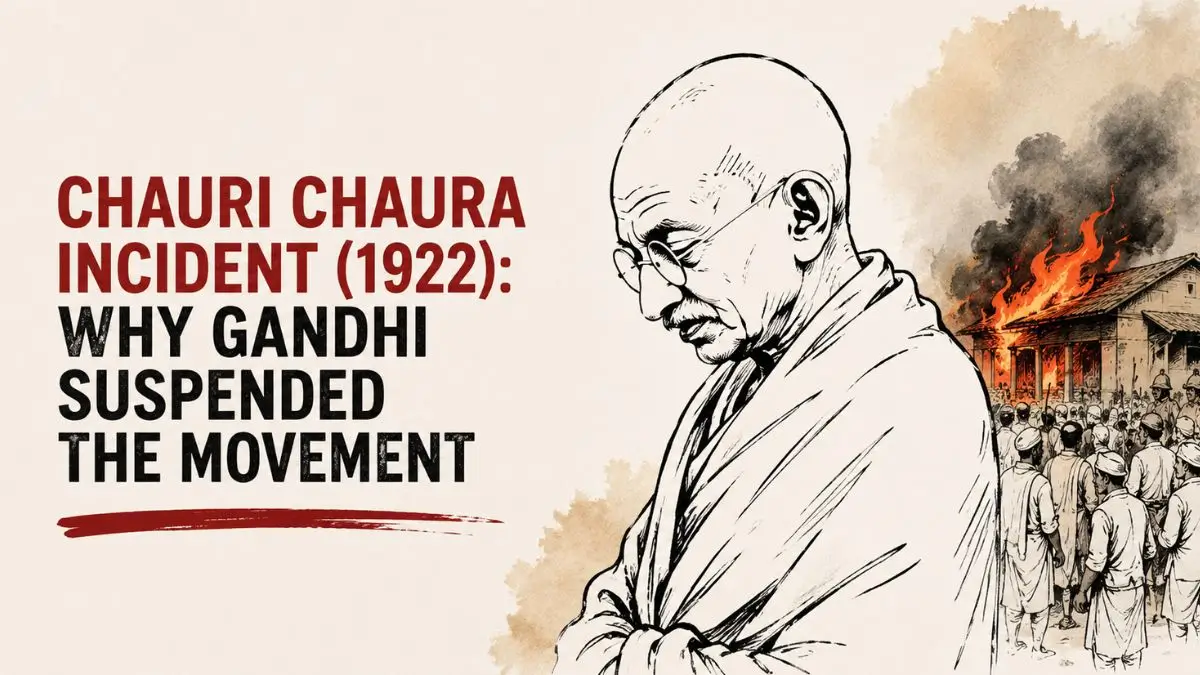
The Chauri Chaura Incident that occurred in 1922 was one of the most significant events in the history of the Indian independence movement. The clash between the demonstrators and the police, which resulted in the killing of 22 policemen, compelled Mahatma Gandhi to stop the Non-Cooperation Movement at the moment when it had already gathered significant momentum.
The problem with violence during the mass movements was exposed by this event, which had its influence on the subsequent development of the process of obtaining freedom by India.
What Is the Chauri Chaura Incident?
The Chauri Chaura Incident took place on February 4, 1922, in Chauri Chaura in the Gorakhpur district of the United Provinces that is now Uttar Pradesh. This event happened at the period of the Non-Cooperation Movement, initiated by Mahatma Gandhi, in 1920.
There were a lot of demonstrators who had gathered for protesting against the British authorities in connection with the picketing of the liquor shop. The police had opened fire on the demonstrators; as a result, three of them were killed, which infuriated the crowd.
Then the protesters attacked the police, which compelled them to hide in the police station. The crowd set this building on fire, and as a result, 22 policemen died.
Background of the Chauri Chaura Case
The event took place during a time when there was high political activity in the country. The Non-Cooperation movement of Gandhi inspired Indians to stop co-operating with British institutions, to refrain from using foreign goods and become self-dependent.
There were people of different social backgrounds taking part in the movement. However, often local conflicts, financial problems and dissatisfaction with colonial administration led to the development of protests.
Local conflicts, economic problems and dissatisfaction with colonial administration played a role in forming the tense situation in Chauri Chaura.
The Events of February 4, 1922
On February 4, a crowd of 2000–3000 demonstrators gathered in Chauri Chaura. It was an action within the framework of the Non-Cooperation movement.
When the situation became tense, the police tried to break up the demonstration and shot at the protesters. As a result, three people were killed, which caused anger among the crowd.
Then, the protesters attacked the police and drove them to the police station. The building was burned, and 22 policemen locked up in the station died.
This event had surprised the national leaders since it went against the Gandhi’s claims about the peaceful nature of the Non-Cooperation movement.
Why Did Mahatma Gandhi Call Off the Non-Cooperation Movement?
The violence at the Chauri Chaura had a huge impact on Gandhi. He felt that the movement had deviated from the principle of Ahimsa, which forms the very essence of his political philosophy.
On February 12, 1922, Gandhi withdrew the Non-Cooperation Movement.
It was a controversial move since the Non-Cooperation Movement was gathering momentum and enjoying wide acceptance. Quite a few leaders within the nationalist fold expressed their shock and disappointment at the sudden suspension of the agitation.
To Gandhi, pursuing a mass movement without proper training and discipline could lead to more violence. For him, an independent India gained through violent means lacked the moral legitimacy of the fight.
Thus, the act of withdrawing from the mass movement showed Gandhi’s commitment to non-violence as a principle of India’s struggle for freedom.
Causes for the Chauri Chaura Incident
It should be noted that the occurrence was not the result of one reason but a combination of various causes. The oppressive British policies had led to the growth of resentment due to their taxes and economic restrictions.
Moreover, the effects of World War I had made the situation worse due to rising prices, unemployment and shortage of goods.
Politically speaking, the Non-Cooperation Movement had united millions of Indians into one powerful mass movement, encouraging people to rebel against British rulers. The discontent among local communities often merged with the struggle for national freedom.
At Chauri Chaura, discontent with the local authorities and the immediate clash between protesters and police created the right conditions for violence.
Effect on Indian Independence Movement
The cancellation of the Non-Cooperation Movement became a serious blow to the nationalist movement in the short run. Nevertheless, Chauri Chaura Incident also affected the future path of the freedom struggle.
The incident highlighted the stress on discipline, non-violence and constructive work advocated by Gandhi. Later, he paid more attention to such issues as promotion of khadi, rural upliftment and social reforms.
At the same time, certain nationalists became disillusioned with the canceling of the movement. This dissatisfaction affected the debate over the Congress political strategy in the future.
C.R. Das and Motilal Nehru were instrumental in setting up the Swaraj Party in 1923. The party intended to contest elections and fight colonial policies from within the legislative councils.
Some nationalists became revolutionary due to the influence of Chauri Chaura Incident. They considered themselves obliged to take some harsh measures in order to free India from British rule.
Chauri Chaura Trials and Madan Mohan Malaviya
As a result of Chauri Chaura Incident, the British authorities carried out mass arrests and tried the accused participants of the violent act.
Madan Mohan Malaviya rendered great help in defending the accused. Due to his legal activity, he managed to save the lives of many accused persons.
Thus, trials also became an important part of the consequences of the Chauri Chaura Incident.
Chauri Chaura Incident as a Turning Point
The Chauri Chaura Incident is considered a turning point as it highlighted the difficulties in the control of such a mass movement.
In Gandhi’s case, the incident brought him to conclude that for a political movement, there must be a commitment to non-violence and discipline. This explains why Gandhi called off the Non-Cooperation Movement.
The Chauri Chaura Incident also highlighted the conflict between the anger of the masses towards colonial rule and the disciplined approach advocated by the nationalists.








 Who Is Navi Pillay? Nobel Peace Prize 20...
 Vande Bharat vs Amrit Bharat Express: Ke...
 Asian Games to LA28: Which Sports Earned...










