
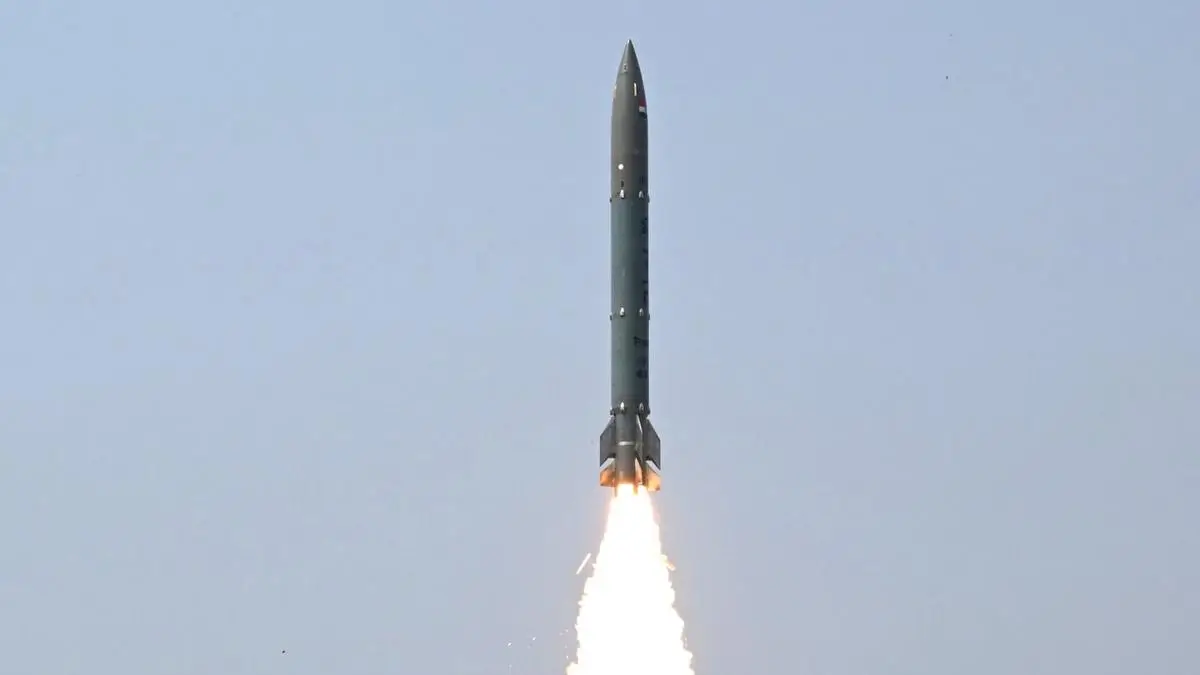
The Defence Research and Development Organisation (DRDO) successfully conducted a flight test of the indigenously developed Pralay quasi-ballistic missile on 5 November 2026, from Dr APJ Abdul Kalam Island off the coast of Odisha.
The missile was launched at approximately 11:10 AM as part of user evaluation trials. According to the Ministry of Defence, all the test objectives were successfully achieved, as confirmed by data collected through tracking instruments deployed by the Integrated Test Range (ITR), Chandipur.
The successful trial marks an important milestone in India’s indigenous defence capabilities and brings the missile system closer to induction into the Indian Armed Forces.
| Particular | Details |
|---|---|
| Missile Name | Pralay |
| Missile Type | Quasi-ballistic missile |
| Test Date | 5 November 2026 |
| Launch Time | Approximately 11:10 AM |
| Launch Location | Dr APJ Abdul Kalam Island, Odisha |
| Testing Organisation | DRDO |
| Lead Development Laboratory | Research Centre Imarat (RCI), Hyderabad |
| Production Partner | Bharat Dynamics Limited (BDL) |
| Tracking Facility | Integrated Test Range, Chandipur |
| Test Category | User Evaluation Trials |
| Result | All test objectives achieved |
What Is the Pralay Missile?
Pralay is an indigenously developed, solid-propellant, surface-to-surface quasi-ballistic missile designed for precision strikes against different types of targets.
Unlike a conventional ballistic missile that generally follows a predictable ballistic trajectory after its powered phase, a quasi-ballistic missile can follow a lower trajectory and perform manoeuvres during flight.
Pralay incorporates modern guidance and navigation technologies to improve accuracy. It is designed to carry different categories of conventional warheads for tactical military operations.
The missile’s first flight test was conducted in December 2021.
Pune News – The Indian Express
Key Features of the Pralay Missile
-
Indigenous development: Designed and developed in India by DRDO laboratories.
-
Solid-propellant propulsion: Uses solid fuel for its rocket propulsion system.
-
Quasi-ballistic trajectory: Can manoeuvre during flight rather than following a purely predictable ballistic path.
-
Precision guidance: Employs advanced guidance and navigation technologies.
-
Multiple warhead compatibility: Designed to carry different categories of conventional warheads.
-
Tactical application: Intended to strengthen the precision-strike capabilities of the Indian Armed Forces.
Details of the Successful Flight Test
The flight test was conducted from Dr APJ Abdul Kalam Island off the Odisha coast on 5 November 2026.
The Integrated Test Range at Chandipur monitored the missile’s performance using multiple tracking and measurement instruments.
The Ministry of Defence confirmed that the trial successfully met all stipulated objectives.
Senior DRDO officials, representatives of the defence industry and members of the Armed Forces witnessed the trial.
The test was part of the user evaluation process, which assesses whether a defence system meets operational requirements before induction into service.
Who Developed the Pralay Missile?
The missile was developed by Research Centre Imarat (RCI), Hyderabad, in collaboration with other DRDO laboratories.
Several specialised laboratories contributed to the project, including the Defence Research and Development Laboratory (DRDL), Advanced Systems Laboratory (ASL), Armament Research and Development Establishment (ARDE) and High Energy Materials Research Laboratory (HEMRL).
Bharat Dynamics Limited (BDL), one of the development-cum-production partners, manufactured the missile system.
This collaboration demonstrates the role of indigenous research institutions and defence manufacturers in strengthening India’s missile technology capabilities.
Pune News – The Indian Express
Defence Minister Rajnath Singh Congratulates DRDO
Defence Minister Rajnath Singh congratulated DRDO, the Armed Forces and industry partners on the successful flight test.
He highlighted that the missile’s advanced technologies would strengthen the military’s technological capabilities and operational preparedness against emerging threats.
Rajesh Kumar Singh, Defence Secretary and Chairman of DRDO, also congratulated the teams involved in the successful trial.
Significance of the Pralay Missile for India
The successful flight test represents an important development in India’s indigenous missile programme.
Strengthening defence preparedness: Pralay is expected to enhance the Armed Forces’ conventional precision-strike capabilities.
Atmanirbhar Bharat: Indigenous development and production support India’s objective of reducing dependence on imported defence technologies.
Advanced missile technology: The programme demonstrates India’s growing expertise in guidance, navigation and missile systems.
Operational readiness: Successful user evaluation trials bring the system closer to induction into military service.








 Cabinet Approves Two-Year Additional Eng...
 Tiger Triumph 2026: India–US Tri-Servi...
 Air Marshal Mehtab Singh Deswal Takes Ov...