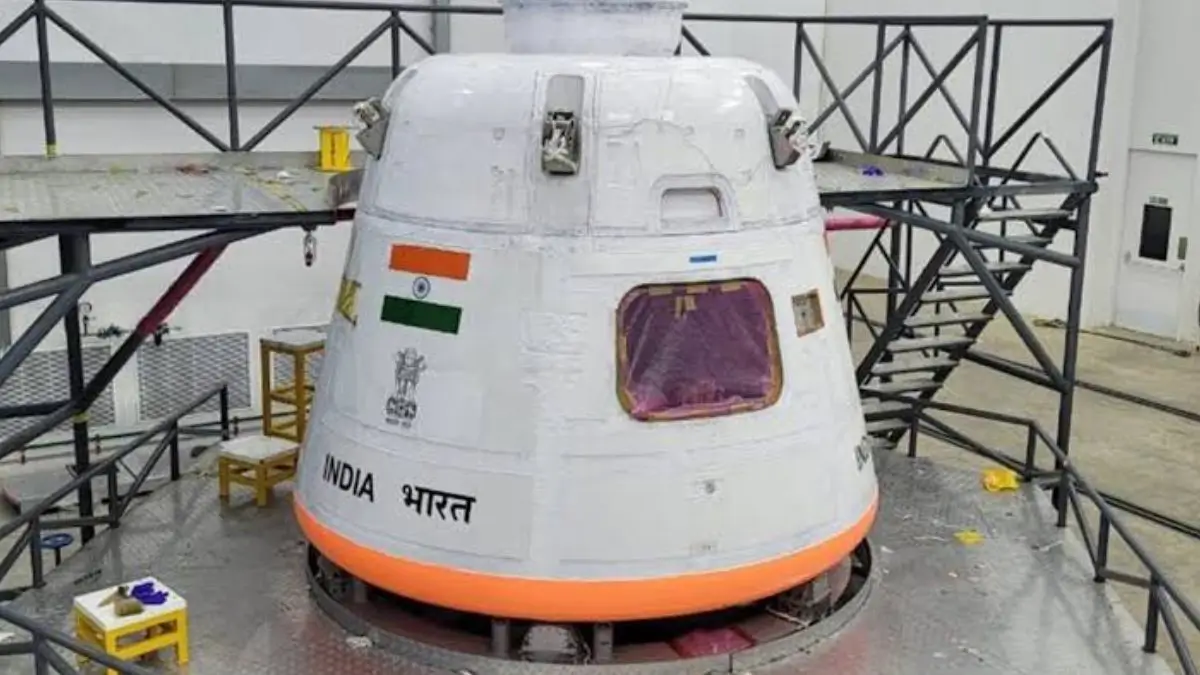
Another important milestone attained in the India’s Gaganyaan mission, as the country prepares to launch its first human spaceflight mission. In his statement to the Rajya Sabha, Union Minister Dr. Jitendra Singh disclosed that several critical human rating systems have been successfully tested. Moreover, he noted that the first test flight of the Gaganyaan mission with the Vyommitra humanoid is scheduled for the fourth quarter of 2026. The BAS (Bharatiya Antariksh Station) has continued its preparation, set to be commissioned in 2035.
Gaganyaan Mission Reaches a Crucial Stage
The Gaganyaan Mission is India’s first indigenous human spaceflight program that is currently undergoing development by the Indian Space Research Organisation (ISRO).
The aim of the mission is to show India’s capability to successfully launch astronauts into Earth orbit and return them safely.
According to Dr. Jitendra Singh, the project has made important advances in the process of developing critical systems needed for human space flight and is progressing towards its operation stage.
Human Rating Milestones Achieved
ISRO has completed some technological advancements that were necessary for ensuring safety and success of the missions.
Important milestones achieved are,
- Testing and validation of all propulsion stages of Human Rated Launch Vehicle (HLVM3).
- Development and testing of Crew Module and Service Module Propulsion Systems.
- Testing of engineering model of the Environmental Control and Life Support System (ECLSS).
- Validation of the Thermal Protection System.
- Development of Crew Module Up-righting System.
- Testing of Deceleration System and Avionics.
The above systems play an essential role in allowing astronauts to travel safely and return alive from their mission into space.
Successful Validation of Crew Safety Systems
Making sure the astronauts are safe is still one of the highest priorities on the mission.
Dr. Jitendra Singh told the Parliament that,
- All five motors of the Crew Escape System (CES) have been successfully developed and static tested.
- Corresponding structure has been qualified.
- TV-D1 Test Vehicle Mission has successfully validated the Crew Escape System in-flight.
- Integrated Air Drop Tests (IADT-01 and IADT-02) have successfully validated the parachute based deceleration system.
- Work on the preparation of the next test of the escape system, TV-D2, is being carried out.
Mission Infrastructure Developed
Moreover, ISRO has set up necessary infrastructures for future missions.
Important facilities that are now operational include,
- Orbital module preparation facility.
- Gaganyaan Control Centre.
- Crew Training Facility.
- Enhanced Second Launch Pad.
- Ground communication system.
- IDRSS-1 feeder stations and terrestrial communication links.
- Crew recovery systems and assets.
These infrastructures will help to conduct launch activities, astronaut training, mission control and recovery after the mission.
Mission Roadmap: Vyommitra to Undertake First Uncrewed Flight
Another major milestone is to conduct the first uncrewed flight of the Gaganyaan in the fourth quarter of 2026.
In this mission, Vyommitra, a half-humanoid robot of ISRO, will be launched to check new technologies before the astronauts go to space.
The roadmap will includes,
- First uncrewed mission with Vyommitra – Q4 2026
- Next two uncrewed missions – 2027
- First Indian crewed orbital mission afterwards
These missions will verify the performance of the spacecraft and crew safety systems before the maiden human flight.
Planned Bharatiya Antariksh Station by 2035
Further, Dr. Jitendra Singh talked about India’s vision in human space exploration for the distant future.
The Bharatiya Antariksh Station (BAS) will become functional by 2035.
The important highlights include,
- Space station will comprise of five modules.
- The government has sanctioned the design and development of the first module (BAS-01).
- Engineering and technology development are being undertaken in ISRO centres.
This space station will be used by India as its own permanent space station for conducting scientific research and human space missions.
Strengthening International Cooperation within the Programme
India is working with several space agencies internationally to improve its mission preparedness.
Some of the key collaborations are,
- ESA – Network operations.
- ASA – Crew and capsule recovery.
- CNES (France) – Training of flight surgeons and support teams.
- Roscosmos (Russia) – Astronauts training and critical systems purchase.
These collaborations will strengthen the India’s own technological capabilities.
Budget and Governmental Approval
The Union Cabinet sanctioned ₹20,193 crore in September 2024 for carrying out eight missions under India’s Human Spaceflight Programme.
This includes,
- Spacecraft development.
- Development of human-rated technologies.
- Astronauts training.
- Mission infrastructure and related facilities.
- Further human spaceflight missions in the future.







 Elon Musk to Rename SpaceXAI as SpaceXSI
 Kerala Develops AI-Based Dengue Early Wa...
 SpaceX Starship Reaches Orbit for First ...