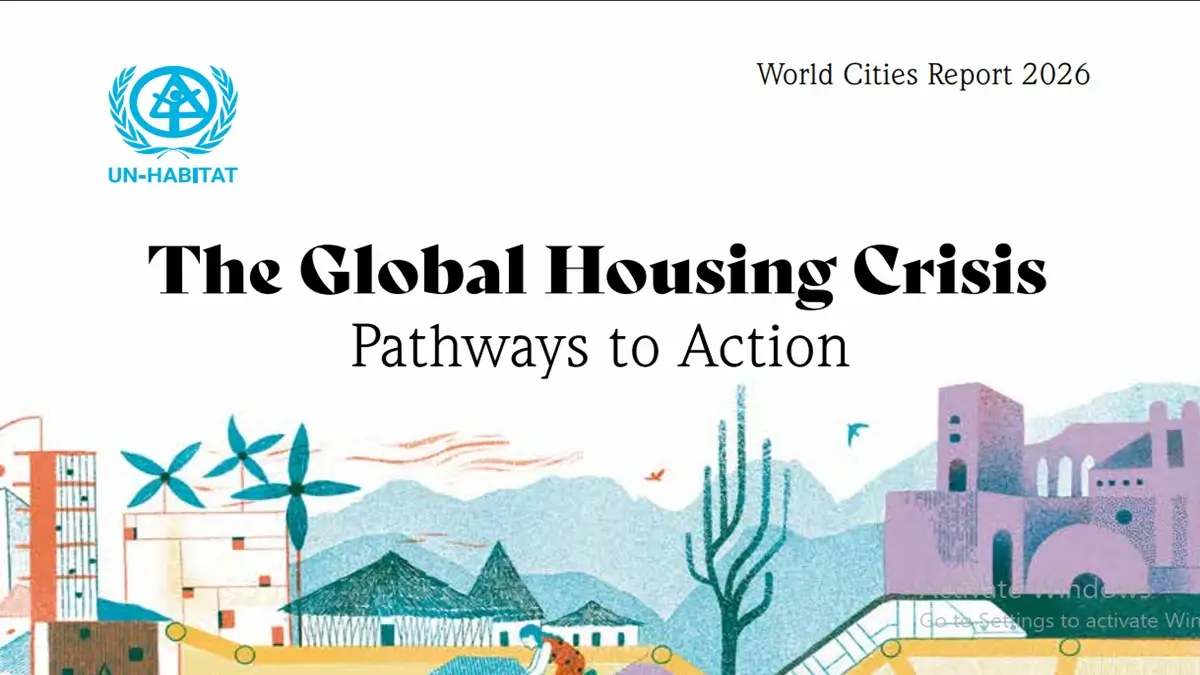
The World Cities Report 2026, released by UN-Habitat during the World Urban Forum in Baku, highlights a rapidly worsening global housing crisis affecting billions of people worldwide.
According to the report, nearly 40% of the global population, around 3.4 billion people, currently face housing-related challenges, including unaffordable homes, poor living conditions, overcrowding, and inadequate access to basic services such as clean water and sanitation. The report describes housing as one of the most urgent urban challenges of the 21st century.
Key Findings of the World Cities Report 2026
The report states that the housing crisis is not limited to developing nations alone. Both developed and emerging economies are struggling with rising housing costs, declining affordability, and growing inequality in urban areas.
1. Housing Prices Rising Faster Than Incomes
One of the most alarming findings is the widening gap between housing prices and household incomes across the world.
- The global price-to-income ratio increased from 9.3 in 2010 to 11.2 in 2023, showing that homes are becoming increasingly unaffordable.
- The price-to-income ratio measures housing affordability by comparing average house prices with average household income.
- In Central and South Asia, including India, the ratio has reached 16.8, indicating severe affordability stress.
This means middle- and low-income families are finding it increasingly difficult to purchase homes in urban areas.
2. Increasing Rental Burden
The report notes that housing costs are consuming a major share of household income globally.
- Around 44% of households worldwide spend more than 30% of their income on housing.
- Spending above this level is generally considered financially stressful and unsustainable.
Rising rents are leaving families with less income for healthcare, education, nutrition, and savings.
3. Homelessness Remains a Major Concern
The report highlights growing homelessness in several countries.
Homelessness Rates (per 10,000 people)
| Country | Homelessness Rate |
|---|---|
| India | 13 |
| United States | 20 |
| China | 21 |
The data shows that even large economies continue to struggle with housing insecurity and inadequate shelter access.
4. Rapid Urbanisation Increasing Pressure
Cities across the world are expected to absorb an additional 2 billion people by 2050.
This rapid urban growth will significantly increase pressure on:
- Land availability
- Housing supply
- Urban infrastructure
- Water and sanitation systems
- Transportation networks
Without major policy reforms and investments, the urban housing shortage is expected to worsen dramatically.
India-Focused Findings
The report gives special attention to India’s urban housing challenges and highlights both concerns and positive developments.
1. Housing Becoming Unaffordable in Major Indian Cities
The report identifies major affordability stress in India’s metro cities.
Price-to-Income Ratios in Indian Cities
| City | Ratio |
|---|---|
| Mumbai | 14.3 |
| Delhi | 10.1 |
These figures indicate that home ownership is increasingly out of reach for households earning median incomes.
2. Decline in Affordable Housing Supply
In India’s eight largest cities:
- Affordable housing’s share in new construction declined sharply from 52% in 2018 to just 17% in 2025.
- Developers are increasingly focusing on luxury and premium housing segments because they generate higher profits.
This shift has reduced the supply of low-cost homes for economically weaker sections and middle-income families.
3. Impact of Pradhan Mantri Awas Yojana (PMAY)
The report acknowledges the contribution of Pradhan Mantri Awas Yojana in improving housing access.
Key achievements include:
- Housing coverage increased from 0.3% of households in 2010 to 7% in 2023.
- Around 12 million houses have been sanctioned for economically weaker and low-income groups.
The scheme has helped improve housing inclusion, especially among vulnerable populations.
4. Ahmedabad Slum Networking Project
The report praises the Ahmedabad Slum Networking Project as a successful model of community-led urban improvement.
The project demonstrated that:
- Existing slums can be upgraded without mass relocation.
- Community participation and small financial contributions can significantly improve living conditions.
- Basic infrastructure such as sanitation, drainage, roads, and water supply can be improved at relatively low cost.
Major Causes of the Global Housing Crisis
Rapid Urbanisation and Population Growth
Mass migration toward cities and fast population growth are increasing housing demand far beyond current supply levels.
Income and Housing Price Mismatch
Housing prices are increasing much faster than wages and household incomes, reducing affordability for middle- and low-income families.
Shift Towards Luxury Housing
Real estate developers are increasingly prioritising luxury and high-margin projects instead of affordable housing.
Rising Land and Construction Costs
Escalating land prices and higher construction material costs are making low-cost housing projects economically difficult.
Limited Access to Housing Finance
Many low-income households lack access to formal banking systems and affordable mortgage finance, limiting home ownership opportunities.
Climate-Induced Housing Stress
Climate disasters are causing large-scale destruction of homes and infrastructure.
- In 2023 alone, climate-related damages caused housing losses worth approximately US$280 billion globally.
- Much of these losses remained uninsured, increasing financial vulnerability.
Impact of the Housing Crisis
Rising Homelessness
Housing shortages and unaffordable rents are increasing homelessness across urban areas.
Growth of Informal Settlements
Many vulnerable populations are forced to live in slums and informal settlements due to lack of affordable formal housing.
Deepening Social Inequality
Unequal access to housing is widening socio-economic divisions within cities.
Financial Pressure on Families
High housing costs reduce disposable income and increase household debt burdens.
Pressure on Urban Infrastructure
The expansion of unplanned settlements puts enormous stress on:
- Water supply
- Sanitation systems
- Electricity networks
- Public transport
- Healthcare facilities
Economic Potential of the Housing Sector
Despite the crisis, the report highlights the strong economic benefits of investment in housing.
South Asia
- Every US$1 invested in housing can generate up to US$5 in economic income.
India
In India:
- An additional ₹100,000 demand in residential construction can generate:
- 2.61 new informal jobs
- 0.04 formal jobs
- Including indirect effects, total employment generation rises to:
- 4.06 jobs
- (3.95 informal and 0.11 formal jobs)
The report notes that housing construction has significant potential to stimulate employment and economic growth.
Recommendations of the World Cities Report 2026
The report stresses that governments must take the lead role in ensuring affordable and adequate housing, as market-driven systems alone cannot solve the crisis.
Key Recommendations
Stronger Government Responsibility
States should play a central role in planning, financing, and regulating housing systems.
Public-Private-Community Collaboration
The report recommends stronger cooperation among:
- Governments
- Private developers
- Community organisations
- Civil society groups
Innovative Housing Models
The report suggests adopting models such as:
- Pay-as-you-go housing
- Rent-to-buy systems
- Community cost-sharing mechanisms
These models can improve affordability for low-income households.
Expansion of Affordable Rental Housing
The report calls for increasing non-profit affordable rental housing, especially for:
- Urban poor
- Migrant workers
- Informal sector workers
Improved Housing Finance Access
Governments and financial institutions should expand access to formal housing finance and reduce dependence on informal borrowing systems.
Community-Led Slum Upgrading
The report supports:
- In-situ slum redevelopment
- Community-led housing projects
- Participatory urban planning
These approaches are considered more cost-effective and socially inclusive.
Climate-Resilient Urban Planning
The report emphasises integrating climate resilience into housing and city planning to reduce vulnerability to disasters and climate risks.








 Academic Freedom Index 2026: India in Se...
 India's Progress in Human Development In...
 CareEdge State Rankings 2025: Maharashtr...