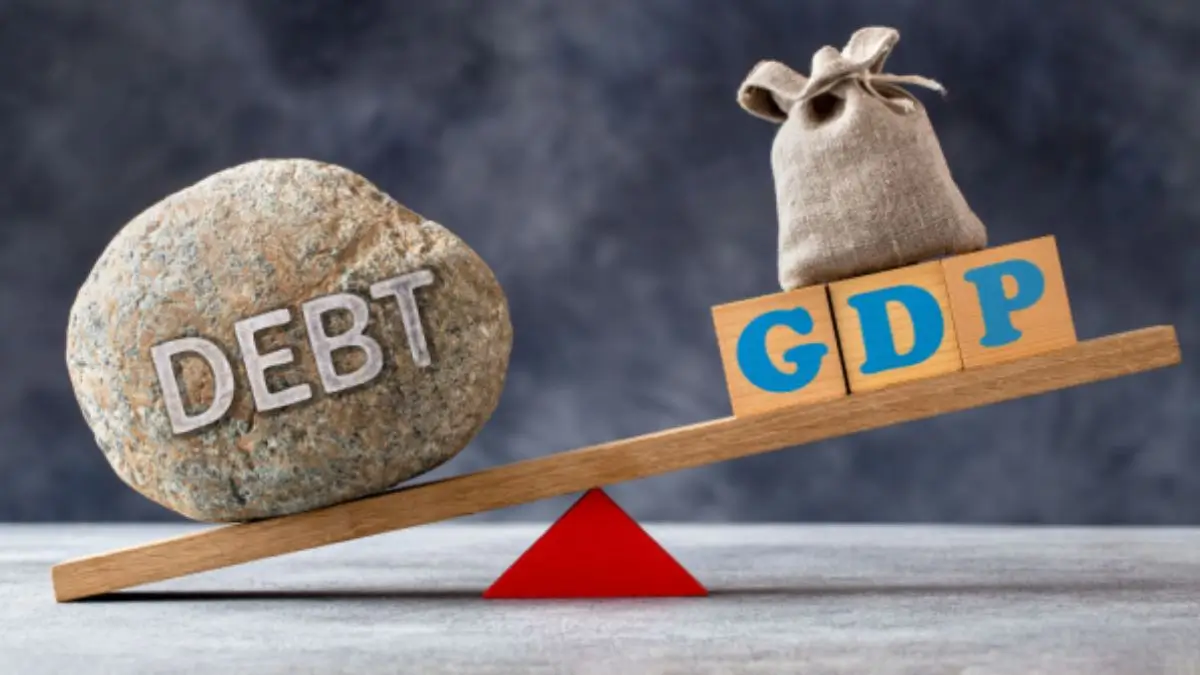
The debt-to-GDP ratio of the Government of India was 58.2%, which was 210 basis points more than the government’s target of 56.1%, revealed Minister of State for Finance, Pankaj Chaudhary. This reflects the ongoing problem of lowering the debt of the government without compromising on fiscal strength amid uncertainties in the global economy. For FY27, the Centre has set a debt-to-GDP target of 55.6%, implying that it has to bring down the ratio by 260 basis points further. The government also intends to utilize the fiscal buffers, such as the ₹1 trillion Economic Stabilisation Fund.
Debt-to-GDP Ratio of India in FY26
As per the data released in Parliament, the outstanding liability of the Union government has decreased from 61.5% of GDP in FY21 to 58.2% in FY26.
Nevertheless, the figure of FY26 was higher than the government’s target of 56.1%.
The difference of 210 basis points suggests that the Centre could not meet its targeted level of lowering debt in FY26.
For FY27, the Centre has set a lower target of 55.6%.
What Caused the Government to Miss the FY26 Target?
First, one of the reasons for missing the target was that the debt-to-GDP ratio increased due to the downward revision of the nominal GDP with the implementation of a new national accounts series with FY23 as the base year.
As the debt-to-GDP ratio is the ratio between outstanding government debt and GDP, a reduction of the latter can increase the former despite an adequate level of debt.
Therefore, the government now needs to work on bringing down the ratio while ensuring economic growth and expenditure control.
FY27 Target Involves Reducing Debt Even More
The government wants to bring the debt-to-GDP ratio down to 55.6% in FY27.
Thus, the ratio would have to be reduced by around 260 basis points from 58.2% achieved in FY26.
There are several criteria for reaching the target such as economic growth, government borrowing, tax collection, and expenditure control.
The latter can be achieved through an increase in nominal GDP.
Fiscal Deficit is Down
In the statement, the government emphasized its improved fiscal situation.
According to Pankaj Chaudhary, the fiscal deficit of the central government has reduced from 9.2% of GDP in FY21 to 4.4% in FY26 as per provisional actual data.
This is due to the effort of the government to make sure that the fiscal deficit reaches a sustainable level after rising substantially during the pandemic period.
Nevertheless, there are still fiscal challenges, especially due to uncertain conditions in the global economy.
₹1 Trillion Economic Stabilisation Fund
An Economic Stabilisation Fund of ₹1 trillion has been established by the government.
As per Chaudhary, the fiscal buffer in terms of such a fund can help the government deal with global headwinds and unforeseen events that have major financial implications.
Such a fund would be useful for the government as it deals with external economic and geopolitical risks in FY27.Increase in Fiscal Deficit in April-June FY27 Quarter
As per the data for Q1 of FY27, the fiscal deficit of the government witnessed a 9.6% increase year-on-year, reaching ₹3.10 trillion.
While this increase has been moderate, there are still issues in terms of fiscal space left with the government.
The government has kept fiscal deficit under control in the initial months of FY27, but this has been driven by the timing of tax devolution to states and expenditure trends.
Debt-to-GDP Ratio Meaning
Debt-to-GDP ratio is the measure that reflects how much debt a government is carrying, as compared to the size of its economy.
This is a crucial metric of fiscal sustainability.
A smaller ratio would provide more flexibility to the government to take borrowing from the financial markets when required in case of downturns or any emergency. A higher debt ratio, on the other hand, could lead to increased interest expenses and lesser fiscal space for investments.








 GST Council Removes Arrest Powers of Tax...
 World Bank Raises India’s GDP Growth F...
 Centre to Borrow ₹7.86 Trillion Throug...