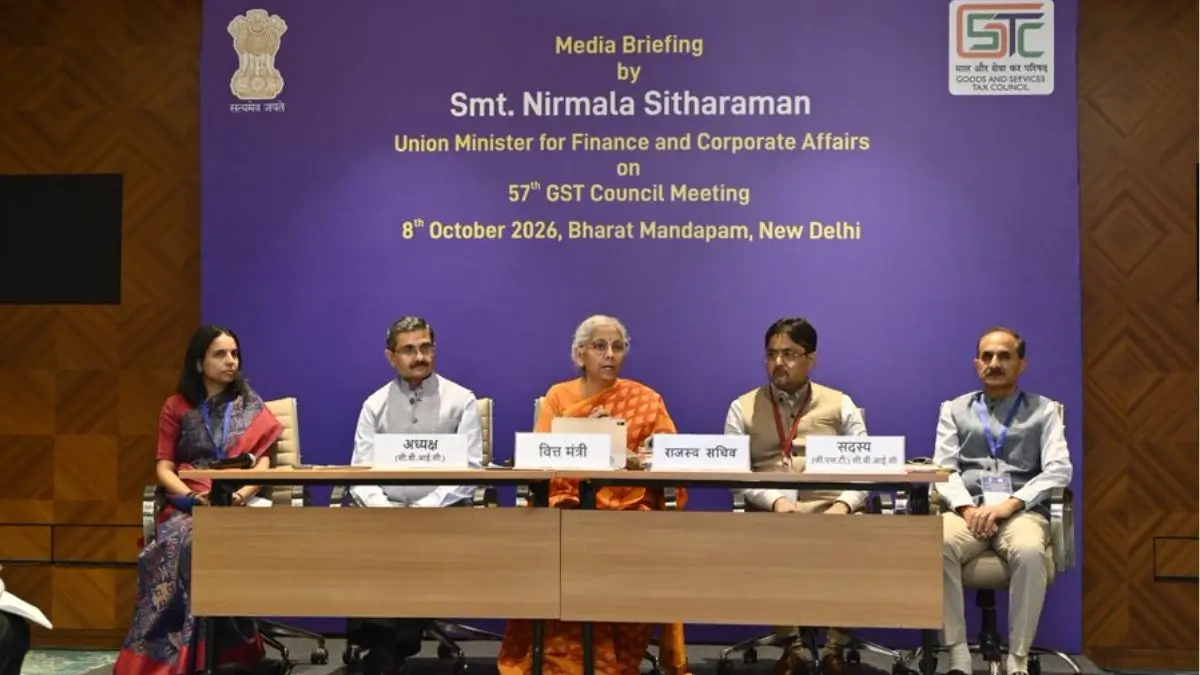
The 57th meeting of the GST Council, chaired by the respected Union Finance Minister Nirmala Sitharaman, was held on October 8th 2026, in New Delhi. In this meeting there were several reforms passed which are related to processes and compliance under the GST regime. These included removal of the arrest powers of the GST tax officers, increasing the threshold for initiation of prosecution from ₹1 crore to ₹5 crore, faster refunds, simplification of registration-related processes, expansion of input tax credit (ITC) facilities, and reduced penalty provisions. However, there were no changes made in the current GST rate structure.
Removal of Arrest Power of Tax Officers by GST Council
One of the important reforms announced at this meeting is the removal of the power of the GST tax officers to make arrests under the GST law. The reform can be seen as part of the general effort being made by the authorities to move from criminalization towards a more trust-based compliance system.
The second important reform in this regard is the increase in the threshold of prosecution from ₹1 crore to ₹5 crore. It means that any case of tax evasion or GST-related offence below ₹5 crore will not result in prosecution under the revised threshold.
Raising the Threshold for Prosecution and Decreasing Fines
The Council adopted several measures that would decrease the level of penalties for procedural mistakes.
Main decisions,
- Threshold for prosecution: Increased from ₹1 crore to ₹5 crore.
- Penalty: Reduced from ₹25,000 to ₹10,000.
- Punishment: The minimum punishment for offenses has been repealed. Thus, now the court will decide whether to impose a fine, imprisonment or both as a punishment.
- Notices regarding GST: No notices for monetary amounts of ₹10,000 or less. Current pending notices of this amount will be withdrawn.
These reforms are expected to separate the criminal nature of serious tax offenses from compliance mistakes that have minor importance.
More Prompt Refunds of GST for Businesses
The Council passed reforms that sought to improve the process of refunding GST.
Refund requests have to be acknowledged within 10 days compared to the existing 15 days. It is also expected that a risk-based approach will facilitate faster processing of refund requests for most of the claims. According to reports from the meeting, 90% of the eligible claims would be cleared within three days.
Prompt refund is especially critical for exporters and businesses where tax credits may affect liquidity.
Input Tax Credit and Compliance Enhancements
The Council increased the ambit of the Input Tax Credit (ITC) in various sectors. One of these decisions pertains to the permission granted to companies in claiming the ITC on GST incurred in procuring insurance for its employees, with due fulfillment of applicable criteria.
In addition, the Council has made provisions that facilitate small vendors carrying out business through e-commerce channels. Among others, it includes simplified and automated mechanisms for registration and refunds, making repetitive engagements with the department unnecessary.
Furthermore, a committee of officers shall evaluate the protection of true consumers having valid invoices, who have received the goods/services, and have paid their suppliers, especially when ITC is challenged owing to supplier side defaults.
No Change Proposed in GST Rates
As opposed to the last big GST reform effort, this time, the 57th meeting of the GST Council did not propose any change in the GST rates. According to the finance minister of India, Nirmala Sitharaman, the council has moved away from trying to rationalize the rates towards better working of the GST system.
GST rate changes are expected to come once a year.








 World Bank Raises India’s GDP Growth F...
 Centre to Borrow ₹7.86 Trillion Throug...
 India Records Record FDI of $94.53 Billi...