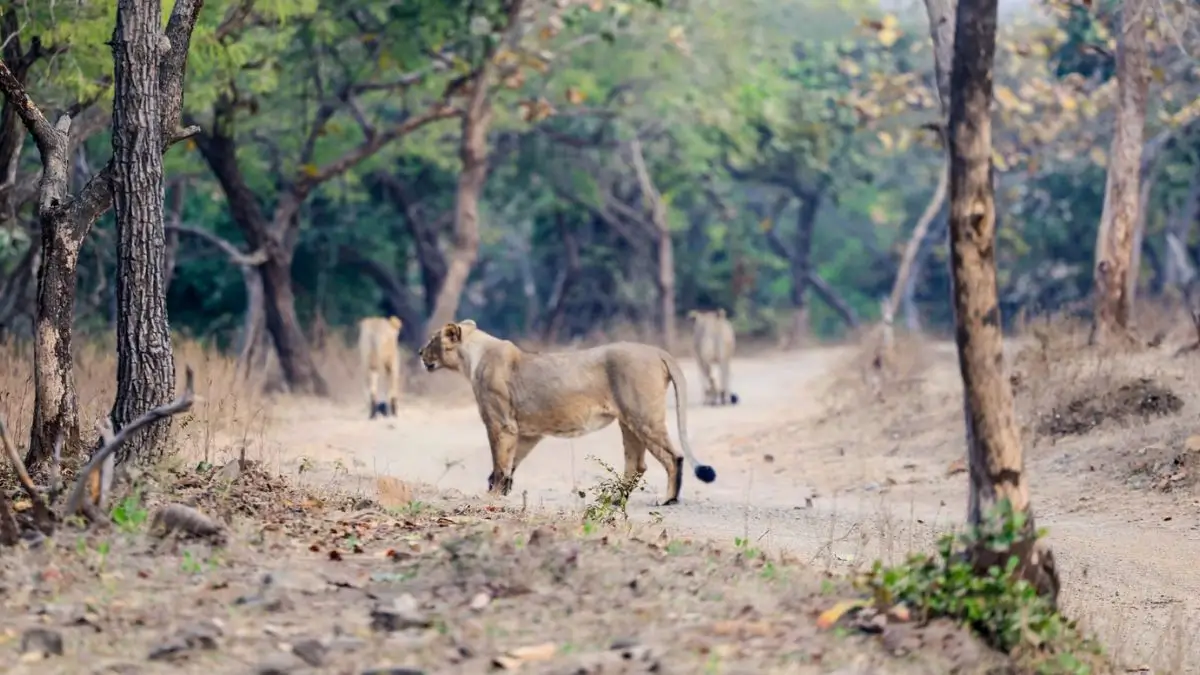
The government of Gujarat has now reorganized the Porbandar forest division so that forest management could be improved and the rehabilitation of Barda as a second habitat of the Asiatic lions could be facilitated. This administrative restructuring has been undertaken following the natural arrival of Asiatic lions back in Barda after 143 years. It has come at a time when there has been a marked rise in the lion population of Gujarat. The restructuring exercise consists of new forest ranges and beats, area-wise responsibilities, recruitment of two Assistant Conservators of Forests (ACF) and mobilization of personnel and equipment.
New Administrative Structure for Porbandar Forest Division
This restructuring process will help to enhance the effective implementation of forest and wildlife related schemes and create area-wise responsibilities of officers and staff.
Under this new administrative structure, Porbandar and Ranavav areas have been separated into individual beats for their forest conservation and patrolling and other work related to the department. The range forests of Porbandar forest division have risen to seven, which comes under Junagadh Wildlife Circle.
Areas of Porbandar and Ranavav Ranges
The new configuration of the Porbandar range includes 80 villages and an area of about 6,840.84 hectares. The Ranavav range includes about 13,051.25 hectares in 27 villages.
Further, 305.94 hectares of the Bhatia range of the adjacent Jamnagar forest division have also been included in the Bhanwad range of the Porbandar forest division.
Kutiyana and Ranavan social forestry ranges have also been added to the Porbandar forest division.
ACFs have been assigned the task of supervision and operation in various areas of the reorganized division.
Second Habitat for Asiatic Lions Becomes Barda
The new structure is associated with the process of strengthening Barda as a secondary home for Asiatic lions. The appearance of the lion species at Barda for the first time since 143 years ago has drawn considerable interest towards this area as an alternative habitat for this species.
It is important to establish such an alternative habitat because historically the Asiatic lion species has been confined only within the Gir landscape area in Gujarat. Expansion of the habitat may have a positive effect on the spatial distribution of the species.
The Barda landscape is situated within the Saurashtra area of Gujarat.
Asiatic Lion Population Grows to 891
The most recent lion census in the state of Gujarat has noted an impressive growth in the population of Asiatic lions in the state.
The figures from the census carried out in May 2026 show that Gujarat has 891 Asiatic lions compared to the 674 reported during the 2020 census.
This marks an additional 217 lions in the past five years. The growth makes the issue of management of habitats even more important.
The Asiatic lion is listed as an endangered species by IUCN and has a natural range limited to Gujarat, India.








 PM-VBRY Scheme: EPFO Offers Up to ₹15,...
 Global Hunger Index 2026: India Ranks 10...
 Sudhakar Dalela Appointed as India’s N...