
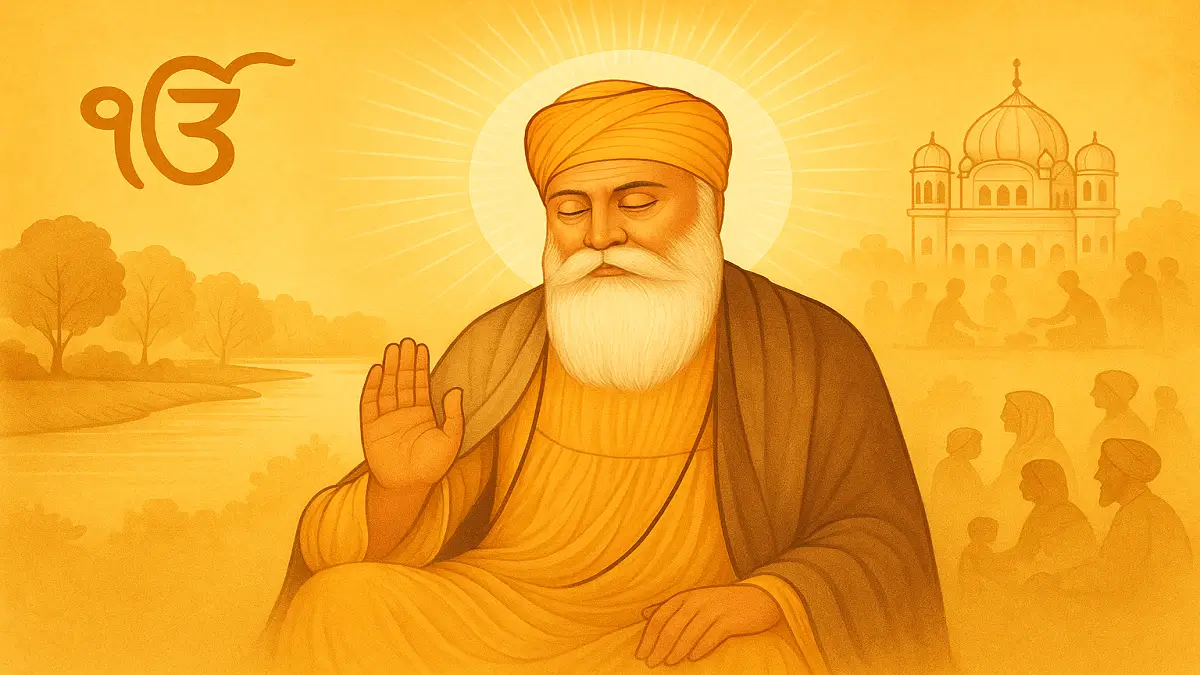
Guru Nanak Dev Ji (1469–1539) was the first Sikh Guru and the founder of Sikhism, a faith rooted in equality, honesty, and service to humanity. Born in Talwandi (now Nankana Sahib, Pakistan), Guru Nanak’s life and teachings brought a message of peace, compassion, and social justice at a time when society was divided by caste and religion.
His simple yet powerful philosophy — “There is only one God, and all humans are equal” — continues to inspire millions around the world. This article explores his life, teachings, and enduring legacy.
Early Life and Background
Guru Nanak Dev Ji was born on 15 April 1469 to Mehta Kalu, a village accountant, and Mata Tripta, in a Hindu family of the Bedi clan. From childhood, Nanak was deeply curious about the world and often questioned traditions that caused inequality.
He studied languages, mathematics, and religious texts, developing a broad understanding of life and spirituality. Though he worked briefly as a storekeeper, his heart was devoted to truth and service. He married Mata Sulakhni, and they had two sons before he dedicated his life fully to spreading divine wisdom.
Historical Context
The 15th century in India was marked by caste discrimination, rigid rituals, and social inequality. Religion had become focused on formality and external practices rather than inner spirituality.
In this environment, Guru Nanak Dev Ji emerged as a reformer, promoting equality and truth over blind faith. He emphasized that one’s actions, not social status or birth, define true devotion. His message appealed to people across communities, offering a path of oneness with God and harmony among humans.
Spiritual Journeys (Udasis)
To spread his message, Guru Nanak undertook extensive journeys known as “Udasis”, traveling across India, Tibet, Arabia, and Persia. During these travels, he met scholars, saints, and common people from various religions — Hinduism, Islam, Buddhism, and Jainism — engaging them in discussions on morality, unity, and devotion.
Through these interactions, he shared universal values of truth (Sat), compassion (Daya), humility (Nimrata), and equality. His travels helped establish Sikhism as a global philosophy centered on peace and service.
Major Teachings of Guru Nanak Dev Ji
Guru Nanak’s teachings, practical and timeless, revolve around three guiding principles:
- Naam Japna: Constant remembrance and meditation on God’s name.
- Kirat Karni: Earning an honest living through integrity and hard work.
- Vand Chakna: Sharing what one has with others, especially the needy.
He rejected social hierarchies and meaningless rituals, declaring that all humans are equal before God. Guru Nanak Dev Ji also supported women’s rights, encouraging equal participation in all aspects of life.
His message of “Ik Onkar” (There is One God) became the cornerstone of Sikh philosophy, promoting unity beyond divisions of religion or caste.
Establishment of Sikhism
Guru Nanak Dev Ji founded Sikhism on the principles of equality, humility, and collective service. Two key institutions symbolized these values:
- Sangat (Community): A gathering where people of all backgrounds come together to pray, learn, and share knowledge.
- Langar (Community Kitchen): A place where everyone, regardless of caste or creed, shares food as equals — a revolutionary concept at that time.
These institutions remain central to Sikh practice today. His successors, the nine Sikh Gurus, expanded his teachings and later compiled them into the Guru Granth Sahib, the holy scripture of Sikhism.
Legacy and Influence
Guru Nanak Dev Ji passed away in 1539 at Kartarpur Sahib, a town he founded along the Ravi River. His followers carried forward his teachings, forming one of the world’s most vibrant and service-oriented religions.
His birth anniversary, celebrated as Guru Nanak Jayanti (Gurpurab), is observed globally with devotion, processions, and community service. Beyond religion, Guru Nanak is remembered as a visionary reformer and spiritual leader who taught equality, kindness, and selfless service.
Even centuries later, his words inspire humanity to rise above prejudice and live truthfully and compassionately.


 Who is known as the Father of Scientific...
 Which River is known as the River of Lif...
 Who is known as the King of the Deccan?











