
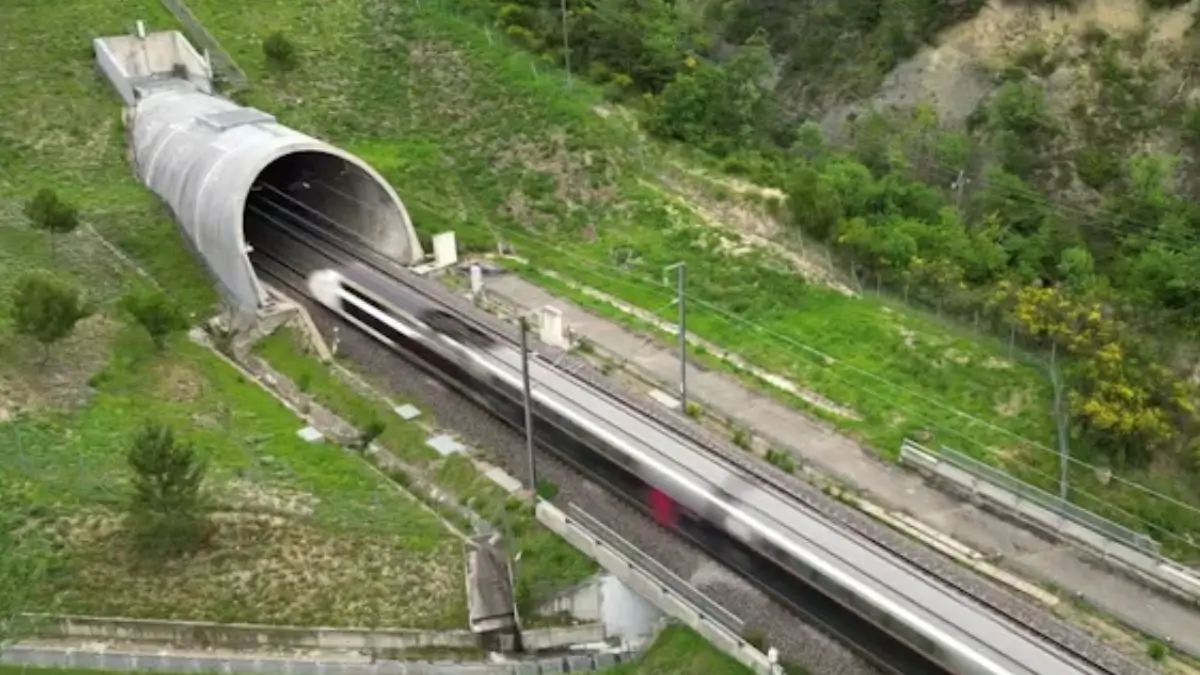
India’s ambitious Mumbai-Ahmedabad Bullet Train Project has achieved the engineering milestone with the deployment of the India’s first railway tunnel hood technology. This innovative system has been installed at the mountain tunnel portals along the high-speed rail corridor to reduce noise, improve passenger comfort and to enhance the operational safety for trains travelling at speeds exceeding 300 kmph.
The adoption of the tunnel hoods reflects country’s commitment to incorporating the global best practices and the advanced engineering solutions in its first high-speed rail project.
What Are Tunnel Hoods?
Tunnel hoods are specially designed structures that are installed at the entrance and exits of the railway tunnels.
This tunnel hoods act as the transition zone between the open atmosphere and the enclosed tunnel environment.
When a high-speed train enters a tunnel it pushes the large volume of the air ahead of its entry and it creates the intense pressure waves.
Without the proper management, these pressure waves can result in to the loud booming sound and it is known as a “tunnel boom,” when the train exits the tunnel.
Tunnel hoods helps to regulate this sudden air compression, ensuring the smoother airflow and reducing noise levels.
How Do Tunnel Hoods Work?
The technology functions by allowing the air to enter and exit the tunnel gradually rather than abruptly.
One of the main features of these structures is the presence of the pressure-relief vents or windows.
These specially designed openings, release the part of the compressed air into the atmosphere as a train enters the tunnel.
This process reduces the pressure build-up, minimizes shock waves and it prevents the generation of excessive noise.
As a result, the aerodynamic interaction between the train and the tunnel becomes smoother and more efficient.
Why Are Tunnel Hoods Important?
The installation of tunnel hoods offers the several operational and environmental benefits.
They significantly reduce the tunnel boom and noise pollution, which helps to minimize disturbances for communities who are living near tunnel exits.
The technology also improves the passenger comfort by reducing the pressure fluctuations experienced inside train coaches.
Additionally, smoother airflow contributes to safer and more efficient for operation of high-speed trains and particularly for those travelling at very high speeds.
Mumbai-Ahmedabad Bullet Train Corridor
The Mumbai-Ahmedabad High-Speed Rail Corridor passes through the challenging terrain and it includes the eight mountain tunnels, seven are located in Maharashtra and one in Gujarat.
Tunnel hoods are being installed at the both ends of these mountain tunnels to ensure the optimal aerodynamic performance throughout the corridor.
The project is being developed by using the advanced Japanese Shinkansen technology and it is expected to transform inter-city transportation in western India.
Global Use of Tunnel Hood Technology
Tunnel hoods are commonly used in countries operating high-speed rail networks, particularly where trains travel at speeds exceeding 300 kmph.
Countries like such as Japan, France and China have successfully incorporated the similar systems into their bullet train infrastructure.
The introduction of this technology in India showed the country’s effort to meet the international standards of safety, sustainability and the passenger experience.








 India’s Internet Subscribers Cross 1.1...
 PM GatiShakti Completes Five Years: Obje...
 President Droupadi Murmu Appoints Six Go...










