
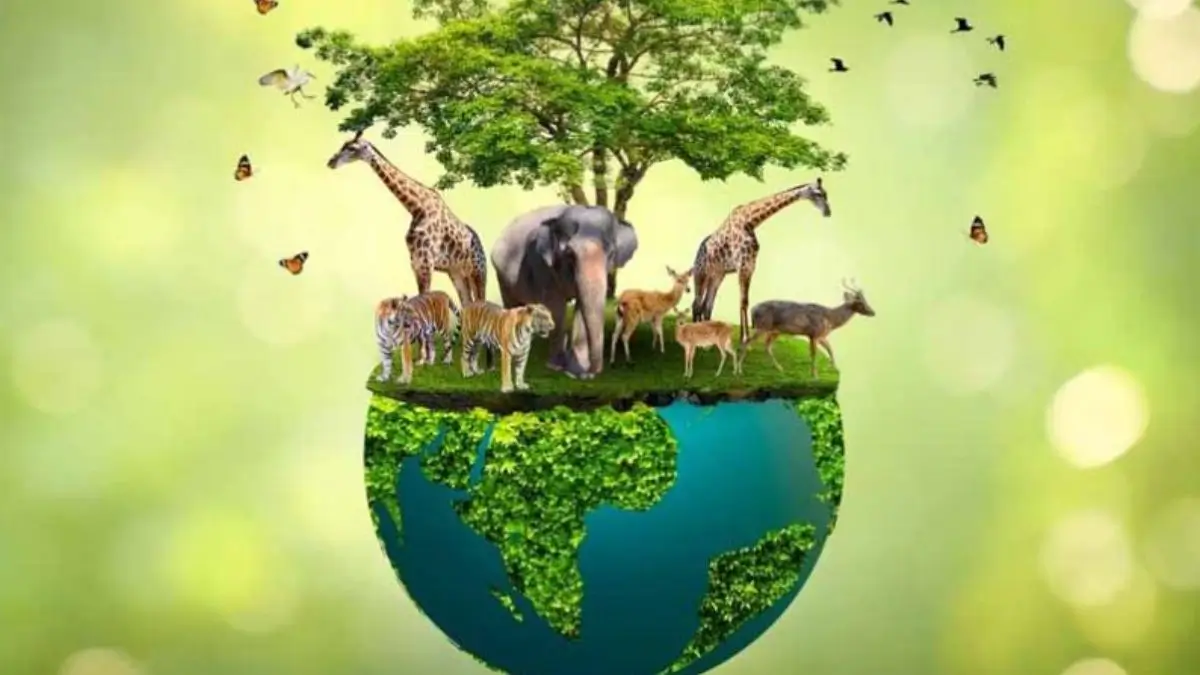
The Ministry of Environment, Forest and Climate Change (MoEFCC) and the National Biodiversity Authority (NBA) has launched the major five-year biodiversity project. This project is aims to strengthen the grassroots governance in the Tamil Nadu and Meghalaya. This project is backed by the Global Environment Facility and the United Nations Development Program. And this initiative focuses on to integrating biodiversity into the local planning systems along with to empowering communities and promoting sustainable livelihoods.
The Landmark Biodiversity Initiative Rooted in Local Governance
The newly launched project titled as the “Strengthening Institutional Capacities for Securing Biodiversity Conservation Commitments” and it will run from 2025 to 2030 with the funding support of USD 4.88 million.
The central part of this initiative aims to embed the biodiversity conservation directly into the local governance frameworks and particularly through Gram Panchayat Development Plans (GPDPs).
This also ensures that conservation is no longer separate from the development but becomes the central part of rural planning and decision-making.
By strengthening the institutions like Panchayati Raj Institutions (PRIs) and Biodiversity Management Committees (BMCs) this project creates the system where local communities actively manage and benefit from the biodiversity resources.
Focus Landscapes: Ecological Hotspots of India
This project is strategically anchored in two the ecologically rich landscapes.
Tamil Nadu: Wildlife Corridors and Community Knowledge
The Sathyamangalam Area is located at the junction of the Western Ghats and Eastern Ghats which includes the,
- Mudumalai Tiger Reserve
- Sathyamangalam Tiger Reserve
These regions are important for the wildlife corridors which supports the species movement. Also the forest-fringe communities living here possess the deep traditional ecological knowledge as which will now be formally integrated into the governance through GPDPs.
Meghalaya: Community-Led Conservation Systems
In the Garo Hills region this project covers the,
- Nokrek Biosphere Reserve
- Balpakram National Park
- Siju Wildlife Sanctuary
Meghalaya uses the Village Employment Councils (VECs0 which function similarly to the gram panchayats. These institutions will lead to the conservation efforts and will ensuring the community ownership.
Key Objectives Driving the Project
This project have ensures that biodiversity is embedded in to the local development plans.
This will strengthens the governance by aligning to the environmental goals with rural development priorities.
The major highlight is the introduction of the sustainable financing mechanisms such as,
- Access and Benefit Sharing (ABS) to reward the communities for conserving biodiversity.
- Also the CSR co-financing to attract the private sector participation.
- The Green micro-enterprises to generate eco-friendly livelihoods.
These approaches will create the direct economic link between the conservation and community welfare.
Capacity Building and Knowledge Sharing
This initiative focuses on to the documenting successful models and scaling them to the nationwide through MoEFCC and NBA platforms.
Special focus to be placed on empowering,
- Women
- Scheduled Castes (SCs)
- Tribal communities
Why This Project Matters for India
India is one of the world’s megadiverse countries but its still faces increasing pressure from the development and climate change. This project is important because it connects the local governance with global environmental goals.
It directly supports the,
- India’s newly updated National Biodiversity Strategy and Action Plan (NBSAP 2024-2030).
- Also the 30×30 target under the Kunming-Montreal Global Biodiversity Framework.
- And the India’s Nationally Determined Contributions (NDCs) under the Paris Agreement.
Question
Consider the following pairs.
Protected Area State
- Kumbhalgarh Wildlife Sanctuary – Rajasthan
- Nauradehi Sanctuary – Madhya Pradesh
- Barak Bhuban Wildlife Sanctuary – Assam
Which of the pairs given above are correctly matched?
A. 1 and 2 only
B. 2 and 3 only
C. 1, 2 and 3
D. 1 and 3 only








 OpenAI Partners with Karmayogi Bharat fo...
 India and Poland Agree to Boost Defence,...
 India and Ghana Sign 2 MoUs to Strengthe...










