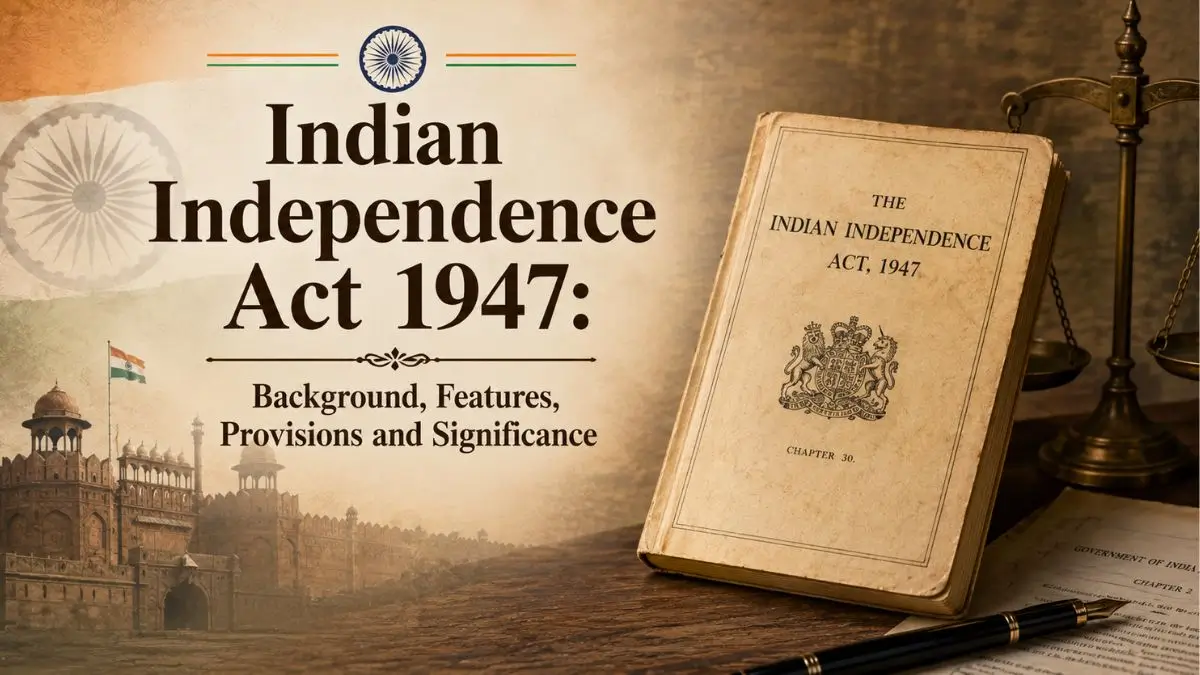
The Indian Independence Act 1947 which was one of the most significant constitutional landmarks in the zistory of modern India. This Act, enacted by the British Parliament, provided the legal basis for the termination of British rule in India and the establishment of two new independent dominions of India and Pakistan.
The Act was given the Royal Assent on 18 July 1947, and came into force on 15 August 1947. With the promulgation of the Indian Independence Act, almost two centuries of British rule in India came to an end, and legislative and executive powers were vested in the newly established dominions.
The Act was drafted on the basis of 3 June Plan, also referred to as the Mountbatten Plan, according to which the partition of British India was accepted. The Act also terminated the British paramountcy over the princely states and gave the Constituent Assemblies of India and Pakistan the power to formulate their own constitutions.
What Was the Indian Independence Act 1947?
- The Indian Independence Act 1947 was a law enacted by the Parliament of the United Kingdom in order to create two independent dominions of India and Pakistan from the territories of British India.
- The Bill was introduced in the British Parliament in July 1947 and given the Royal Assent on 18 July 1947. The Indian Independence Act came into force on 15 August 1947, thus ending the British sovereignty over India.
- On 14 August 1947, Pakistan became an independent dominion, while India got independence on 15 August 1947.
- The Act was the legal result of a long political process involving the Indian national movement and negotiations between the British Government, the Indian National Congress and the Muslim League.
Introduction to the Indian Independence Act 1947
- The Indian Independence Act was not an abrupt occurrence. The act was a culmination of years of political activity and constitutional discussions for an end to British rule.
Emergence of the Indian National Movement
- The Revolt of 1857 proved to be a significant challenge to British rule in the Indian subcontinent. In response to the revolt, the British Crown took direct control over India from the East India Company.
- The establishment of the Indian National Congress in 1885 provided Indians a political forum to demand a greater role in governance and, ultimately, self-government.
- In the twentieth century, the Indian freedom struggle grew stronger with the help of leaders like Mahatma Gandhi, Jawaharlal Nehru, Sardar Vallabhbhai Patel, Subhas Chandra Bose and Maulana Abul Kalam Azad.
Movements of Non-Cooperation and Civil Disobedience
- The Indian national movement gained momentum due to movements like the Non-Cooperation Movement (1920-22) and the Civil Disobedience Movement (1930-34).
- There was a gradual shift in the demand from constitutional changes and dominion status to full independence.
Quit India Movement
- The Quit India Movement of 1942 initiated by Mahatma Gandhi provided a significant impetus to the struggle for an end to British rule in the Indian subcontinent.
- Even though the movement was suppressed by the British government and leaders were arrested, the political scenario after the Second World War made continuation of the colonial regime in the region difficult.
Lahore Resolution of 1940
- Communal and political differences between the Congress and the All-India Muslim League increasingly impacted the constitutional discussions.
- The Lahore Resolution of 1940 by the Muslim League made the demand for separate Muslim states stronger, which later served as the political foundation for Pakistan.
Failure of the Cabinet Mission Plan
- The Cabinet Mission Plan of 1946 tried to maintain the integrity of India in the form of a federal system having a substantial amount of provincial autonomy.
- But differences between the Congress and the Muslim League over the nature of the constitution proposed made it impossible for the mission to accomplish its goal.
- Communal conflict followed, resulting in violence.
Attlee’s Declaration
- Clement Attlee, the then British Prime Minister, made an announcement on February 20, 1947, that Britain would make efforts to transfer power in India no later than June 1948.
- But with deteriorating politics and communal situation, a faster schedule was devised.
Plan of Lord Louis Mountbatten
- Lord Louis Mountbatten, the last Viceroy of India, came to India in March 1947. He worked out a plan for the transfer of power and partition, which was announced on June 3, 1947.
- Congress and the Muslim League accepted this plan, which made possible the Indian Independence Act.
Important Features of the Indian Independence Act, 1947
The Act completely altered the constitutional and political system of India.
1. Partition of British India
The Act partitioned the British India into the two following dominions,
- Dominion of India
- Dominion of Pakistan
Originally Pakistan comprised West Pakistan and East Bengal; however, East Bengal subsequently became Bangladesh in 1971.
2. End of British Sovereignty
- British sovereignty over India came to an end under the Act.
- British Parliament ceased to exercise sovereign legislative power over the newly established dominions from August 15, 1947.
- Thus the constitutional relationship between Britain and the Indian sub-continent was thoroughly transformed.
3. Abolishment of the Office of Viceroy
- The office of the Viceroy was done away with.
- Each dominion had to appoint a Governor-General by the British monarch in consultation with the respective dominion government.
- The Governor-General was supposed to act as the constitutional head in the early phase of the dominions’ independence.
4. Powers of the Constituent Assemblies
Constituent Assemblies of India and Pakistan were vested with ample powers.
They could,
- Draft their respective constitutions.
- Work as Legislatures.
- Amend or repeal the existing British Acts.
- Legislate over their respective territories.
This feature of the Act proved highly significant in that it allowed Constituent Assembly of India to frame the Constitution of India.
5. Termination of British Paramountcy Over Princely States
- With the termination of the Act, British paramountcy over the princely states ended.
- This implies that treaties and agreements entered into by the British Crown and princely states were brought to an end.
- Subsequently, the princely states were faced with the problem of accession to either India or Pakistan. Political integration of these states became one of the biggest challenges of independent India and was achieved through the leadership of Sardar Vallabhbhai Patel and V. P. Menon.
6. Boundaries Determination
- Partition necessitated the separation of territories between India and Pakistan.
- A boundary commission, presided over by Sir Cyril Radcliffe, was set up to demarcate the boundaries of Punjab and Bengal.
- Resulting Radcliffe Award led to the separation of these two provinces and facilitated the largest mass migration witnessed in modern history.
7. Termination of Office of the Secretary of State for India
- Office of the Secretary of State for India was also terminated through this Act as it played a crucial part in the governance of British India.
- Responsibilities of this office were vested in the government’s structure in connection with Commonwealth affairs.
8. Government of India Act 1935 As Constitutional Provisions
- Until the two dominions adopted their constitutions, the Government of India Act 1935 could be used with necessary amendments as constitutional provisions.
- It provided for smooth administration of the government in the process of transition from colonial to constitutional status.
9. Legislative Powers of the Governor-General
- Act gave constitutional powers to the Governor-General during the transitional period.
- The right of the British monarch to exercise the power of veto or reservation of legislation in the same way as exercised under the colonial constitution was largely amended.
- Governor-General was empowered to give assent to legislation on behalf of the Crown.
10. Changes in Civil Services
- This Act also introduced many changes concerning civil services.
- British Secretary of State for India lost his power to make appointments and reservations in civil services.
- Rights of officials appointed before the Independence would remain unchanged under the transitional arrangement.
Importance of the Indian Independence Act 1947
The Indian Independence Act was important because it gave the legislative provisions for the transfer of power from Britain to India and Pakistan.
It legally abolished British rule over India and set the constitutional framework for the two newly formed dominions.
For India, the Indian Independence Act paved the way for completing the Constitution by the Constituent Assembly. The Constitution of India finally came into effect on January 26, 1950.
This Act heralded a new political era despite Independence being marred by the huge human catastrophe of Partition.








 Dussehra 2026: Top 30 Most Important GK ...
 Dussehra and UNESCO: Ramlila, Durga Puja...
 Mysuru Dasara 2026: History, Jamboo Sava...