
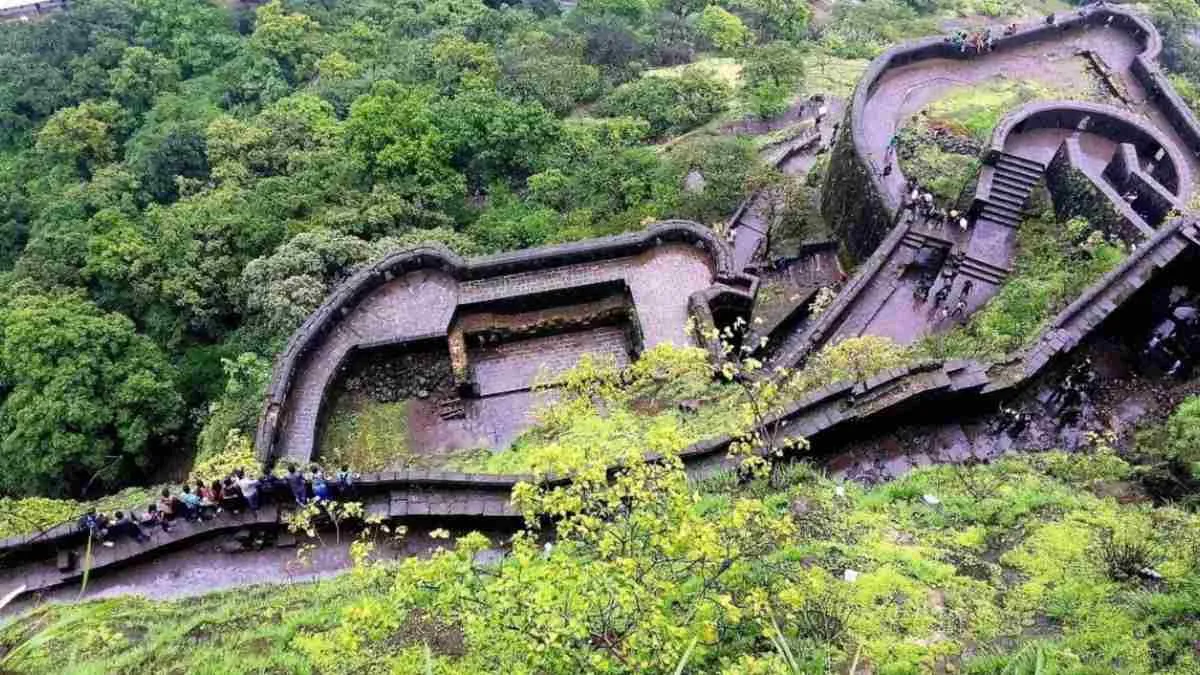
Nestled in the scenic hills of Lonavala in Maharashtra, Lohagad Fort is one of India’s oldest and most historically significant hill forts. Believed to be nearly 2,000 years old, the fort has witnessed the rise and fall of several dynasties, including the Satavahanas, Chalukyas, Rashtrakutas, Yadavas, Marathas, Mughals, and the British.
Known as the “Iron Fortress of the Deccan,” Lohagad Fort is renowned for its strong fortifications, strategic location, and rich Maratha heritage. Today, it is a popular trekking destination and an important historical monument.
Where is Lohagad Fort Located?
Lohagad Fort is situated near Lonavala in Pune district, Maharashtra, in the Sahyadri mountain range (Western Ghats).
Key Location Details
| Particular | Details |
|---|---|
| State | Maharashtra |
| District | Pune |
| Nearest Hill Station | Lonavala |
| Mountain Range | Sahyadri (Western Ghats) |
| Elevation | Approximately 1,033 metres (3,389 feet) above sea level |
The fort offers breathtaking views of lush green valleys, waterfalls, and nearby forts, making it a favourite destination during the monsoon season.
Why is Lohagad Called the “Iron Fortress of the Deccan”?
The name Lohagad literally translates to “Iron Fort.”
- Loha means Iron in Marathi.
- Gad means Fort.
The fort earned this title because of its:
- Massive basalt stone walls.
- Exceptionally strong defensive architecture.
- Iron-rich terrain providing a solid foundation.
- Strategic hilltop location overlooking important trade routes.
Its robust construction made it extremely difficult for enemies to conquer, earning it the reputation of the Iron Fortress of the Deccan.
Architectural Features of Lohagad Fort
Lohagad Fort is an excellent example of medieval military architecture.
Some of its most notable features include:
Four Massive Gates
The fort has four well-preserved entrance gates:
- Ganesh Darwaja
- Narayan Darwaja
- Hanuman Darwaja
- Maha Darwaja
These gates were designed to slow invading armies and strengthen the fort’s defence.
Strong Fortification
Other remarkable structures include:
- Thick stone walls.
- Bastions for surveillance.
- Ancient caves.
- Water reservoirs.
- Step wells.
- Secret escape passages.
- Granaries and storage facilities.
Who Built Lohagad Fort?
The exact origin of Lohagad Fort remains uncertain, but historical evidence suggests that its earliest structures date back nearly 2,000 years.
Over the centuries, the fort was controlled and expanded by several ruling dynasties, including:
- Satavahanas
- Chalukyas
- Rashtrakutas
- Yadavas
- Bahmani Sultanate
- Nizam Shahis
- Marathas
- Mughals
- British
Historical records also indicate that the Lohtamia Dynasty controlled the fort for a significant period during the medieval era.
Lohagad Fort During the Maratha Empire
Lohagad Fort occupies a special place in Maratha history.
Capture by Chhatrapati Shivaji Maharaj
- 1648: Chhatrapati Shivaji Maharaj captured Lohagad Fort.
- 1665: The fort was surrendered to the Mughals under the Treaty of Purandar.
- 1670: Shivaji Maharaj recaptured the fort.
After reclaiming Lohagad, Shivaji reportedly used it as a secure storage site for treasures obtained during military campaigns.
Lohagad During the Peshwa Period
During the Peshwa administration, the fort was extensively developed by Nana Phadnavis.
He introduced several improvements, including:
- Construction of step wells.
- Additional water storage facilities.
- Residential structures.
- Hidden chambers.
- Strengthening of defensive systems.
These developments improved both the fort’s military capability and its sustainability.
Capture of Lohagad Fort by the British
Following the Third Anglo-Maratha War, the British East India Company captured Lohagad Fort on 4 March 1818.
The British believed the fort contained hidden Maratha treasures.
They carried out:
- Excavations.
- Digging operations.
- Searches around underground chambers.
- Attempts to drain water tanks.
Despite extensive efforts, no treasure was discovered.
Eventually, the British abandoned the fort in 1845.
Jain Brahmi Inscriptions Discovered
In September 2019, trekkers from Pune discovered an ancient inscription inside Cave No. 7 at Lohagadwadi.
Key Highlights
- Written in Jain Brahmi script.
- Language: Prakrit.
- Consists of six lines.
- Begins with the phrase “Namo Arahamtanam”, meaning “Reverence to the Enlightened Ones.”
The inscription is considered one of the earliest pieces of evidence of Jainism in the region and highlights the spread of Jain culture across western India.
Historical Importance of Lohagad Fort
Lohagad Fort has played a vital role throughout Indian history.
Its strategic importance includes:
- Guarding important trade routes connecting the Konkan coast and the Deccan Plateau.
- Serving as a military stronghold for multiple dynasties.
- Protecting Maratha wealth and supplies.
- Acting as a surveillance point over surrounding valleys.
- Demonstrating advanced medieval fort architecture.
Interesting Facts About Lohagad Fort
- Nearly 2,000 years old.
- Located near Lonavala in Maharashtra.
- Popularly known as the Iron Fortress of the Deccan.
- Features four magnificent entrance gates.
- Captured and recaptured by Chhatrapati Shivaji Maharaj.
- Used by the Marathas to store war treasures.
- Captured by the British in 1818.
- Ancient Jain Brahmi inscriptions were discovered in 2019.
- Declared a protected historical monument and one of Maharashtra’s popular trekking destinations.
Key Facts at a Glance
| Particular | Details |
|---|---|
| Fort Name | Lohagad Fort |
| Meaning | Iron Fort |
| Location | Lonavala, Pune District, Maharashtra |
| Mountain Range | Sahyadri (Western Ghats) |
| Elevation | Approximately 1,033 metres above sea level |
| Famous For | Strong fortifications and Maratha history |
| Captured by Shivaji | 1648 |
| Recaptured by Shivaji | 1670 |
| British Capture | 4 March 1818 |
| Important Discovery | Jain Brahmi inscription (2019) |








 Who Is Navi Pillay? Nobel Peace Prize 20...
 Vande Bharat vs Amrit Bharat Express: Ke...
 Asian Games to LA28: Which Sports Earned...










