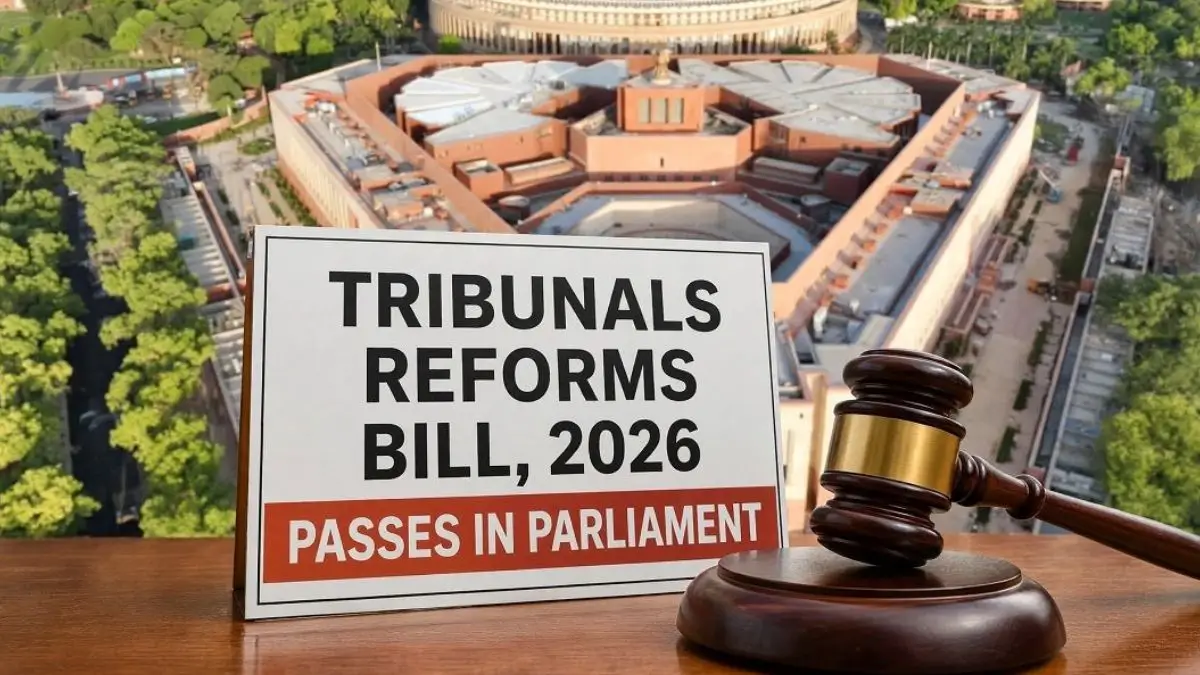
The Tribunals Reforms Bill, 2026 has received approval from the Parliament and hence, the stage has been set for setting up the National Tribunals Commission (NTC). The objective of the new legal structure is to achieve uniformity in terms of appointment, terms of service, and tenure of tribunal members. The Tribunals Reforms Bill, 2026 has been approved by both Houses of the Parliament and hence, marks a significant move towards the restructuring of tribunals in India. The Tribunals Reforms Bill, 2026 is an attempt at replacing the Tribunals Reforms Act, 2021 with a new legal regime built around NTC.
Tribunals Reforms Bill, 2026
Tribunals Reforms Bill 2026 is an act that aims at bringing about changes in the current framework within which tribunals operate in India. The Bill envisages the setting up of an independent National Tribunals Commission which would be the main agency for managing important tribunals.
The Bill gives a standard approach for the selection and appointment of chairpersons and members of tribunals. It also contains provisions pertaining to their tenure, terms of service and administration.
These reforms aim at addressing the issues that have surfaced time and again in connection with appointments, tenures, administration and independence of tribunals.
What Is the National Tribunals Commission?
National Tribunals Commission (NTC) would have its office in New Delhi and it would work as an autonomous body for the administration of important tribunals.
NTC will have various important functions, such as,
- Recommendation of candidates for filling vacancies in tribunals.
- Overseeing the functioning of tribunals.
- Carrying out investigations against members of tribunals wherever necessary.
- Manning the proposed National Tribunals Data Grid.
- Bringing about uniformity in appointments and conditions of services.
The proposed data grid would make the monitoring and management of tribunal matters more effective.
Formation of the National Tribunals Commission
The proposed formation of the National Tribunals Commission will consist of five members.
The composition will be made up of,
- Chairman: Either an ex-Supreme Court Judge or a retired Chief Justice of a High Court.
- Two Judicial Members: Individuals who were once Chief Justices or Judges of a High Court.
- Two Technical Members: Individuals with at least 25 years of experience in fields such as public administration, finance, law, management, banking, IT or accountancy.
How Does the Bill Change the Appointments of Tribunals?
One of the most significant clauses of the Bill is in the appointment process.
The Selection Committee will now propose names for the vacant positions. A waiting candidate will also be proposed by the committee in case the proposed person is not appointed.
Appointments will have to be made by the Central Government within three months of receiving the proposals from the Selection Committees.
It is hoped that this method will help in reducing delays in appointments and help in keeping the Tribunals running.
Tenure Terms of Members of Tribunals
As per the Tribunals Reforms Bill, 2026, the tenure terms of the members of the Tribunals will be the same.
According to the Bill, the Tenure terms will be as follows,
- The Chairpersons of the Tribunals will be able to continue for five years or till they reach the age of 70 years, whichever comes first.
- The Members of the Tribunals will be able to continue for five years or till they reach the age of 67 years, whichever comes first.
- Members may be reappointed depending on their performance.
Which Tribunals Would Be Included in the New Regime?
The First Schedule of the Bill provides for 16 major tribunals and appellate tribunals.
The main tribunals which would be covered are,
- Central Administrative Tribunal (CAT)
- National Green Tribunal (NGT)
- Income Tax Appellate Tribunal (ITAT)
- Customs, Excise and Service Tax Appellate Tribunal (CESTAT)
- Debt Recovery Tribunal (DRT)
- Telecom Disputes Settlement and Appellate Tribunal (TDSAT)
These tribunals will be handling specialized disputes in areas like taxation, environment, government services, debt recovery and telecommunication.
Need for the Tribunals Reforms Bill, 2026
There have been several issues with the tribunal system in India like vacancy, appointment delays, administrative dependency and lack of independence of the tribunals.
The previous Act of 2021 had proposed several changes in the tribunal system. But, several clauses of the said act were challenged in courts due to the provisions on tenure, appointment procedures and executive interference.
The current bill is an attempt to create a better mechanism for administration through the National Tribunals Commission.
How Will the Bill Enhance the Justice System?
Tribunals were created in order to offer specialized and slightly quicker avenues to settle disputes. Vacancies and administrative challenges may however impact their effectiveness.
In what ways will the new system assist?
- Faster appointments: A timeline for appointment would assist in reducing the number of vacancies.
- Standardization: Standard provisions concerning terms of service and tenure would assist in minimizing inconsistencies among different tribunals.
- Effective oversight: The National Tribunals Data Grid would provide an avenue for overseeing tribunal information.
- Independence: An independent commission would address issues arising from too much executive control in the management of the tribunals.
- Efficient justice: Better tribunals would assist in reducing the workload of conventional courts by settling specialized disputes.








 Supreme Court Constitutes Standing Commi...
 Aadhaar Name Change Rules Revised: Docum...
 IMC 2026: PM Modi Highlights India’s 5...