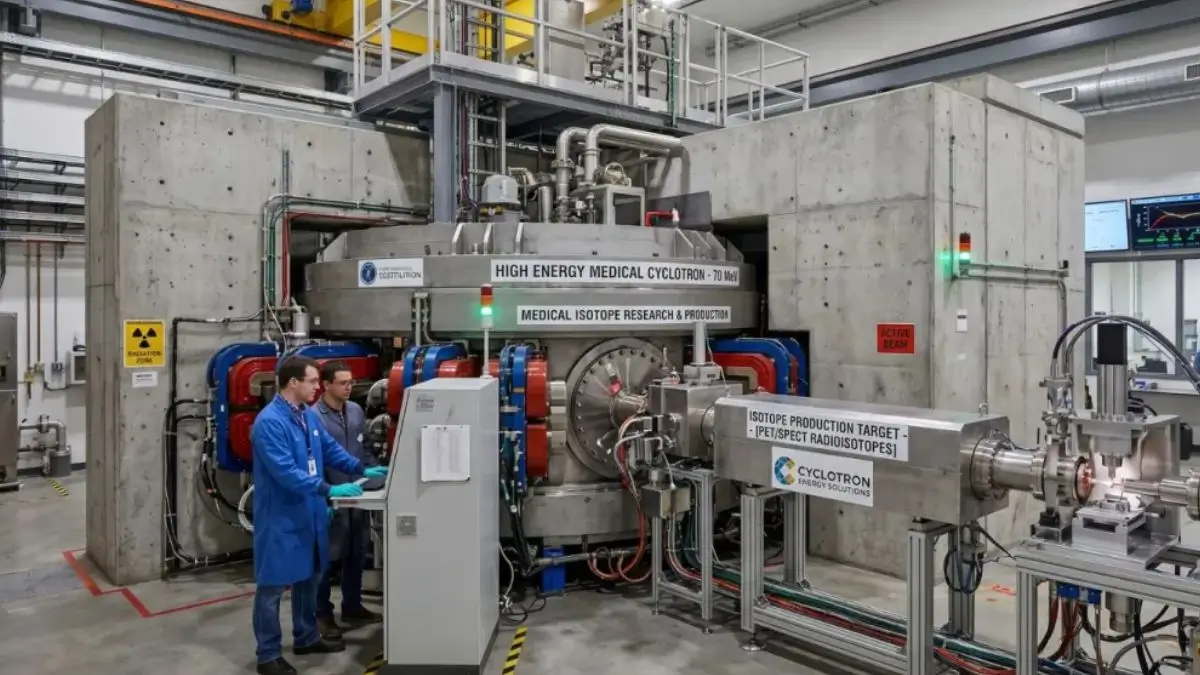
The Maharashtra Cabinet has approved the establishment of the High-Energy Medical Cyclotron Project (HEMCP) in the Nagpur, this will be implemented with the estimated investment around ₹300 crore. This project aims to strengthen the cancer diagnosis and treatment infrastructure across the Central India by ensuring the local production of the critical radioisotopes used in to the nuclear medicine and PET-CT scans.
Alongside with this healthcare initiative, the state government has also approved the Maharashtra Rural Drinking Water Policy of 2026 and it provide the sustainable and reliable drinking water access to the rural households.
Maharashtra Clears High-Energy Medical Cyclotron Project
The High-Energy Medical Cyclotron Project will be established in the Nagpur and it is developed as a Radiopharmaceutical Innovation Hub.
The facility is expected to reduce the dependence on major healthcare centres such as the Mumbai and Hyderabad for radioisotope supplies.
Radioisotopes are essential components in to the advanced cancer diagnosis and treatment.
They are widely used in the PET-CT scans, nuclear medicine procedures and medical research. Timely availability of these materials is vital because many radioisotopes have the short half-life and it must be used quickly after production.
This project has been approved with a budget of around ₹300 crore, which will be funded equally by the Medical Education Department and the Industry Department. The Medical Education Department will immediately contribute around the ₹150 crore for implementation.
Why Nagpur Was Chosen
The strategic location of Nagpur in central India makes it an ideal location for the project. The facility will serve the patients within a radius of approximately 500 kilometres and covering the parts of Maharashtra, Madhya Pradesh, Chhattisgarh, Telangana and Andhra Pradesh.
The city already hosts the important healthcare institutions which includes the Government Medical College (GMC), the National Cancer Institute (NCI), and the All India Institute of Medical Sciences.
These institutions will benefit from the improved access to the radiopharmaceuticals and advanced diagnostic services.
A 30-hectare land parcel at the Bhansoli (Kinhi) in Hingna Taluka has been approved for the project.
What is a Cyclotron?
A cyclotron is a type of particle accelerator which is used to produce the radioactive isotopes for medical applications.
These isotopes are used in to the diagnostic imaging techniques such as Positron Emission Tomography (PET) scans and in targeted cancer therapies.
Cyclotrons plays the crucial role in modern nuclear medicine by enabling the production of the short-lived isotopes close to healthcare facilities which ensures the timely availability for patient treatment.
Project Implementation Framework
The project will be implemented via the state-owned company Mahacare using a Special Purpose Vehicle (SPV) which was established under the Companies Act, 2013.
Until the SPV is formally constituted, a steering committee chaired by the Shrikar Pardeshi, Principal Secretary to the Chief Minister will oversee the project’s execution and coordination.
The initiative is expected to promote the research, innovation and capacity-building in the radiopharmaceutical sciences while enhancing the healthcare infrastructure in the region.
Maharashtra Rural Drinking Water Policy 2026
The Maharashtra Cabinet has also approved the Maharashtra Rural Drinking Water Policy 2026 to ensure the sustainable and uninterrupted drinking water supply in rural areas.
This policy supports the objectives of the Jal Jeevan Mission 2.0 and it focuses on long-term operation and maintenance of rural water supply schemes.
Also a dedicated corpus fund will be established at the Gram Panchayat, Zilla Parishad and Maharashtra Jeevan Pradhikaran levels.
Technology will also plays the key role in implementation. The state plans to deploy SCADA systems for the multi-village water supply schemes, establish GIS-based dashboards and strengthen the digital monitoring of water assets.
Key Features of the Drinking Water Policy
This policy introduces the household water tariffs ranging from a minimum of ₹150 to a maximum of ₹400 per month.
If revenue collection falls short, Gram Panchayats may use the grants received under the 15th and 16th Finance Commissions to bridge the funding gap.
Women Self-Help Groups (SHGs) and Primary Agricultural Credit Societies (PACS) will receive the priority in water billing, collection and maintenance contracts.
The three-tier grievance redressal mechanism will also be established and it will be supported by the Nal Jal Seva mobile application and Nal Jal Mitra







 Delhi Institute for Transformation and I...
 Delhi Cabinet Approves Go-Delhi Foundati...
 Asiatic Lions Return to Barda Wildlife S...