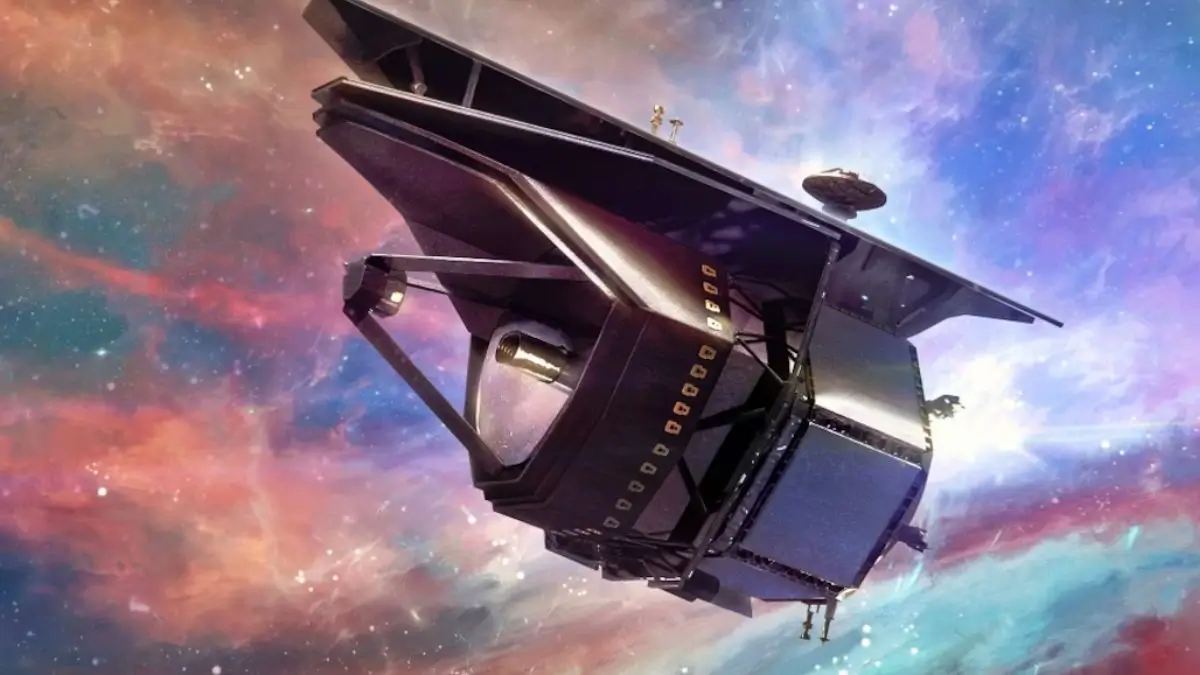
NASA selected PRIMA (PRobe far-Infrared Mission for Astrophysics) to move into Phase B, the stage covering preliminary design and technology development. It is the first mission in a new class of astrophysics missions called Probe Explorers, within the Explorers Program. NASA announced the decision on Wednesday, 23 September 2026. The observatory has a 5.9-foot (1.8-metre) telescope and is targeted for launch in 2033.
NASA’s PRIMA Telescope
NASA said the mission remains subject to a confirmation review. The review will assess technical, programmatic and cost performance to decide whether PRIMA is ready to enter Phase C, the implementation stage.
Some reports describe the mission as a “$1.2 billion telescope”. Strictly, $1.2 billion is a cap on project cost if the mission is confirmed. It excludes launch and other non-project costs.
Key Details of PRIMA
- Full form: PRobe far-Infrared Mission for Astrophysics
- Wavelength band: far-infrared
- Telescope size: 5.9 feet (1.8 metres)
- Launch target year: 2033
- Planned mission length: five years
- Cost of the mission: $1.2 billion, excluding launch and other non-project costs
- Managing centre: NASA’s Jet Propulsion Laboratory (JPL), California
- Other NASA contributors: Goddard Space Flight Center and Marshall Space Flight Center
- International partners (as reported): France, Italy, Germany, Canada, South Korea, Japan and the UK
Why Far-Infrared?
Far-infrared light lies between the mid-infrared range seen by the James Webb Space Telescope (JWST) and the submillimetre range seen by radio telescopes such as ALMA in Chile.
PRIMA will conduct deep, sensitive surveys in this band, helping bridge the gap between infrared observatories such as Webb and radio telescopes.
The Herschel Space Observatory, operational from 2009 to 2013, was the last space observatory able to detect these longer wavelengths. Australia News Beepku
Science Goals
- How planets form outside the solar system, through study of the cold dust and gas in planet-forming environments
- How galaxies and their central black holes have grown over cosmic time
- How dust and heavy elements accumulated in the universe
- How water reached Earth, a goal NASA’s Science Mission Directorate chief Nicky Fox cited in her statement
Probe Explorers and the Decadal Survey
NASA chose PRIMA after evaluating Probe Explorer concept studies. It weighed scientific merit in line with the Decadal Survey’s recommendations, the feasibility of cost and schedule plans, and the use of technologies that could support future large missions. The US National Academies’ 2020 Decadal Survey had called for this mid-cost class.
Probe missions are meant to address major astrophysical questions at a lower cost than flagship observatories. NASA Jet Propulsion Laboratory
PRIMA was one of two probe concepts selected for further study. NASA was to choose either a far-infrared or an X-ray observatory.
The principal investigator is Jason Glenn of Goddard. Caltech’s IPAC will serve as the mission science centre, handling data processing, archiving and scheduling of astronomers’ observing time. ku








 TRISHNA Satellite Mission 2027: ISRO-Fra...
 World Bank Ranks India Among Top 10 Emer...
 Elon Musk to Rename SpaceXAI as SpaceXSI