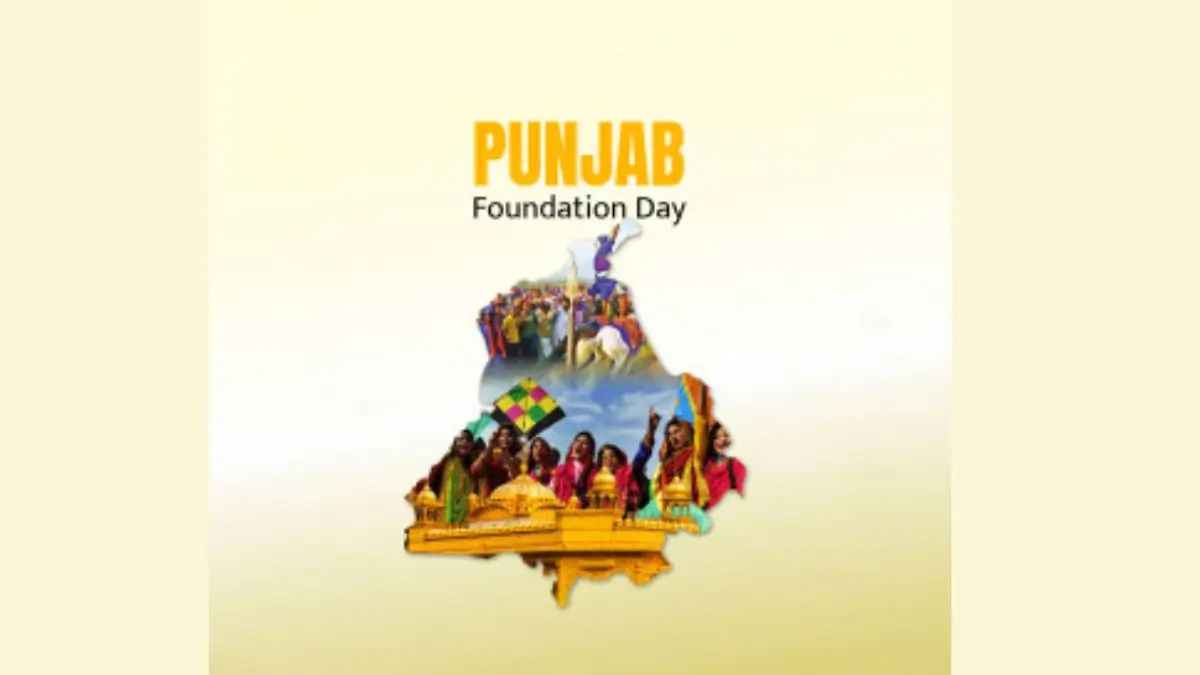
Punjab Formation Day, or simply called Punjab Day and Punjab Reorganization Day, is celebrated every year on the 1st November. It marks the reorganization of Punjab in 1966. This event formed the present day state of Punjab, with the Punjabi speaking region, created the state of Haryana from the Punjabi-speaking region, and transferred certain areas of the hills to Himachal Pradesh. The 60th anniversary of the reorganization takes place in 2026. This day celebrates the linguistic background, heritage, culture, and contribution to Indian agriculture, the freedom struggle, and national development.
Punjab Formation Day 2026 Date & Significance
Punjab Formation Day 2026 will take place on Sunday, 1st November 2026. This marks the start of the Punjab Reorganization Act, 1966.
This day commemorates the formation of the modern-day state of Punjab. It recognizes the political and social movement for recognition of the Punjabi language.
History of Punjab Formation Day
Punjab Before & After Independence
- Punjab was a major province of the British before independence. In 1947, the partition of the country caused a massive movement of people.
- After independence the Indian portion became a state. In 1948, the union of a number of princely states in the area formed the Patiala and East Punjab States Union (PEPSU). In 1956 PEPSU was merged with Punjab.
- Punjab now included areas from different linguistic and cultural backgrounds. This resulted in a call for reorganization.
Punjabi Suba Movement
- The Punjabi Suba Movement began in the 1950’s and 1960’s. The movement aimed to create a separate state for the Punjabi language.
- The movement was aimed at recognition of the Punjabi language and culture. This became a key point in the political debate.
Punjab Reorganization Act 1966
The Punjab Reorganization Act was passed by the Government of India. It took effect on the 1st November 1966. This caused massive changes to the areas:
Punjab
- The Punjabi-speaking region became the reorganised state of Punjab.
Haryana
- The Hindi-speaking region became a separate state called Haryana.
Himachal Pradesh
- Certain areas of the hills were transferred to Himachal Pradesh.
Chandigarh
- Chandigarh became a Union Territory and joint capital of Punjab and Haryana.
This created the state of modern day Punjab.
Historical Events Leading to the Formation of Modern Punjab
Modern Punjab was formed due to a number of major events.
| Date | Event |
| 1947 | Partition caused the split of the former British Punjab Province. |
| 1950 | PEPSU was created by merging a number of princely states, including Patiala. |
| 1956 | PEPSU was merged with Punjab. |
| 1966 | Punjab was reorganized following the Punjab Reorganization Act. This created modern Punjab, Haryana and transferred certain areas to Himachal Pradesh. |
This created a separate state for the Punjabi-speaking region.
Constitution & Legislation
Punjab Reorganization Act 1966
The Punjab Reorganisation Act 1966 was passed by Parliament. It was enacted on 18th September 1966. The appointed day was 1st November 1966.
It created,
- A new state of Haryana.
- New Union Territory of Chandigarh.
- Transferred specified areas to Himachal Pradesh.
- Reorganised the remaining areas into modern Punjab.
This also outlined how the administration would run, who would have representation, and how the assets and liabilities would be split between the new governments.
Article 3 of the Constitution of India
Article 3 allows Parliament to,
- Create a new state by separating territory from an existing state.
- Merge two or more states or parts of states.
- Change the area of a state.
- Change the boundaries of a state.
- Change the name of a state.
- The reorganization of Punjab in 1966 is an example of how the internal borders of India can be changed.
Why is Punjab Called the Land of Five Rivers?
Punjab stems from two Persian words, ‘Panj’ meaning five, and ‘Ab’ meaning water. This translates to ‘Land of Five Rivers’.
The five rivers traditionally associated with Punjab are,
- Sutlej.
- Beas.
- Ravi.
- Chenab.
- Jhelum.
Following partition in 1947 the Chenab and Jhelum became part of Pakistan’s Punjab. Whereas the Sutlej, Beas and Ravi run through modern-day Punjab in India.








 Chhattisgarh Formation Day 2026: History...
 Madhya Pradesh Foundation Day 2026: Hist...
 Sardar Vallabhbhai Patel Jayanti 2026: 1...